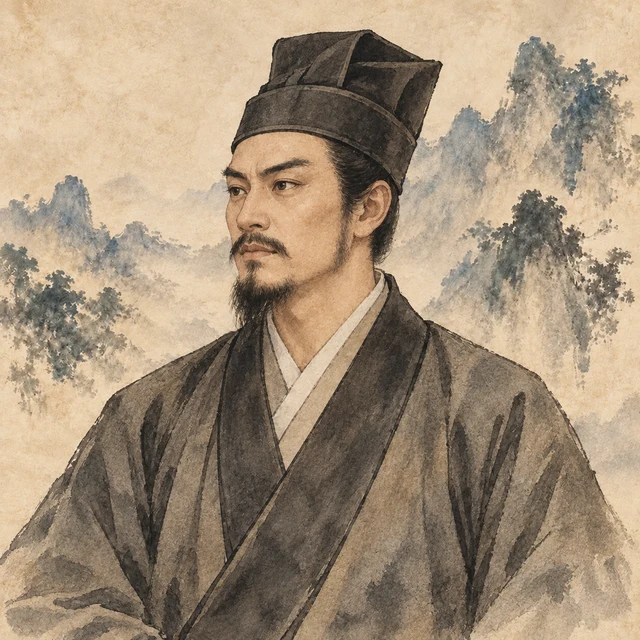
HISTORICAL PERSON
Bao Xun
鲍勋
A legal official and son of Bao Xin; he repeatedly challenged Cao Pi over legal matters and was executed after a dispute over enforcement.
This entry is supported by historical references, but does not yet have a conversation profile.
PRIMARY BIOGRAPHY
Biography
Bao Xun, styled Shuye, was from Pingyang in Taishan, son of the late Han cavalry commandant Bao Xin. In recognition of Bao Xin’s death in his lord’s rescue, the Grand Ancestor enfeoffed Bao Xun’s elder brother and summoned Bao Xun as a clerk of the chancellery; under the Wei kingdom he served as gentleman of the right and palace-attending clerk. While Emperor Wen was still heir apparent, Bao Xun was among his palace officers before being sent out as commandant of Wei commandery’s west. The heir’s wife’s younger brother, a clerk of Quzhou, embezzled government cloth — a crime warranting public execution — and though the heir wrote several personal letters begging for him, Bao Xun dared not suppress the case and reported it in full. His unbending conduct at the heir’s court had already displeased him, and once on the throne the emperor grew angrier the more Bao Xun remonstrated to his face.
In Huangchu 4 the director of the secretariat Chen Qun and the supervisor Sima Yi jointly recommended Bao Xun as chief censor; the emperor used him unwillingly, and the bureaucracy stood in awe of him. In the autumn of year 6, when the emperor resolved on a great campaign against Wu, Bao Xun remonstrated face to face: the royal armies had repeatedly failed because Wu and Shu braced each other like lips and teeth behind mountains and rivers, and the throne would do better to rest its soldiers and people. The emperor, furious, demoted him to law enforcement clerk. Returning from Shouchun, the army camped in Chenliu; the administrator Sun Yong visited the emperor and passed Bao Xun’s post, taking a slanted path outside the marked lines before the ramparts were finished. The camp clerk Liu Yao wanted to prosecute him, but Bao Xun, since the works were not yet complete, stopped the case.
When the army returned to Luoyang, Liu Yao himself committed an offense and Bao Xun memorialized his dismissal — whereupon Liu Yao secretly accused Bao Xun of having quashed Sun Yong’s case. The edict came down: “Bao Xun calls a deer a horse — arrest him for the commandant of justice.” The court found a five-year sentence, and the reviewing officers reduced it under statute to a fine of two catties of gold; the emperor raged, “Bao Xun has no share in life, and you dare spare him,” and jailed the reviewers themselves. The defenders Zhong Yao, Hua Xin, Chen Qun, Xin Pi, Wei Zhen, and Gao Rou all petitioned that Bao Xin had died meritoriously for the Grand Ancestor, begging mercy for his son; the emperor refused, and Bao Xun was executed. His private conduct was cultivated, his purse open to others, and on the day of his death his house held no surplus wealth. Twenty days later Emperor Wen himself died, and all sighed with regret for Bao Xun.
Life and role
- Primary role
- Cao Wei legal official
- Active period
- Documented coverage: late Han through Cao Wei
- Primary group
- Cao-Wei
Affiliations across a lifetime
- Huangchu era
Chief censor
Recommended jointly by Chen Qun and Sima Yi; feared by the bureaucracy; ruined by remonstrating against the Wu campaign
- Huangchu 7 (226)
Condemned for calling a deer a horse
Framed by Liu Yao’s secret memorial, executed over the petitions of the highest ministers, and mourned as wronged
HISTORICAL RECORD
Historical sources
- Records of the Three Kingdoms · Wei, Book 12 · 崔毛徐何邢鲍司马传 ↗
Chen Shou’s base text contains the biographies of Cui Yan, Mao Jie, Xu Yi, He Kui (with his son He Zeng), Xing Yong, Bao Xun, and Sima Zhi (with his son Sima Qi). The accounts mention Yang Xun under Cui Yan; Guan Cheng, Wang Ying, and Guo Zu under He Kui; Liu Yao under Bao Xun; and Liu Jie under Sima Zhi. Bao Xin’s extended account is in a Pei Songzhi annotation citing Wei Shu.