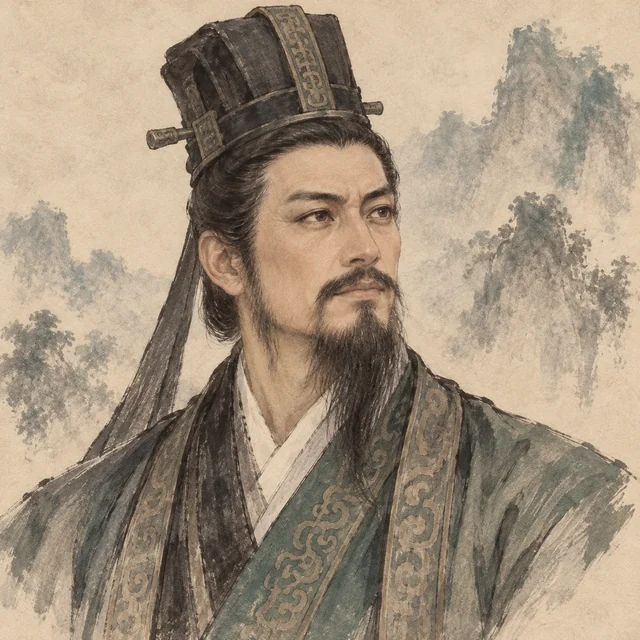
HISTORICAL PERSON
Bu Zhi
步骘
Bu Zhi rose from hardship to office under Sun Quan, governed Jiaozhou, and used both negotiation and force to stabilize the southern commanderies before holding senior military posts.
This entry is supported by historical references, but does not yet have a conversation profile.
PRIMARY BIOGRAPHY
Biography
Bu Zhi, styled Zishan, came from Huaiyin in Linhuai. Fleeing the troubles to Jiangdong, single and poor, he and his friend Wei Jing of Guangling grew melons for a living, working their limbs by day and reciting the classics by night. The grandee Jiao of Kuaiji, a local magnate whose retainers ran wild, received them when they came bearing melons for a meal — and served them coarse fare; Wei Jing burned with shame, but Bu Zhi’s countenance never changed: “We are poor and lowly, so our host treats us as poor and lowly — that is only fitting. What is there to be ashamed of?”
Sun Quan, as General who Smites the Caitiffs, summoned Bu Zhi as registrar, then made him chief of Haiyan and an officer of the chariot-and-cavalry staff. In 210 he went out as administrator of Poyang and within the year was moved to be inspector of Jiao province as General who Establishes Might, marching south with a thousand archers. The next year he was advanced to commissioner with credentials and General who Conquers the South. Wu Ju, the Cangwu administrator left by Liu Biao, outwardly submitted while inwardly defying him; Bu Zhi feigned cordiality, invited him to a meeting, and cut him down — his fame shook the south, the Shi Xie brothers came in one after another to offer allegiance, and the submission of the southern lands began from this. When the Yi province magnate Yong Kai killed the administrator Zheng Ang and opened contact with Wu, Bu Zhi, acting on his own authority, sent envoys to proclaim grace and win him over.
Bu Zhi recommended the overlooked and rescued the desperate in dozens of memorials, all men of talent. In 220 Lü Dai replaced him and Bu Zhi led ten thousand Jiao-province volunteers up to Changsha; when Liu Bei came east and the Wuling tribes stirred, Sun Quan sent him up to Yiyang. After Liu Bei’s defeat, Ling and Gui commanderies still bristled with blocked roads, and Bu Zhi campaigned around them until all were pacified. In 223 he was made General of the Right and Protector of the Left and transferred to the marquisate of Linxiang; in 226, given the credentials, he garrisoned Oukou. When Sun Quan took the imperial title Bu Zhi was made General of Agile Cavalry and — in absentia — governor of Ji province. That year he commanded at Xiling, and when Lü Xun died he succeeded him as Chancellor; still he taught his students, never letting go of his books, and dressed and lived like a scholar — though the finery of his household’s wives and concubines drew some ridicule. Twenty years at Xiling, and the neighbouring enemy respected his credibility and might. Generous and winning, he never showed joy or anger in face or voice, and all within and without stood in awe of his order. He died in 247.
Life and role
- Primary role
- General of Agile Cavalry
- Active period
- Late Han and Eastern Wu (190s–250s)
- Primary group
- Jiangdong–Sun Wu
Affiliations across a lifetime
- refugee years
Melon farmer
Farmed melons with Wei Jing by day, recited classics by night; unshamed by a magnate’s coarse fare
- 210–220
Inspector of Jiao province
Cut down the double-dealing Wu Ju; the Shi brothers submitted and the south was won
- 229–247
Chancellor · Xiling command
Succeeded Lü Xun as chancellor; twenty years at Xiling, respected by the enemy
HISTORICAL RECORD
Historical sources
- Records of the Three Kingdoms · Wu, Book 7 · 张顾诸葛步传 ↗
Chen Shou’s base text: Zhang Zhao’s nephew Fen, who designed a siege engine at age twenty, later served as a Wu general, and was appointed commander of Pingzhou; other biographies and annotations are outside this locator.