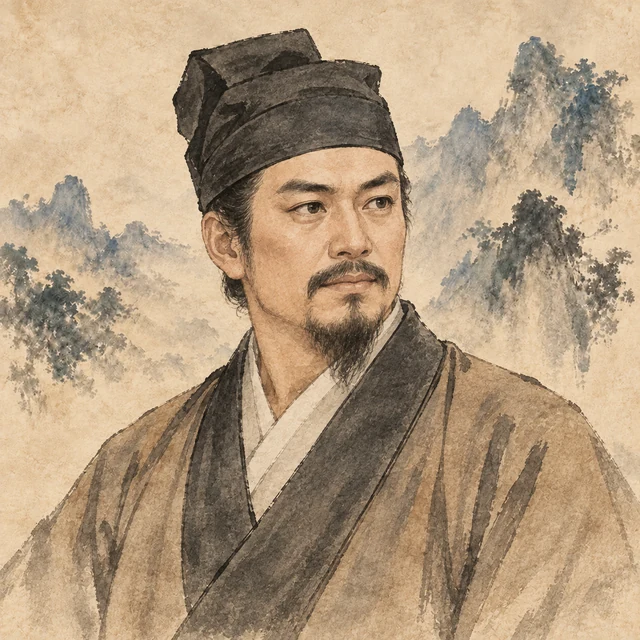
HISTORICAL PERSON
Cang Ci
仓慈
An administrator of Dunhuang who curbed local elites, aided poorer residents, and handled trade and travel for merchants from the Western Regions.
This entry is supported by historical references, but does not yet have a conversation profile.
PRIMARY BIOGRAPHY
Biography
Cang Ci, styled Xiaoren, was a man of Huainan. He began as a commandery clerk. In the Jian’an era, when the Grand Progenitor opened garrison-farms in Huainan, Cang Ci was made commandant for gathering and settling. At the end of the Huangchu era he was prefect of Chang’an — pure and frugal with method; the officers and people stood in awe of him and loved him.
In the Taihe era he was promoted to administrator of Dunhuang. The commandery lay on the westernmost edge; cut off by the ruin of the times, it had gone twenty years without an administrator, and the great clans had swollen until it was the settled custom. The former administrators Yin Feng and the rest had merely followed the old ways and reformed nothing. When Cang Ci came, he checked and curbed the powerful and comforted the poor and weak, and all fell into order. The old great families had more fields than they could use while the small folk had not an awl’s point of land; Cang Ci cut and allotted by mouth-count, bit by bit letting the small folk repay the bare value. Before, the suits of the subject towns were many and tangled; the counties could not decide them and they piled up below the commandery. Cang Ci went in person to review them, weighing heavy and light: short of capital crimes, he sent them off with the whip or the rod — and in a year the punishments he judged did not reach ten men.
Moreover the various Hu of the western regions had long wished to come offer tribute, but the great families mostly met them with refusal and cut them off; when trade did happen, there was cheating and bullying, and things were seldom made clear. The Hu nursed their resentment, and Cang Ci comforted them all. For those wishing to go on to Luo he sealed their passports; for those wishing to return from the commandery the office bought at fair price, trading from its own stores on equal terms, and sent officers and people to escort them on the roads. So native and stranger with one voice praised his virtue and kindness. He died in office after some years; officers and people grieved as for a parent, drew his likeness and kept his image in remembrance. And when the Hu peoples of the western regions heard that Cang Ci was dead, they gathered at the seats of the colonel of the centre and of the senior officers to mourn — some cutting their faces with knives to show the truth of their blood — and raised him a shrine and sacrificed to him from afar.
Life and role
- Primary role
- Administrator of Dunhuang
- Active period
- Documented coverage: late Han through Cao Wei
- Primary group
- Cao-Wei
Affiliations across a lifetime
- 196–226
Settlements commandant, prefect of Chang’an
Raised the Huainan garrison-farms; as Chang’an’s prefect he was loved and feared for pure, frugal method
- 227–230s
Administrator of Dunhuang
Broke the great clans’ grip, reallotted spare land to the poor, and judged the piled-up suits himself — under ten punishments a year
- at his death
Mourned by Hu and Han alike
He made the border trade fair and safe; at his death the people drew his image and the western Hu cut their faces with knives and built him a shrine
HISTORICAL RECORD
Historical sources
- Records of the Three Kingdoms · Wei, Book 16 · 任苏杜郑仓传 ↗
Chen Shou’s base text: biographies of Ren Jun, Su Ze, Du Ji (including Du Shu and notices about Le Xiang), Zheng Hun, and Cang Ci. Pei Songzhi’s annotations are registered separately.