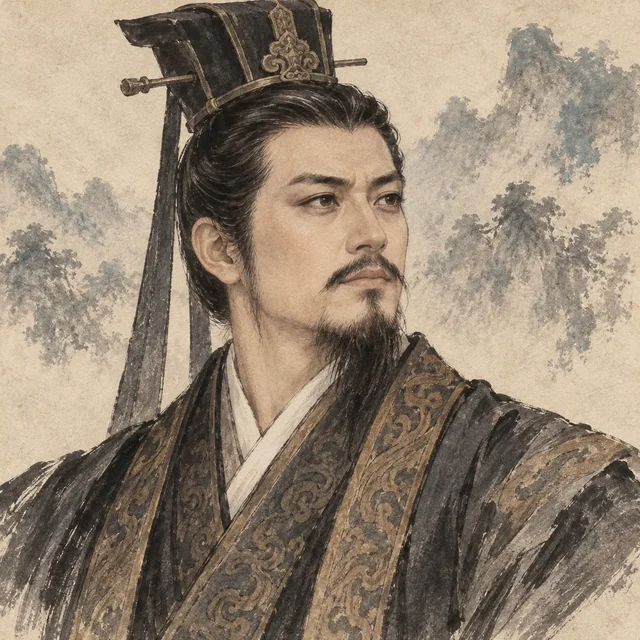
HISTORICAL PERSON
Cao Pi
曹丕
After Cao Cao’s death, Cao Pi succeeded as King of Wei and accepted Emperor Xian’s abdication in 220, founding Cao Wei and shaping its early institutions.
This entry is supported by historical references, but does not yet have a conversation profile.
PRIMARY BIOGRAPHY
Biography
Cao Pi (187–226), courtesy name Zihuan, was Cao Cao’s son by Empress Bian; after his elder brother Cao Ang died at Wan, he stood first in line. A student of both letters and arms from youth, he matured into the man Chen Shou judged “naturally gifted in letters, composing as the brush touched paper, broadly read and retentive.” In 211 he became General of the Five Offices and deputy chancellor; in 217, heir of Wei. His brother Cao Zhi’s talent nearly displaced him — until Jia Xu, pressed by Cao Cao, answered only, “I was thinking of Yuan Shao and Liu Biao and their sons.” Cao Cao laughed, and the succession was settled.
When Cao Cao died at Luoyang in the first month of 220, Cao Pi succeeded as chancellor and King of Wei. That winter the Han emperor, conceding where the realm’s hopes lay, sent the imperial seals by envoy, and Cao Pi ascended a raised altar at Fanyang to take the throne, proclaiming the Huangchu era. He moved the capital to Luoyang, posthumously titled his father Emperor Wu, and enfeoffed the fallen Han sovereign as Duke of Shanyang. Already as King of Wei he had adopted Chen Qun’s Nine-Rank system for grading officials — the framework that would govern appointments for centuries.
His seven-year reign saw three great thrusts at Wu: in 222 Cao Xiu, Zhang Liao, and Zang Ba struck at Dongkou, Cao Ren at Ruxu, and Cao Zhen, Xiahou Shang, Zhang He, and Xu Huang besieged Nan commandery — all repulsed; in 224 and 225 he personally reviewed fleets at Guangling but never crossed the Yangzi. In 226, dying, he summoned Cao Zhen, Chen Qun, Cao Xiu, and Sima Yi to receive his final charge, and passed away in the Jiafu Hall at forty. A prolific man of letters, he left nearly a hundred works; his Dianlun essay — “literature is the great work of statecraft, an imperishable glory” — founded Chinese literary criticism.
Life and role
- Primary role
- First emperor of Cao Wei
- Active period
- Documented coverage: Late Han and early Wei (c. 200–226)
- Primary group
- Cao-Wei
Affiliations across a lifetime
- 211–220
General of the Five Offices, then heir
Jia Xu’s pointed silence settled the succession
- 220–226
Emperor Wen of Wei
Received the Han abdication; founded the Nine-Rank system; thrice reached the Yangzi, never crossed
HISTORICAL RECORD
Historical sources
- Records of the Three Kingdoms · Wei, Book 17 · Biographies of Zhang Liao, Le Jin, Yu Jin, Zhang He, and Xu Huang ↗
Chen Shou’s base text: biographies of Zhang Liao, Le Jin, Yu Jin, Zhang He, and Xu Huang, plus the attached account of Zhu Ling. Pei Songzhi’s annotations are registered separately.
- Records of the Three Kingdoms · Wei, Book 18 · Biographies of the Two Lis, Zang, Wen, Lü, Xu, Dian, Two Pangs, and Yan ↗
Chen Shou’s base text: biographies of Li Dian, Li Tong, Zang Ba (including Sun Guan), Wen Pin, Lü Qian (including Wang Xiang), Xu Chu, Dian Wei, Pang De, Pang Yu (including his mother Zhao E), and Yan Wen (including Zhang Gong). Pei Songzhi’s annotations are separately registered.
- Records of the Three Kingdoms · Wei, Book 19 · Biographies of the Prince of Rencheng, Prince Chen Si, and Prince Xiao Huai ↗
Chen Shou’s base text: biographies of Cao Zhang, Cao Zhi, and Cao Xiong. Pei Songzhi’s annotations, including variant accounts and cited works, are registered separately.
- Records of the Three Kingdoms · Wei, Book 20 · Biographies of the sons of Cao Cao and Cao Pi ↗
Chen Shou’s base text: biographies of Cao Cao’s and Cao Pi’s sons and their fiefs. Pei Songzhi’s annotations and cited works are registered separately.
- Records of the Three Kingdoms · Wei, Book 2, Annals of Emperor Wen ↗
Chen Shou’s base text in the Annals of Emperor Wen (Wei, Book 2) records Cao Pi’s succession, abdication transition, and reign; the account of the abdication also concerns Liu Xie. Pei Songzhi’s annotations should be distinguished.