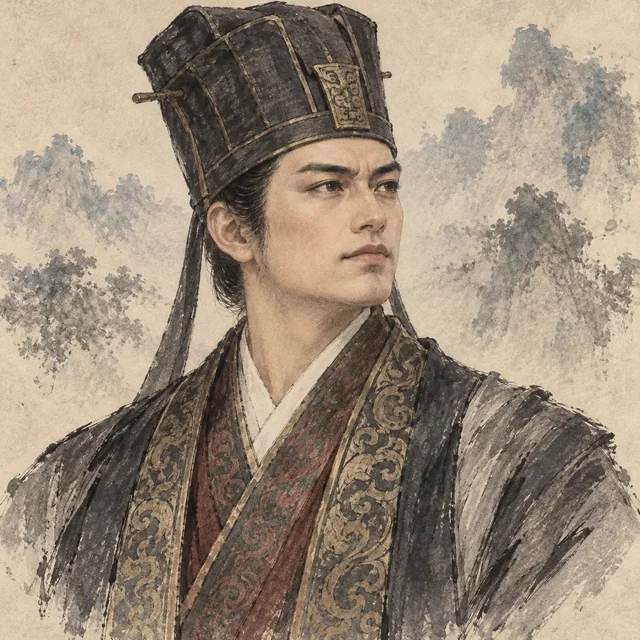
HISTORICAL PERSON
Cao Shuang
曹爽
Cao Shuang received a regency after Emperor Ming’s death, shared power with Sima Yi, and was executed after surrendering authority during the 249 coup.
This entry is supported by historical references, but does not yet have a conversation profile.
PRIMARY BIOGRAPHY
Biography
Cao Shuang (d. 249), courtesy name Zhaobo, was Cao Zhen’s eldest son. When Emperor Ming lay dying in 239, he named Cao Shuang General-in-Chief to govern jointly with Sima Yi for the eight-year-old Cao Fang.
At first he treated the elder statesman like a father; then his circle — He Yan, Deng Yang, Ding Mi — persuaded him to sideline Sima Yi with the hollow title of Grand Tutor. They carved up state farmland, helped themselves to palace treasures and the late emperor’s women, and in 244 Cao Shuang launched a grand invasion of Shu through the Luo valley: Wang Ping held the Xingshi heights, Fei Yi’s reinforcements arrived, and the Wei army staggered home with Guanzhong drained.
On the third day of 249, while Cao Shuang accompanied the emperor to the Gaoping Tombs, Sima Yi seized the armory and the Luo bridge and impeached him. The counselor Huan Fan slipped out and urged Cao Shuang to take the emperor to Xuchang and summon the outer armies; Cao Shuang hesitated from dusk to the fifth watch, then threw down his knife: “At worst I remain a rich man under house arrest.” Days later he, his brothers, He Yan, Huan Fan and their whole clans were executed to the third degree. Wei never recovered its throne.
Life and role
- Primary role
- General-in-Chief and regent
- Active period
- Late Han and Cao Wei (190s–240s)
- Primary group
- Cao-Wei
Affiliations across a lifetime
- 239–244
Co-regent of Wei
Joint regent by Emperor Ming’s testament; sidelined Sima Yi on He Yan’s advice
- 244–249
Dominance and fall
Broken at Xingshi; surrendered to Sima Yi at Gaoping Tombs, clan exterminated
HISTORICAL RECORD
Historical sources
- Records of the Three Kingdoms · Wei, Book 9 · Biographies of the Xiahou and Cao families ↗
Chen Shou’s base text: Xiahou Dun (with Han Hao and Shi Huan), Xiahou Yuan, Cao Ren (with Cao Chun), Cao Hong, Cao Xiu, Cao Zhen (with Cao Shuang, Deng Yang, and He Yan), and Xiahou Shang (with Xiahou Xuan, Xu Yun, and Wang Jing). The page also carries Pei Songzhi’s annotations, which should be identified separately.