HISTORICAL PERSON
Cao Xiu
曹休
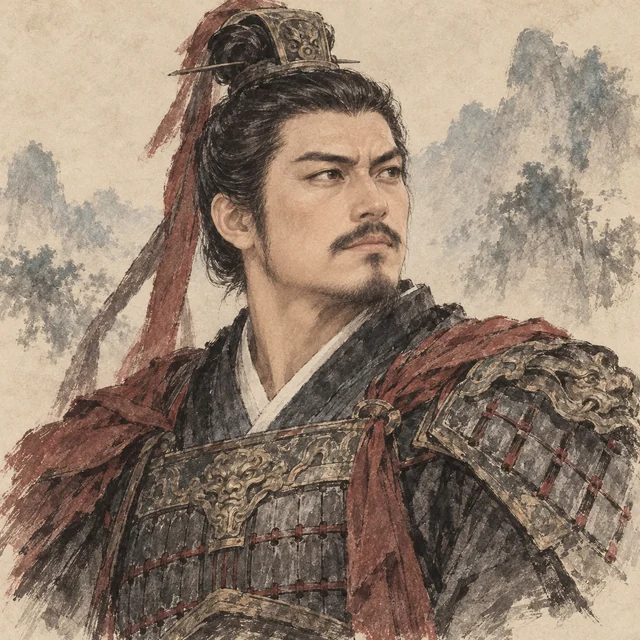
Cao Xiu returned from Wu to join Cao Cao and later commanded campaigns against Wu.
This entry is supported by historical references, but does not yet have a conversation profile.
PRIMARY BIOGRAPHY
Biography
Cao Xiu (d. 228), styled Wenlie, was a clansman of Cao Cao. In the disorders the clan scattered; orphaned at ten or so, he carried his father’s coffin to a temporary grave with a single retainer, then took his old mother across the Yangzi to Wu. Hearing that Cao Cao had raised troops, he changed his name, made his way to Jing province, and slipped north to join him. Cao Cao told his attendants: "This is our clan’s thousand-li colt," had him lodge with Cao Pi, and treated him as a son. He followed the campaigns in command of the elite Tiger-and-Leopard cavalry.
In 218 Liu Bei sent Wu Lan to hold Xiabian; Cao Cao sent Cao Hong against him with Cao Xiu as Cavalry Commandant attached to the army. Cao Cao told Xiu: "Though you are called an adviser, you are the real commander" — and Cao Hong, hearing it, gladly left matters to him. Liu Bei sent Zhang Fei to Gushan to cut the army’s rear; while the others wavered, Cao Xiu said: "If they meant to cut our road they would move in secret. Trumpeting it first means they cannot. Strike Wu Lan before Zhang Fei gathers; once Lan breaks, Fei will flee of himself." Cao Hong agreed, attacked, shattered Wu Lan, and Zhang Fei withdrew. After Hanzhong was settled, Cao Xiu returned as Central Army Leader.
When Cao Pi took the throne, Cao Xiu became General of the Leading Army and Marquis of Dongyang. After Xiahou Dun’s death he was made General Who Guards the South with imperial authority over the armies. He broke the Wu detachment at Liyang and sent troops across the Yangzi to burn their camps at Wuhu. Promoted General Who Conquers the East and inspector of Yang province, then Marquis of Anyang. In 222, when Cao Pi attacked Sun Quan, Cao Xiu was made Grand General Who Conquers the East with the golden battle-axe, commanding Zhang Liao and over twenty armies of the provinces; he defeated Sun Quan’s general Lü Fan at Dongpu and was made Governor of Yang. Under Emperor Ming he was enfeoffed Marquis of Changping and rose to Grand Marshal, still holding Yang. In 228 the emperor struck Wu on two axes — Sima Yi down the Han River, Cao Xiu toward Xunyang. A Wu general feigned surrender and drew him deep; defeated, he fell back to Sushiting, where the army panicked in the night and abandoned armor and baggage. He memorialized his fault; the emperor sent Yang Ji to console him with ever greater honors. The shame brought on an abscess of the back, and he died — posthumously named the Stalwart Marquis.
Life and role
- Primary role
- Grand Marshal
- Active period
- Late Eastern Han to Cao Wei
- Primary group
- Cao-Wei
Affiliations across a lifetime
- Early 190s
Return to Cao Cao · "the clan’s thousand-li colt"
Crossed the Yangzi with his father’s coffin, slipped north under an alias; Cao Cao treated him as a son and gave him the Tiger-and-Leopard cavalry
- 218
Xiabian · adviser in name, commander in fact
Read Zhang Fei’s bluff and drove Cao Hong to smash Wu Lan before the trap could close
- 220–228
Grand General of the East → Grand Marshal
Broke Lü Fan at Dongpu; lured deep by a feigned surrender in 228 and defeated, died of an abscess brought on by shame
HISTORICAL RECORD
Historical sources
- Records of the Three Kingdoms · Wei, Book 9 · Biographies of the Xiahou and Cao families ↗
Chen Shou’s base text: Xiahou Dun (with Han Hao and Shi Huan), Xiahou Yuan, Cao Ren (with Cao Chun), Cao Hong, Cao Xiu, Cao Zhen (with Cao Shuang, Deng Yang, and He Yan), and Xiahou Shang (with Xiahou Xuan, Xu Yun, and Wang Jing). The page also carries Pei Songzhi’s annotations, which should be identified separately.
- Records of the Three Kingdoms · Wei, Book 18 · Biographies of the Two Lis, Zang, Wen, Lü, Xu, Dian, Two Pangs, and Yan ↗
Chen Shou’s base text: biographies of Li Dian, Li Tong, Zang Ba (including Sun Guan), Wen Pin, Lü Qian (including Wang Xiang), Xu Chu, Dian Wei, Pang De, Pang Yu (including his mother Zhao E), and Yan Wen (including Zhang Gong). Pei Songzhi’s annotations are separately registered.