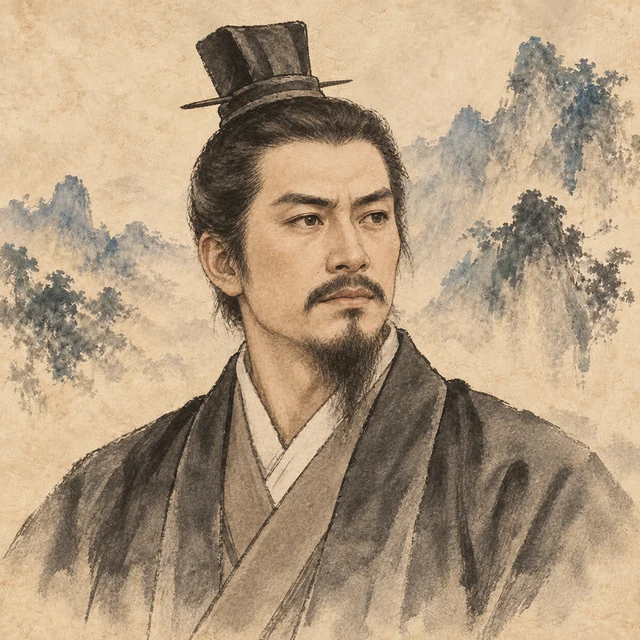
HISTORICAL PERSON
Chang Lin
常林
A Wen man from Henei who took refuge in Shangdang before joining Cao Cao; he rose to Imperial Household Grandee in Wei, noted for integrity.
This entry is supported by historical references, but does not yet have a conversation profile.
PRIMARY BIOGRAPHY
Biography
Chang Lin, styled Bohuai, came from Wen in Henei. At seven, when a friend of his father’s came to the door and asked “Is Boxian at home? Why do you not bow?”, Chang Lin answered: “A guest should be received, but to speak my father’s style-name before his son — why should I bow to that?” All praised him for it. When Administrator Wang Kuang raised troops against Dong Zhuo, he sent students through the counties to sniff out the faults of officers and people, arresting them and extorting money and grain in ransom; delay meant extermination of the clan, to magnify his awfulness. Chang Lin’s uncle had beaten a retainer and was denounced; Wang Kuang in anger had him arrested and the whole clan was terrified. Chang Lin went to Wang Kuang’s fellow townsman Humu Biao and set out that with a child sovereign and a rebel minister holding power, conquest lay in harmony and not in campaigns — punishments gone awry and daily deepening tyranny were no way to keep a commandery. Humu Biao spoke to Wang Kuang, who pardoned the uncle. Chang Lin then took refuge in Shangdang and farmed the mountain slopes; in a year of drought and locusts his fields alone bore richly, and he called in all his neighbours and shared it out by the peck and pint. Sheltering with the former Hejian administrator Chen Yan’s stronghold, when Zhang Yang coveted its women and goods, Chang Lin led his clan in planning its defence; besieged over sixty days, they kept the walls entire.
The inspector of Bing province Gao Gan memorialised him as cavalry commandant; Chang Lin declined. Later the inspector Liang Xi recommended the province’s famous men — Chang Lin, Yang Jun, Wang Ling, Wang Xiang and Xun Wei — and the Grand Progenitor made them all county prefects. Chang Lin governed Nanhe with success and was jumped up to administrator of Boling and inspector of You province, leaving achievements in both. When the future Emperor Wen was General of the Five Offices, Chang Lin was his merit officer. While the Grand Progenitor campaigned in the west, Tian Yin and Su Bo rebelled and You and Ji provinces stirred; the future emperor wished to campaign against them in person. Chang Lin said: “I once served in Boling and again in You province — the rebels’ shape can be judged. The officers and people of the north love peace and hate turmoil, have long been steeped in civilisation, and the keepers of the good are many. Tian Yin and Su Bo are dogs and sheep gathered together, small of wit and large of scheme — they can do no harm. Today the great host is far away and a strong enemy is without; you, general, are the realm’s anchor. To move lightly and march far — even victory would be no glory.” The future emperor took his counsel, sent generals, and the rebels were promptly destroyed. Chang Lin went out as administrator of Pingyuan and chief commandant of the east of Wei commandery, entered as east bureau clerk of the chancellery, and when the state of Wei was founded was made a Master of Writing. At Emperor Wen’s accession he rose to Privy Treasurer, enfeoffed Marquis of Yueyang precinct, then Grand Minister of Agriculture.
Under Emperor Ming he was advanced to Marquis of Gaoyang district and moved to Superintendent of the Imperial Household and Grand Master of Ceremonies. The Prince of Jin-to-be, Sima Yi, considering Chang Lin the honoured elder of his home county, bowed to him whenever they met. Someone said to Chang Lin: “Duke Sima is exalted and weighty — you should stop him.” Chang Lin said: “Duke Sima himself wishes to honour the ordering of elder and younger and set a rule for those who come after. His rank is not mine to fear; his bow is not mine to forbid.” The speaker withdrew in discomfort. Opinion of the time, prizing his austere purity, would have raised him to the ducal ministers — but Chang Lin pleaded grave illness. He was made Grandee of Glorious Favour, and died at eighty-three, posthumously made general of the agile cavalry and buried with a duke’s rites, with the title Marquis Zhen.
Life and role
- Primary role
- Cao Wei official
- Active period
- Documented coverage: late Han through Cao Wei
- Primary group
- Cao-Wei
Affiliations across a lifetime
- 190s
Saved his uncle; held the stronghold
His plea freed his uncle from Wang Kuang’s terror; his planning held Chen Yan’s walls through sixty days of siege
- 218
Stopped the heir’s campaign
Told the future emperor the realm’s anchor must not move lightly for dogs-and-sheep rebels; generals sent crushed them at once
- 226–249
Accepting Sima Yi’s bow
When Sima Yi bowed to him as the honoured elder of his county, he would neither stop it nor claim it; died at eighty-three
HISTORICAL RECORD
Historical sources
- Records of the Three Kingdoms · Wei, Book 23 · 和常杨杜赵裴传 ↗
Chen Shou’s base text contains the biographies of He Qia, Chang Lin, Yang Jun, Du Xi, Zhao Yan, and Pei Qian. The page also carries Pei Songzhi’s annotations, which should be identified separately.