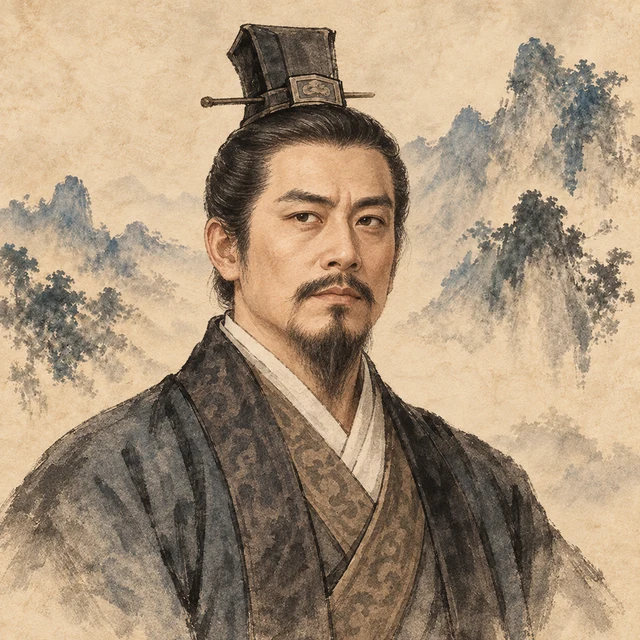
HISTORICAL PERSON
Chen Jiao
陈矫
A Guangling man born to the Liu clan and adopted into the Chen; he served Wei up to Prefect of the Masters of Writing under Emperor Ming.
This entry is supported by historical references, but does not yet have a conversation profile.
PRIMARY BIOGRAPHY
Biography
Chen Jiao, styled Jibi, came from Dongyang in Guangling. Having fled the turmoil to Jiangdong and Dongcheng, he declined calls from Sun Ce and Yuan Shu and returned to his own commandery. Administrator Chen Deng made him merit officer and sent him to Xu, saying: “The talkers at Xu find fault with me — observe them for me and instruct me on your return.” Chen Jiao came back and reported: “Far and near they rather call you proud and self-satisfied.” Chen Deng said: “For harmony and virtue in the household I honour the brothers Chen Yuanfang; for limpid purity, rite and law, Hua Ziyu; for austere hatred of evil, Zhao Yuanda; for breadth of learning and brilliance, Kong Wenju; for heroic bearing and a hegemon’s strategy, Liu Xuande. With such as these my objects of reverence — wherein am I proud?” Such was Chen Deng’s mind, and he held Chen Jiao in deep respect and friendship.
When the commandery was besieged by Sun Quan at Kuangqi, Chen Deng sent Chen Jiao to beg relief from the Grand Progenitor. Chen Jiao urged: “Our small commandery may be tiny, but it is a land of advantage; if it has your relief and stands as an outer bulwark, Wu’s designs will be blunted, the Xu lands forever quiet, your martial fame will roll afar, and the unsubmitted will come over like bending grass — this is the work of kingship.” The Grand Progenitor, struck by him, wished to keep him; Chen Jiao declined: “My home hangs upside down and I ran to cry its peril — though I cannot match Shen Baoxu’s achievement, dare I forget Hong Yan’s duty?” Relief was sent; when the Wu army withdrew, Chen Deng laid ambushes and pursued, breaking them utterly. The Grand Progenitor engaged Chen Jiao as an Excellency’s clerk, then prefect of Xiang, senior clerk of the southern campaign, administrator of Pengcheng and Leling, and chief commandant of the west of Wei commandery. When a man of Quzhou whose father lay sick had sacrificed an ox in prayer and the county court sentenced him to die in the market, Chen Jiao said “this is a filial son” and memorialised his pardon. Promoted administrator of Wei commandery, he found prisoners held by the thousand, some for years; judging that to prize the scales of guilt while ignoring the evil of endless detention was an error, he read every charge in person and judged them all at a single sitting.
On the great eastern campaign he entered as senior clerk of the chancellery; afterwards he returned to Wei commandery, transferred to the west bureau, followed the Hanzhong campaign, and came back a Master of Writing. He had not yet reached Ye when the Grand Progenitor died at Luoyang. The ministers, bound by precedent, held that the Heir Apparent’s accession must await an edict. Chen Jiao said: “The King has died abroad and the realm is seized with fear. The Heir Apparent should cut short his grief and ascend, to hold the hopes of near and far — and with a favoured son close at hand, if change springs from either side the altars are in peril.” He at once prepared officers and rites, all complete in a single day, and next morning the Queen’s order invested the Heir Apparent. Emperor Wen said: “Chen Jibi in a great pass shows a clarity beyond other men’s — truly the outstanding talent of his age.” At the accession Chen Jiao was moved to head the ministry of personnel, enfeoffed Marquis of Gaoling precinct, and made Prefect of the Masters of Writing. Under Emperor Ming he was advanced to Marquis of Dongxiang. The imperial carriage once came unannounced to the Masters of Writing’s gate; Chen Jiao knelt and asked, “Where does Your Majesty wish to go?” — “Merely to look through the documents.” — “That is your servant’s own charge, not a place Your Majesty should approach. If I am unfit for my office, I ask to be dismissed; Your Majesty should turn back.” The emperor, abashed, turned his carriage around: such was his upright plainness. He was made palace attendant and Grandee of Glorious Favour, then Minister over the Masses. He died in 237 with the posthumous title Marquis Zhen.
Life and role
- Primary role
- Cao Wei official
- Active period
- Documented coverage: late Han through Cao Wei
- Primary group
- Cao-Wei
Affiliations across a lifetime
- 200s
Chen Deng’s merit officer
Carried Chen Deng’s plea for relief to Xu and moved Cao Cao with the argument of kingship; pardoned the filial ox-sacrificer and cleared Wei commandery’s backlog of prisoners
- 220
The succession at Luoyang
When Cao Cao died abroad he had the heir invested within a day, lest “a favoured son close at hand” spring change — praised by Emperor Wen as the talent of his age
- 220–237
Prefect of the Masters of Writing, then Minister over the Masses
Barred Emperor Ming from inspecting the Masters’ documents as none of his business — the emperor turned his carriage around, abashed
HISTORICAL RECORD
Historical sources
- Records of the Three Kingdoms · Wei, Book 22 · 桓二陈徐卫卢传 ↗
Chen Shou’s base text contains the biographies of Huan Jie, Chen Qun (with his son Chen Tai), Chen Jiao, Xu Xuan, Wei Zhen, and Lu Yu. The concluding evaluation is separate from the biographies.