HISTORICAL PERSON
Chen Lin
陈琳
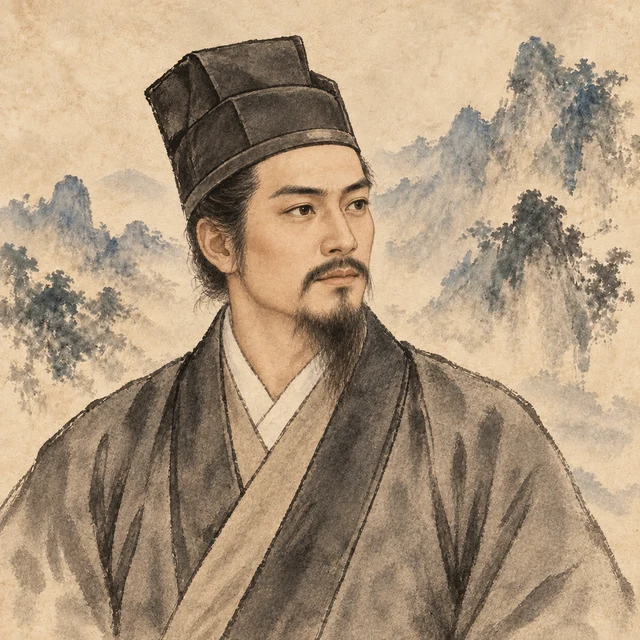
Chen Lin served He Jin, then Yuan Shao, and later Cao Cao; the biography describes his role in drafting political and military documents.
This entry is supported by historical references, but does not yet have a conversation profile.
PRIMARY BIOGRAPHY
Biography
Chen Lin, styled Kongzhang, was from Sheyang in Guangling. He had earlier been senior clerk to He Jin. When He Jin wished to destroy the eunuchs and the empress dowager would not consent, he summoned the fierce generals of the four quarters to lead their troops toward the capital to frighten her into it. Chen Lin remonstrated: “Your generalship commands the imperial majesty and holds the keys of the army; with dragon strides and tiger treads, the heights and depths are in your hand. To act on this is no different from lighting a great furnace to burn a strand of hair. You need only loose the thunderbolt, decide at once, and though you depart from the classics you will join the Way, and heaven and men will follow you. Instead you cast away your keen weapon and summon outside aid — once the great hosts gather, the strongest becomes master; this is what is called holding the halberd backwards and giving the handle to another. The work will surely fail, and become only a stairway to disorder.” He Jin would not hear him, and so came to ruin.
Chen Lin fled the troubles into Ji province, where Yuan Shao put him in charge of written documents. When the Yuan house fell, Chen Lin came over to the Grand Ancestor, who said to him, “When you wrote that proclamation for Benchu, you might have confined yourself to cataloguing my crimes — hatred should stop at the man himself. Why did you have to reach up to my father and grandfather?” Chen Lin apologized, and the Grand Ancestor, loving his talent, did not blame him. He made both Chen Lin and Ruan Yu libationers of the ministry of works’ military councils in charge of the records office, and the greater part of the state’s letters and proclamations were the work of Chen Lin and Ruan Yu.
The Grand Ancestor suffered from wind-illness of the head. One day, as the pain came on, he lay reading what Chen Lin had written, and rose at once, saying, “This has cured my illness.” He bestowed rich gifts again and again. Chen Lin transferred to be supervisor of the gate, and died in Jian’an 22.
Life and role
- Primary role
- Court official and writer
- Active period
- Late Han and Cao Wei (190s–240s)
- Primary group
- Cao-Wei
Affiliations across a lifetime
- Jian’an era
Master of the records office
Once wrote Yuan Shao’s proclamation reviling Cao Cao’s father and grandfather; taken in for his talent, he and Ruan Yu drafted the state’s letters and proclamations
HISTORICAL RECORD
Historical sources
- Records of the Three Kingdoms · Wei, Book 21 · 王卫二刘傅传 ↗
Chen Shou’s base text contains the biographies of Wang Can (with attached biographies of Xu Gan, Chen Lin, Ruan Yu, Ying Yang, Liu Zhen, Handan Chun, Fan Qin, Lu Cui, Ding Yi (丁仪), Ding Yi (丁廙), Yang Xiu, Xun Wei, Ying Qu, Ruan Ji, Ji Kang, and Wu Zhi), Wei Ji, Liu Yi, Liu Shao (with attached biographies of Miao Xi, Zhong Changtong, Su Lin, Xiahou Hui, Sun Gai, and Du Zhi), and Fu Gu. The Wei Dan material is in a Pei Songzhi annotation on Liu Shao’s biography, citing the Wenzhang Xulu; identify it as an annotation, not Chen Shou’s base text.
- Records of the Three Kingdoms, with Pei Songzhi annotations · Pei Songzhi annotations to Wei, Book 21 · Wang, Wei, Liu, and Fu biographies ↗
Embedded citations to Wei Lue, Wei Shu, Biographies of the Literary Men, and other works; attributed accounts are kept separate from Chen Shou’s base text.