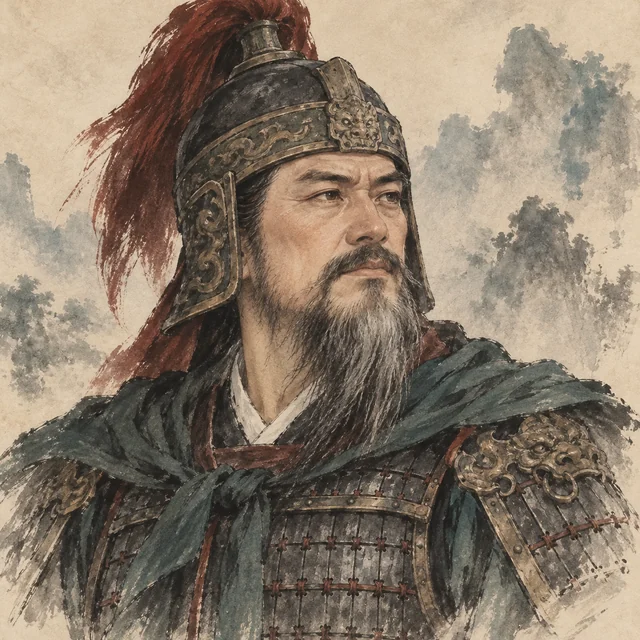
HISTORICAL PERSON
Cheng Pu
程普
Cheng Pu served Sun Jian and Sun Ce in campaigns, later helped Sun Quan, and took part in the Red Cliffs and Jiangling campaigns.
This entry is supported by historical references, but does not yet have a conversation profile.
PRIMARY BIOGRAPHY
Biography
Cheng Pu (d. after 215), courtesy name Demou, of Tuyin in Youbeiping, was the senior veteran of the Sun house. He followed Sun Jian against the Yellow Turbans at Wan and Deng and against Dong Zhuo at Yangren, his body a record of wounds; after Sun Jian’s death he campaigned with Sun Ce across the Yangzi, taking Lujiang and fighting at Hengjiang and Dangli.
In the sweep through Moling, Hushu, Jurong, and Qu’a, Cheng Pu’s merits piled up — two thousand more men, fifty horses. When bandits encircled Sun Ce at Zulang, Cheng Pu and one rider shielded him, charging with levelled spears until the bandits broke.
At Chibi in 208 he and Zhou Yu were joint commanders of the left and right — the only co-equal command in Wu’s wars — and drove Cao Ren out of Nan commandery. Older than Zhou Yu, he at first slighted him, but Zhou Yu’s patience won him over until Cheng Pu told people that befriending Zhou Yu was like drinking fine wine: you grow warm without noticing. He succeeded Zhou Yu at Nan commandery and died as General who Pacifies Bandits, first among Chen Shou’s “tiger ministers of Jiangdong.”
Life and role
- Primary role
- General Who Quells Bandits
- Active period
- Late Eastern Han to Eastern Wu
- Primary group
- Jiangdong–Sun Wu
Affiliations across a lifetime
- 184–200
Sun Jian and Sun Ce
Veteran of all three Sun generations’ founding campaigns
- 200–after 215
Left commander, Administrator of Nan
Co-commander at Chibi with Zhou Yu; succeeded him at Nan commandery
HISTORICAL RECORD
Historical sources
- Records of the Three Kingdoms · Wu, Book 10 · 程黄韩蒋周陈董甘凌徐潘丁传 ↗
Chen Shou’s base text contains the biographies of Cheng Pu, Huang Gai, Han Dang, Jiang Qin, Zhou Tai, Chen Wu (with Chen Biao), Dong Xi, Gan Ning, Ling Tong, Xu Sheng, Pan Zhang, and Ding Feng. The concluding evaluation is separate from the biographies.