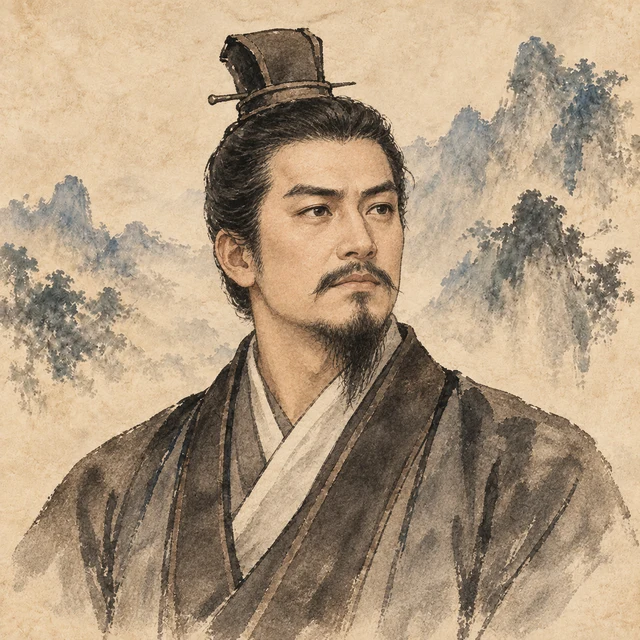
HISTORICAL PERSON
Cui Lin
崔林
A Dongwucheng man from Qinghe and cousin of Cui Yan; as Inspector of You he kept the northern frontier quiet and rose to Minister of Works.
This entry is supported by historical references, but does not yet have a conversation profile.
PRIMARY BIOGRAPHY
Biography
Cui Lin, styled Deru, was from Dongwucheng in Qinghe. Slow to ripen in youth, he was unknown to his own clan; only his elder cousin Cui Yan thought him remarkable. When the Grand Ancestor settled Ji province he was summoned and made prefect of Wu, but too poor for horse or carriage, he walked to his post alone. When the Grand Ancestor campaigned at Huguan he asked which senior officer had the finest record of rule; the inspector of Bing province, Zhang Zhi, named Cui Lin, and so he was raised to be senior clerk of Ji province, then made attendant officer and chancellery clerk. At the founding of the Wei kingdom he gradually rose to chief censor.
At Emperor Wen’s accession he was made a secretariat officer, then sent out as inspector of You province. The colonel of the northern army Wu Zhi, commanding the armies north of the river, was a favored and honored servant of the throne, and the administrator of Zhuo, Wang Xiong, said to Cui Lin’s aide, “Every province and commandery sends Wu Zhi respectful letters, yet your inspector has had no dealings with him at all — if he has you beheaded for neglecting the frontier, can your master protect you?” The aide reported this in full, and Cui Lin said, “This inspector regards leaving this province as one shakes off a slipper — why should I fear to implicate anyone? This province adjoins the Hu caitiffs; it should be held in calm. Trouble them and you stir their rebellious hearts, breeding a northern worry for the state for nothing — that is my charge.” In his full term in office raiding and theft lay quiet; yet for not serving his superior he was demoted to administrator of Hejian, and honest opinion widely resented it on his behalf.
He was promoted to grand herald. When the king of Kucha sent a hostage son to court, the throne, honoring the distance, rewarded the king richly, whereupon the other states each sent sons and the envoys came in unbroken succession. Cui Lin feared these missions were not all genuine — that distant kin and traveling merchants were trading on embassies to profit from seals and ribbons, while the escorts on the road cost ever more, burdening the people who must be fed to profitless ends and drawing the barbarians’ laughter. He sent a letter to Dunhuang setting out his meaning and recording the precedents of former ages for the generous or frugal reception of the states, so there would be a constant standard. Under Emperor Ming he was enfeoffed marquis within the passes, transferred to be superintendent of the imperial household and colonel director of the retainers, and dismissed the illegally appointed supernumerary clerks of the subordinate commanderies. In government he dealt in good faith and kept to the great pattern, and so he was always remembered with longing after leaving. In Jingchu 1, the offices of minister over the masses and minister of works both being vacant, the cavalier attendant Meng Kang recommended Cui Lin, and he was made minister of works and enfeoffed marquis of Anyang precinct with six hundred households — the enfeoffment of the three excellencies as full marquises began with Cui Lin. Soon after he was advanced to marquis of Anyang district. He died in Zhengshi 5, posthumously named Xiao.
Life and role
- Primary role
- Cao Wei official
- Active period
- Documented coverage: late Han through Cao Wei
- Primary group
- Cao-Wei
Affiliations across a lifetime
- Huangchu era
Inspector of You province
Held the frontier in calm until raiding ceased — then was demoted for not courting the favorite Wu Zhi, which honest opinion resented
- Jingchu 1 (237)
Minister of works, marquis of Anyang
Set a constant standard for the western embassies as grand herald; the enfeoffment of excellencies as marquises began with him
HISTORICAL RECORD
Historical sources
- Records of the Three Kingdoms · Wei, Book 24 · 韩崔高孙王传 ↗
Chen Shou’s base text contains the biographies of Han Ji, Cui Lin, Gao Rou, Sun Li, and Wang Guan. The concluding evaluation is separate from the biographies.