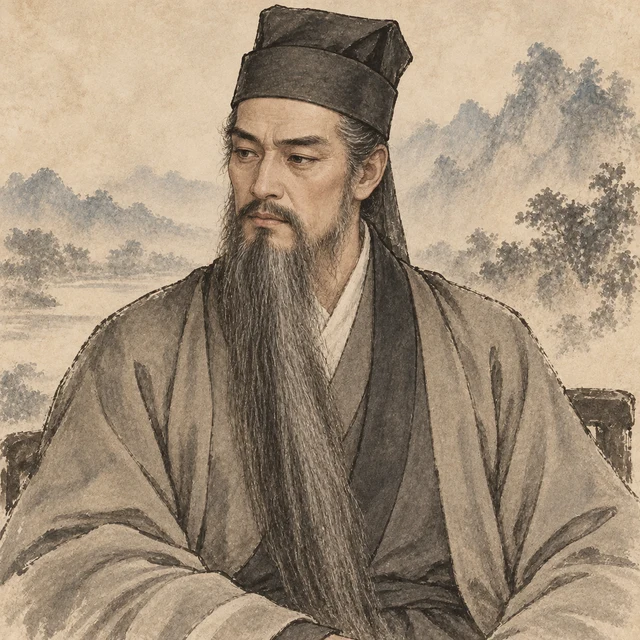
HISTORICAL PERSON
Cui Yan
崔琰
Cui Yan, courtesy name Jigui, served Yuan Shao and Cao Cao, held authority in personnel selection, and supported Cao Pi as heir; he was later sentenced and executed after a letter was interpreted as slander.
This entry is supported by historical references, but does not yet have a conversation profile.
PRIMARY BIOGRAPHY
Biography
Cui Yan (d. 216), courtesy name Jigui, of Qinghe, was a sword-loving young man until twenty-nine, when he went to study under Zheng Xuan. Driven from his books by the Yellow Turbans, he wandered four years among the provinces before going home.
Serving Yuan Shao, he protested soldiers digging up graves: “The road is lined with unburied bones and the people have seen no kindness — order the counties to bury the dead, and show the love of King Wen.” After Guandu, Cao Cao boasted to him of Ji province’s census: “three hundred thousand men!” Cui Yan answered: “The realm is split, the two Yuan brothers turned their own weapons on each other, and the people of Ji lie unburied in the fields. I have not heard of your army asking after their suffering — only counting spears. Is that what this province hoped for from you?” Cao Cao changed countenance and apologized; the assembled guests turned pale.
As Eastern Bureau selector he chose only the upright — Cao Cao’s charge: “You have the air of Bo Yi and the uprightness of Shi Yu; misers grow honest at your name.” When Cao Cao secretly polled his officers on the succession, Cui Yan alone replied openly: “By the Spring and Autumn, the eldest — the General of the Five Offices is humane, filial, and wise; I defend it to the death.” Though Cao Zhi was his own niece’s husband, Cao Cao honored his impartiality. In 216 a letter he wrote — “times change; there will come a season of change” — was twisted into sedition. Degraded to convict labor, he received guests as proudly as ever, beard bristling. Cao Cao ordered his death; the age called it injustice.
Life and role
- Primary role
- Court official and personnel adviser
- Active period
- Late Han and Cao Wei (190s–240s)
- Primary group
- Cao-Wei
Affiliations across a lifetime
- ?–200
Under Zheng Xuan, then Yuan Shao
Counseled Yuan Shao to bury the dead and keep his borders; ignored
- 204–216
Wei — chief selector
The incorruptible selector; forced to suicide over a misread letter
HISTORICAL RECORD
Historical sources
- Records of the Three Kingdoms · Wei, Book 12 · 崔毛徐何邢鲍司马传 ↗
Chen Shou’s base text contains the biographies of Cui Yan, Mao Jie, Xu Yi, He Kui (with his son He Zeng), Xing Yong, Bao Xun, and Sima Zhi (with his son Sima Qi). The accounts mention Yang Xun under Cui Yan; Guan Cheng, Wang Ying, and Guo Zu under He Kui; Liu Yao under Bao Xun; and Liu Jie under Sima Zhi. Bao Xin’s extended account is in a Pei Songzhi annotation citing Wei Shu.