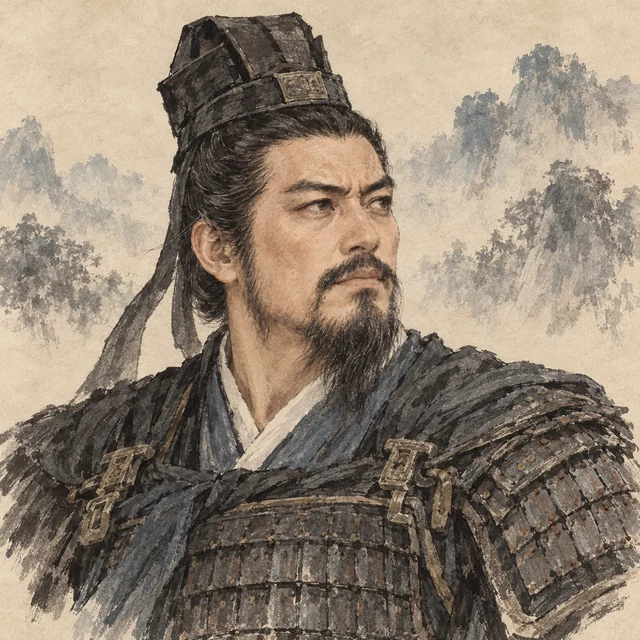
HISTORICAL PERSON
Deng Ai
邓艾
Rising from agricultural administration to frontier command, Deng Ai promoted military farming and canals; in 263 he led the route through Yinping that helped bring about Shu Han’s fall.
This entry is supported by historical references, but does not yet have a conversation profile.
PRIMARY BIOGRAPHY
Biography
Deng Ai (197–264), courtesy name Shizai, came from Jiyang in Yiyang. Orphaned and poor, he grew up as a military-colony household in Runan and later Yingchuan. A stutter kept him from clerical office, and he spent years as a hay-and-ration clerk for the rice colonies; yet his mind was on war. Whenever he saw high mountains or great marshes he would pace out where camps and garrisons should stand, and everyone laughed at him. Reporting to Luoyang on colony business, he met the Grand Commandant Sima Yi, who recognized his ability, took him onto his staff, and promoted him into the imperial secretariat.
In the Zhengshi era Deng Ai surveyed the Shouchun region and wrote the Ji River Discourse, arguing that the conquest of Wu depended on grain, and grain on the Huai: he proposed great military colonies and transport canals north and south of the river. The court adopted the plan; granaries soon lined the Huai, and armies could sail straight down to the southeast front — the logistical foundation of Wei and Jin pressure on Wu.
From 249 Deng Ai served on the Longyou front against Jiang Wei, first under Guo Huai, where his predictions repeatedly proved right, then as administrator of Nan’an and finally General who Guards the West and area commander of Longyou, enfeoffed as Marquis of Deng. At Duangu in 256 he crushed Jiang Wei in the severest defeat of the northern expeditions, and at Houhe in 262 he defeated him again. For over a decade Deng Ai was the opponent Jiang Wei could never get past.
In 263 Sima Zhao resolved to destroy Shu: Zhong Hui took the hundred-thousand-strong main force through the Xie and Luo valleys into Hanzhong, while Deng Ai and Zhuge Xu, with thirty thousand each, pinned Jiang Wei down in the northwest. When Zhong Hui stalled before the Jiange fortress, Deng Ai proposed a flank march: from Yinping he crossed more than seven hundred li of uninhabited mountains, cutting roads and building plank bridges along the cliffs. At the worst point the path ended altogether; Deng Ai wrapped himself in felt and rolled down the slope, and his men followed, gripping trees and rock. The vanguard descended on Jiangyou, whose commander Ma Miao surrendered; at Mianzhu he shattered Zhuge Zhan, who died with the secretariat officer Zhang Zun. Liu Shan came out bound, carrying his coffin, and Shu Han ceased to exist.
In Chengdu, following the precedent of the Han general Deng Yu, Deng Ai acted in the emperor’s name to appoint Liu Shan honorary General of Agile Cavalry and restored the Shu officials to their posts, keeping strict discipline. He proposed to Sima Zhao that twenty thousand Longyou and twenty thousand Shu troops remain to make salt and iron and build warships for a downstream conquest of Wu, and that Liu Shan be generously enfeoffed as a signal to Wu. Sima Zhao had the army supervisor Wei Guan warn him that such measures required prior approval; Deng Ai replied that his appointments were expedients to settle the newly surrendered. Zhong Hui, already plotting rebellion, had Deng Ai secretly denounced for treason, and an edict ordered him sent to the capital in a cage cart.
After Zhong Hui’s revolt collapsed, Deng Ai’s own soldiers set out to bring their commander back; Wei Guan, who had helped frame him, feared the reckoning and sent the officer Tian Xu to intercept the party. Deng Ai and his son were killed west of Mianzhu, his remaining sons in Luoyang were executed, and his womenfolk and grandchildren were exiled to the far west. After Emperor Wu acceded in 265, the official Duan Zhuo petitioned to clear Deng Ai’s name; the Book of Jin says Emperor Wu praised the intent of the memorial. In 265 he also pardoned Deng Ai’s family and allowed his line to continue. A separate Tai Shi 9 (273) edict, preserved in Complete Prose of Jin and attributed there to Deng Ai’s biography in Wei Zhi, appointed Deng Ai’s agnatic grandson Lang as a langzhong.
Life and role
- Primary role
- General Who Conquers the West
- Active period
- Documented coverage: Cao Wei (c. 220–264)
- Primary group
- Cao-Wei
Affiliations across a lifetime
- Before 240
Wei · agricultural colony clerk
A stuttering colony clerk whose talent Sima Yi recognized and brought into the central administration.
- 249–263
Wei · Longyou front against Jiang Wei
Rose to area commander of Longyou; won the battles of Duangu and Houhe against Jiang Wei.
- 263–264
Conqueror of Shu · framed and killed
Crossed the Yinping track, accepted Liu Shan’s surrender at Chengdu, then was denounced by Zhong Hui, arrested, and murdered by Tian Xu on Wei Guan’s orders.
- 265–273
Jin · family reprieve and grandson’s appointment
After Duan Zhuo’s petition, Emperor Wu pardoned Deng Ai’s family in 265 and allowed his line to continue; a separate 273 edict appointed his agnatic grandson Lang as a langzhong.
HISTORICAL RECORD
Historical sources
- Records of the Three Kingdoms · Wei, Book 28 · 王毌丘诸葛邓锺传 ↗
Chen Shou’s base text contains the biographies of Wang Ling, Guanqiu Jian (with Wen Qin), Zhuge Dan (with Tang Zi), Deng Ai (with Zhou Tai), and Zhong Hui (with Wang Bi). Zhong Hui’s biography also records Jiang Wei’s final actions after Shu fell. Pei Songzhi’s annotations on the page should be identified separately.
- Book of Jin · Biographies 48 · Duan Zhuo ↗
Duan Zhuo’s biography records his petition after Emperor Wu’s accession arguing that Deng Ai was not a rebel and requesting posthumous redress. It says the emperor read the memorial and praised its intent; it does not date the petition to 273 or record the later appointment of Deng Lang.
- Book of Jin · Annals 3 · Emperor Wu, first year ↗
The first-year annals record Emperor Wu’s 265 order pardoning Deng Ai’s family and allowing his line to continue; this is distinct from the appointment of Deng Lang in 273.
- Complete Prose of Jin · Volume 4 · Emperor Wu, part 3 · Tai Shi 9 ↗
Preserves the Tai Shi 9 edict appointing Deng Ai’s agnatic grandson Lang as a langzhong. The anthology attributes the edict to the Deng Ai biography in Wei Zhi; this is the source for the 273 appointment.
- Book of Jin · Book 2 · Annals of Emperor Jing and Emperor Wen ↗
Annals of Sima Shi (Jing) and Sima Zhao (Wen), posthumously honored by Jin.