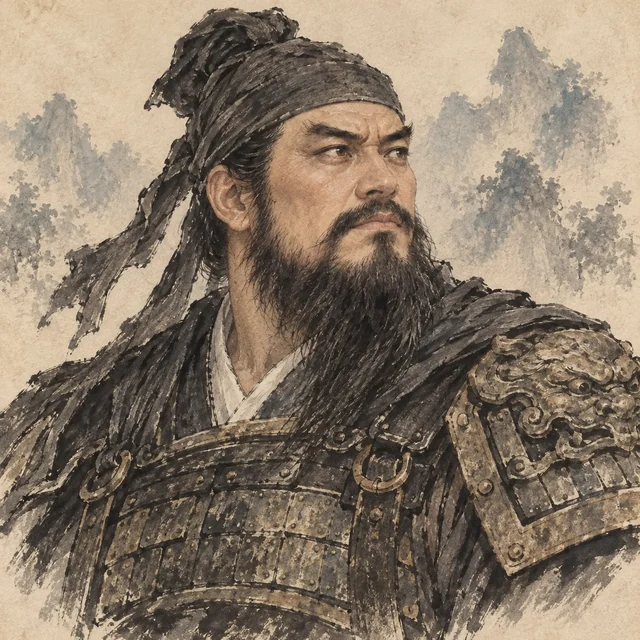
HISTORICAL PERSON
Dian Wei
典韦
Dian Wei served under Zhang Miao and Xiahou Dun before becoming a guard commander for Cao Cao; he died defending Cao Cao’s camp during Zhang Xiu’s attack.
This entry is supported by historical references, but does not yet have a conversation profile.
PRIMARY BIOGRAPHY
Biography
Dian Wei (d. 197), of Jiwu in Chenliu, was broad and towering, prodigiously strong, a man of honor. When the Liu family of Xiangyi had a blood feud with Li Yong of Suiyang — a former prefect, well guarded — Dian Wei took it up. He drove a cart laden with chicken and wine to Li Yong’s gate as if a caller, walked in with a hidden dagger, killed Li Yong and his wife, strolled out, took up his halberd, and walked away through a market frozen in terror; hundreds pursued, none dared close. Among the volunteer armies under Zhang Miao, the great camp banner was too heavy for any man to raise — Dian Wei set it up with one hand.
In 194, fighting Lü Bu near Puyang, Cao Cao destroyed an outlying camp by night and was caught by Lü Bu’s relief force on three sides; Lü Bu fought in person from dawn to dusk. Cao Cao called for a forlorn hope. Dian Wei stood first, leading dozens in double armor, shields cast aside, long halberds only. As arrows fell like rain he did not look, saying only: “Tell me when they are ten paces.” “Ten paces.” “Five paces.” Then he rose with a roar, a dozen halberds in hand, and everything he struck fell; Lü Bu’s men gave way, and dusk let Cao Cao withdraw. Dian Wei was made commandant and given a picked guard of several hundred who ringed the great tent.
In 197 Zhang Xiu surrendered at Wan. At the feast, Dian Wei stood behind Cao Cao with a great axe, a chi-long blade, glaring at Zhang Xiu and his officers as Cao Cao poured; none dared meet his eyes. Ten days later Zhang Xiu turned and stormed the camp. Cao Cao fled on a light horse; Dian Wei fought at the gate so none could enter, then stood with a dozen men as the enemy poured through other gates — each fighting one against ten. His long halberd swept right and left, breaking ten spears at a swing. When his men were all down, himself bleeding from dozens of wounds, he grappled bare-handed, seized two attackers, and crushed them dead; the rest dared not come on. He charged once more, killed several, then his wounds burst open and, eyes bulging, he died cursing. Only then did they dare approach to take his head. Cao Cao, fallen back to Wuyin, wept; he sent men to steal back the body, mourned over it himself, buried Dian Wei at Xiangyi, and whenever his carriage passed, sacrificed to him.
Life and role
- Primary role
- Palace guard commander
- Active period
- Late Eastern Han to Cao Wei
- Primary group
- Cao-Wei
Affiliations across a lifetime
- 190–194
Volunteer armies
Avenged a blood feud in the open market; raised the camp banner one-handed
- 194–197
Cao Cao’s guard commandant
Broke Lü Bu’s charge at Puyang; died holding the gate at Wan
HISTORICAL RECORD
Historical sources
- Records of the Three Kingdoms · Wei, Book 18 · Biographies of the Two Lis, Zang, Wen, Lü, Xu, Dian, Two Pangs, and Yan ↗
Chen Shou’s base text: biographies of Li Dian, Li Tong, Zang Ba (including Sun Guan), Wen Pin, Lü Qian (including Wang Xiang), Xu Chu, Dian Wei, Pang De, Pang Yu (including his mother Zhao E), and Yan Wen (including Zhang Gong). Pei Songzhi’s annotations are separately registered.