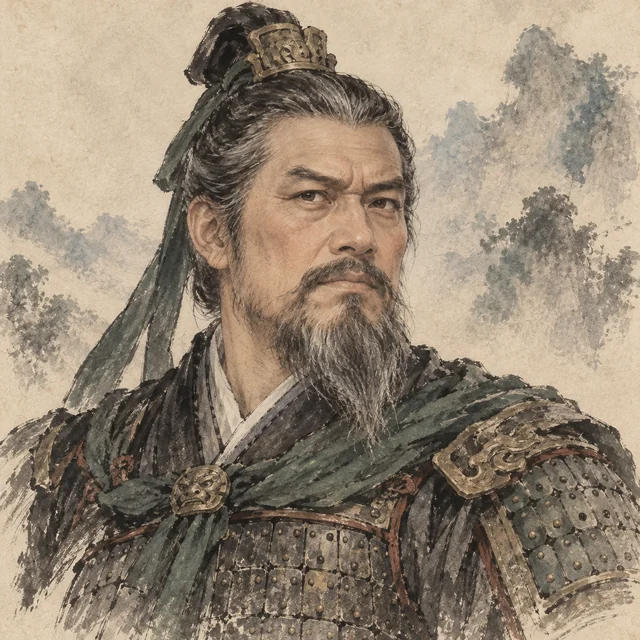
HISTORICAL PERSON
Ding Feng
丁奉
Ding Feng rose from a junior commander to senior office. At the Battle of Dongxing, he led a fast attack through winter conditions that helped rout the Wei vanguard.
This entry is supported by historical references, but does not yet have a conversation profile.
PRIMARY BIOGRAPHY
Biography
Ding Feng (d. 271), courtesy name Chengyuan, rose from the ranks of Wu’s light troops, serving under Gan Ning, Lu Xun, and Pan Zhang; in every battle he fought in the van, taking heads and standards, his body a map of scars.
At Dongxing in 252, as Wei’s great army feasted behind its siege lines in a blizzard, Ding Feng told his men: “Our titles and rewards are won today!” Stripped to light armor and short blades, his vanguard charged laughing Wei soldiers and routed the vanguard camp; the Wei retreat jammed the pontoon bridge until it collapsed, drowning tens of thousands. The “short blades in the snow” charge became legend.
In 255 he speared his way into the Wei pursuit at Gaoting to cover Wen Qin’s defection; in 258 he helped Sun Xiu eliminate the dictator Sun Chen at a banquet and became General-in-Chief. Under Sun Hao he was made Grand Marshal of the Right. He died in 271 — a soldier of four reigns whose career spanned Wu’s whole arc from triumph to decline.
Life and role
- Primary role
- Grand Marshal
- Active period
- Late Han and Eastern Wu (190s–250s)
- Primary group
- Jiangdong–Sun Wu
Affiliations across a lifetime
- ?–252
Wu field armies
Rose from junior officer under Gan Ning, Lu Xun, Pan Zhang to General of Champions
- 252–271
Wu high command
Hero of Dongxing; executed Sun Chen, became General-in-Chief, then Grand Marshal of the Right
HISTORICAL RECORD
Historical sources
- Records of the Three Kingdoms · Wu, Book 10 · 程黄韩蒋周陈董甘凌徐潘丁传 ↗
Chen Shou’s base text contains the biographies of Cheng Pu, Huang Gai, Han Dang, Jiang Qin, Zhou Tai, Chen Wu (with Chen Biao), Dong Xi, Gan Ning, Ling Tong, Xu Sheng, Pan Zhang, and Ding Feng. The concluding evaluation is separate from the biographies.