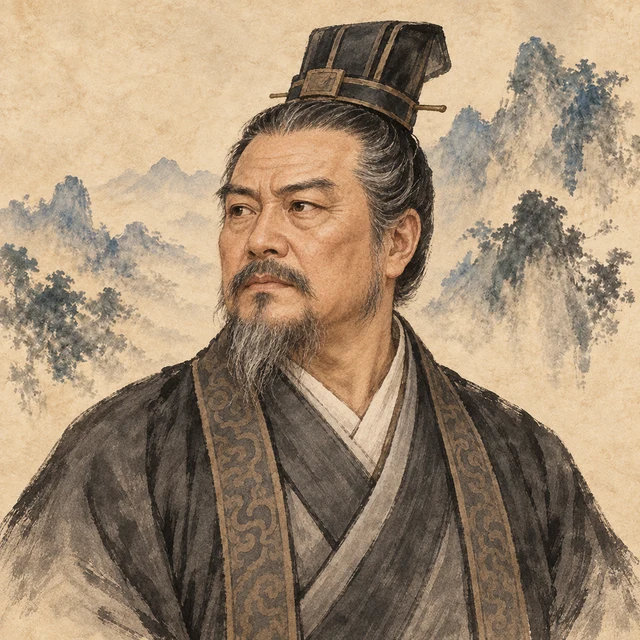
HISTORICAL PERSON
Dong Zhao
董昭
Dong Zhao served Yuan Shao before joining Cao Cao; he helped secure the emperor’s move from Luoyang to Xu, arranged grain transport by canal, and later held high office and advised on Wei’s political institutions.
This entry is supported by historical references, but does not yet have a conversation profile.
PRIMARY BIOGRAPHY
Biography
Dong Zhao, styled Gongren, came from Dingtao in Jiyin. Recommended filial-and-incorrupt, he was chief of Yingtao and prefect of Bairen, and Yuan Shao made him an army consultant. When Yuan Shao faced Gongsun Zan at Jieqiao and the administrator of Julu, Li Shao, with the commandery’s capped gentry, all meant to go over to the stronger Gongsun Zan, Yuan Shao gave Dong Zhao the commandery. The great clan of the Suns, Sun Kang and several dozen more, were then the plotters-in-chief, alarming officers and people. On reaching the commandery Dong Zhao forged an order of Yuan Shao’s proclaiming that the captured bandit scout Zhang Ji had confessed an attack on Julu with the former filial-and-incorrupt Sun Kang and others as his agents within — the order to arrest them and apply military law on arrival, the guilt ending with their persons, wives and children untouched. Acting on the forged order he had them all beheaded on the spot; the whole commandery trembled, then he soothed them one by one, and all were settled and gathered in. When the Wei commandery administrator Li Pan was killed by soldiers, Yuan Shao gave Dong Zhao that commandery too; its borders were then in great tumult with bandits by the ten thousand who sent envoys back and forth to trade and market. Dong Zhao treated the envoys generously, turned them into his spies, and struck the bandits’ emptiness by surprise — breaking them greatly every time.
Dong Zhao’s younger brother Dong Fang was serving in Zhang Miao’s army; Zhang Miao being at feud with Yuan Shao, Yuan Shao listened to slander and meant to charge Dong Zhao, who set out for the Emperor Xian instead and was detained at Henei by Zhang Yang. Through Zhang Yang he returned his seals and was made cavalry commandant. The Grand Progenitor, then holding Yan province, sent an envoy to Zhang Yang asking passage west to Chang’an; Zhang Yang refused. Dong Zhao urged him: “Yuan and Cao may be one house for now, but they will not long keep company. Cao is weak today, yet he is truly the hero of the realm — you should bind him to you. With this opening, put his dispatches through and memorialize on his behalf; if it succeeds you have a bond for life.” Zhang Yang put the Grand Progenitor’s dispatches through and recommended him; Dong Zhao wrote letters for the Grand Progenitor to the Chang’an generals Li Jue, Guo Si and the rest, each weighted to their standing, and Zhang Yang also sent his own envoy. The Grand Progenitor sent Zhang Yang horses, dogs, gold and silk, and traffic with the west was opened. When the Son of Heaven was at Anyi, Dong Zhao went from Henei and was made court gentleman by edict. In 196, when the Grand Progenitor had settled the Yellow Turbans at Xu and sent envoys to Hedong, the Son of Heaven returned to Luoyang, where Han Xian, Yang Feng and Dong Cheng were all at odds. Judging Yang Feng’s troops strongest but his partisans fewest, Dong Zhao wrote a letter in the Grand Progenitor’s name to Yang Feng; delighted, Yang Feng told the generals: “The Yan province host is close at Xu, with soldiers and grain — the state may rely on them”, and they joined in memorialising the Grand Progenitor as General who Guards the East, inheriting his father’s fief of Fei precinct. When the Grand Progenitor came to court at Luoyang he seated Dong Zhao beside him and asked: “Now that I am here, what plan should I follow?” Dong Zhao said: “You raised a righteous host to punish the violent, entered the court and winged the royal house — the achievement of the five hegemons. The generals below differ in mind and will not obey; to stay and prop the throne is impossible — there is only moving the carriage to Xu. Yet the court has wandered long and just regained the old capital; near and far stand on tiptoe hoping for one morning of peace, and to move it again will not content them. But he who does the extraordinary wins the extraordinary — weigh the greater side, general.” The Grand Progenitor said: “That is my own intent. But Yang Feng is close at Liang and his troops are keen — will he not be an obstacle?” Dong Zhao said: “Yang Feng has few partisans and will come over alone. Send an envoy at once with generous thanks to quiet his mind, saying: ‘The capital has no grain; the carriage will pass for a while to Luyang, which is near Xu, and the transport is easier.’ Yang Feng is brave and short on thought — he will not suspect, and by the time the messengers have gone and come, the plan is fixed.” The Grand Progenitor said, “Good”, sent the envoy, and moved the great carriage to Xu; Yang Feng’s hopes were dashed. In 198 Dong Zhao became Intendant of Henan. When Zhang Yang was killed by his officer Yang Chou and Zhang Yang’s senior clerk Xue Hong with the Henei administrator Miao Shang held the city awaiting Yuan Shao’s rescue, the Grand Progenitor sent Dong Zhao into the city alone; he exhorted Xue Hong and Miao Shang, and they surrendered with their whole host that day.
In 212 Dong Zhao held that the Grand Progenitor should be advanced to Duke of a state with the nine bestowments complete, to mark his singular service, and wrote to Xun Yu: “Now Duke Cao, meeting the realm’s overthrow and the ancestral temples burned, has himself donned armour and fought his rounds, combed by wind and bathed by rain nigh on thirty years, mowing down the massed evildoers to clear the people’s harm, so that the house of Han stands again and the Liu line keeps its sacrifices. Set beside the famed men of old he is Mount Tai against an ant-hill — can they be named in one day?” When the state of Wei was founded he held eminent office in turn. At Emperor Wen’s accession he was made Grand Herald, advanced to Marquis of the Right district, then moved to palace attendant. In 222, when the general Cao Xiu came to the Yangzi and offered to take his keen soldiers striding south of the river, the emperor, fearing Cao Xiu would cross at once, sent a galloping edict to stop him. Dong Zhao, in attendance, said: “A crossing now is what men find hardest; even if Cao Xiu wills it, he cannot go alone — he must have the generals. Zang Ba and the rest are rich and honoured already and want nothing more; why would they stake their lives on a lucky throw? If Zang Ba’s men will not go in, Cao Xiu’s ardour dies of itself.” Soon after, a storm wind drove the enemy boats all beneath Cao Xiu’s camp, and the enemy scattered with heads taken and prisoners made. When the carriage went to Wan and the general Xiahou Shang attacked Jiangling without success — the river running shallow and narrow — Xiahou Shang meant to take his foot and horse by boat and camp on the mid-river isle, making a floating bridge for passage, and most held the city must fall. Dong Zhao memorialised: “The Martial Emperor’s wit and courage surpassed all men, yet in war he feared the enemy and dared not be so light. To camp on the isle is the deepest of penetrations; to cross by a floating bridge, the utmost of danger; to move by a single road, the narrowest of passages — three things the master of war avoids, and we do them all. The enemy attacks the bridge again and again; one slip, and the picked troops on that isle are Wei’s no longer but turned into Wu’s. And the river waters are rising — if one day they surge, how shall we defend?” The emperor awoke to it and ordered Xiahou Shang out at once; ten days after the army came out, the river surged. The emperor said: “Your judgment of this matter — how exact it was! Even Zhang Liang and Chen Ping could add nothing.” In 224 his fief was moved to Marquis of Chengdu district; he was made Grand Master of Ceremonies, then Grandee of Glorious Favour and steward, then Grand Coachman. Under Emperor Ming he was advanced to Marquis of Leping and made Commandant of the Guards. In 230 he acted as Excellency over the Masses, and in 232 was confirmed. He memorialised on the ills of the age’s current — the young men making a trade of companionship, banding in cliques and puffing one another with false praise — and the emperor issued a stern edict dismissing Zhuge Dan, Deng Yang and their set. Dong Zhao died at eighty-one with the posthumous title Marquis Ding.
Life and role
- Primary role
- Senior Wei statesman
- Active period
- Late Han and Cao Wei (190s–240s)
- Primary group
- Cao-Wei
Affiliations across a lifetime
- 192–196
Opened the road between Cao and Yang Feng
Persuaded Zhang Yang to put Cao Cao’s dispatches through and wrote the letters to Li Jue and Guo Si himself — opening the way west
- 196
Moved the Son of Heaven to Xu
His plan — win Yang Feng by letter, soothe him with the Luyang pretext — carried the emperor to Xu unopposed
- 212–236
The nine bestowments; the warning at the isle
First voice for the dukedom and nine bestowments; his warning pulled Xiahou Shang off the river isle ten days before the flood
HISTORICAL RECORD
Historical sources
- Records of the Three Kingdoms · Wei, Book 14 · 程郭董刘蒋刘传 ↗
Chen Shou’s base text: biographies of Cheng Yu (including his grandson Cheng Xiao), Guo Jia, Dong Zhao, Liu Ye (including his son Liu Tao), Jiang Ji, and Liu Fang. Pei Songzhi’s annotations are registered separately.