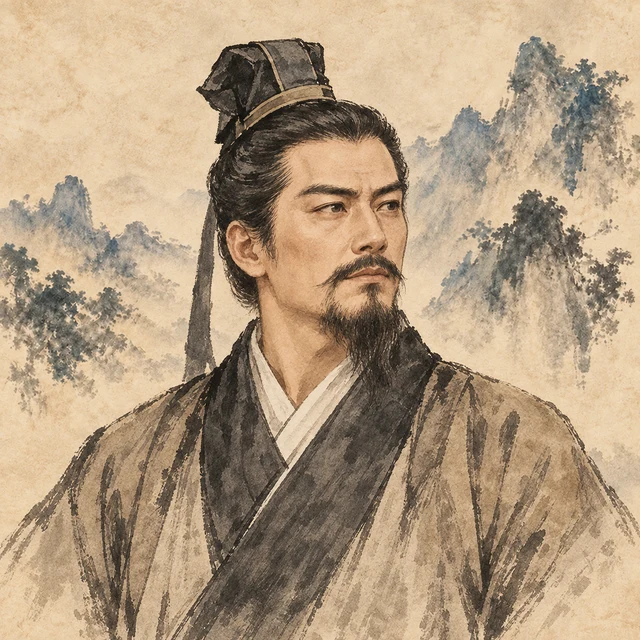
HISTORICAL PERSON
Du Ji
杜畿
Appointed to govern Hedong during Gao Gan’s rebellion, Du Ji entered alone, divided the conspirators’ forces, and restored local order through both strategy and civil administration. He later died while testing a government vessel.
This entry is supported by historical references, but does not yet have a conversation profile.
PRIMARY BIOGRAPHY
Biography
Du Ji, styled Bohou, came from Duling in the capital district. Orphaned young and harshly used by his stepmother, he was known for filial piety. At twenty he was the commandery’s merit officer and acting magistrate of Zheng, where several hundred prisoners lay chained; Du Ji went to the gaol in person, weighed the gravity of each case, and decided and released them all — and though not every judgment was exact, the commandery marvelled that one so young had such breadth of mind. Recommended filial-and-incorrupt, he was made assistant administrator of Hanzhong; when the realm fell into chaos he abandoned office and lodged in Jing province, returning in the Jian’an era. Xun Yu presented him to the Grand Progenitor, who made him rectifier of the ministry of works, then colonel protecting the Qiang with the credentials and administrator of Xiping.
When the Grand Progenitor had settled the lands north of the river, Gao Gan raised Bing province in revolt. The Hedong administrator Wang Yi had been recalled, and the Hedong men Wei Gu and Fan Xian, while openly petitioning to keep Wang Yi, were secretly in league with Gao Gan. The Grand Progenitor sent Du Ji as the new administrator of Hedong; Wei Gu and his fellows blocked the Shan crossing with several thousand soldiers, and Du Ji could not cross. Some said a great army was needed, but Du Ji said: “Hedong has thirty thousand households — not all of them want revolt. Press them hard with an army and those who would stay good, leaderless, will fear and follow Wei Gu; with the odds in his hands he will fight to the death. If we attack and lose, the neighbours will answer and the realm’s troubles will not end; if we attack and win, we have maimed a whole commandery’s people. Wei Gu has not openly disowned the king’s mandate — he asks for the old administrator in name and will not harm the new one. I will go alone in a single carriage, where they do not expect it. Wei Gu is full of schemes but no resolution; he will feign acceptance. Give me one month in the commandery and I can hobble them with stratagems — it is enough.” He crossed by a by-road at the Dou ford. Fan Xian wanted to kill Du Ji to cow the rest, but Wei Gu said, “Killing him gains nothing and buys an evil name — and we hold the reins”, and so they received him. Du Ji made Wei Gu controller with the powers of assistant administrator, heading the merit bureau, while Fan Xian commanded the three thousand officers and soldiers; the two were pleased and paid Du Ji only outward homage. When Wei Gu wanted a great levy, Du Ji advised: “To do an extraordinary deed you must not stir the people’s hearts. A great levy now will throw them into tumult — better to raise soldiers slowly, by pay.” Wei Gu agreed, and after tens of days, when it was done, the greedy captains had answered the call in droves while sending few of their own men. Du Ji further persuaded him: “Men’s hearts turn to home. Let the captains and clerks go back in turns to rest — recalling them in need is easy.” Again Wei Gu agreed — and so the good men abroad became Du Ji’s secret aid while the wicked scattered home, and the host dissolved. Just then the White Riders attacked Dongyuan and Gao Gan entered Huoze; before Wei Gu’s secret levy arrived, Du Ji, knowing the counties were his, rode out with a few dozen horsemen to hold Zhangpi, and the clerks and people rose in their towns to help him — within tens of days he had over four thousand men. Wei Gu, Gao Gan and Zhang Sheng attacked together and could not take him; plundering the counties, they got nothing; and when the great army came, Gao Gan and Zhang Sheng were beaten and Wei Gu and the rest executed. The remnant of their party Du Ji pardoned and restored to their homes.
Of all the realm’s shattered commanderies, Hedong was settled first and least diminished. Du Ji governed it by generosity, leaving the people in peace. When litigants came, he received them in person, laid out the great principles, and sent them home to think it through, bidding them return if anything still rankled — until the village elders scolded one another, “With such a lord, how can we not follow his teaching?”, and lawsuits nearly ceased. Through the counties he commended filial sons, chaste wives and obedient grandsons, remitting their service and comforting them in season. Step by step he set the people to breeding cows and mares, down to chickens, pigs and dogs, each with its rule, until all farmed diligently and every household was full. Then Du Ji said, “The people are rich — they must now be taught”, and in the winter months he drilled arms and opened a school, taking the classics in hand to teach himself, and the commandery was transformed. When Han Sui and Ma Chao rebelled and Hongnong and Pingyi rose in answer by whole counties, Hedong, though bordering the rebels, did not waver in heart. The Grand Progenitor marched west to Puban and faced the enemy across the Wei with the army’s food drawn wholly from Hedong; when the enemy broke, over two hundred thousand hu remained. His order read: “The administrator of Hedong, Du Ji — as Confucius said of Yu, ‘I find no flaw in him’ — is raised in rank to full two-thousand-bushel.” On the Hanzhong campaign five thousand of his men were sent as porters, and they exhorted one another: “A man has one death — we will not fail our lord”, and not one deserted: such was the hearts he won. When the state of Wei was founded Du Ji was made a Master of Writing; after the peace, a further order said: “Of old Xiao He settled Guanzhong and Kou Xun pacified Henei — such service is yours. I had thought to give you the office of remonstrance, but Hedong is my thigh-and-arm commandery, the well-stocked place by which I control the realm, so I must trouble you to govern it reclining.” Sixteen years in Hedong, and always rated the best in the realm. When Emperor Wen became king he was enfeoffed Marquis within the Passes and called in as Master of Writing; at the imperial accession he was advanced to Marquis of Fengle precinct, acting as colonel-director of retainers. When the emperor campaigned against Wu, Du Ji, as deputy Prefect of the Masters of Writing, directed the affairs left behind; afterwards, when the emperor visited Xuchang, Du Ji again held the capital. Charged by edict to build the imperial tower-ship, he was testing it on the Tao river when a storm sank it and he drowned. The emperor wept for him and decreed: “Of old Ming died in the waters in zeal for his office, and Ji died on the mountain in zeal for the hundred grains. The late deputy Prefect of the Masters of Writing Du Ji, testing a ship at Mengford, capsized and was lost — the utmost of loyalty. I grieve for him deeply.” He was posthumously made Grand Coachman with the posthumous title Marquis Dai.
Life and role
- Primary role
- Administrator of Hedong
- Active period
- Late Han and Cao Wei (190s–240s)
- Primary group
- Cao-Wei
Affiliations across a lifetime
- 205
Into Hedong in a single carriage
Refused the army, crossed by a by-road, hobbled Wei Gu with stratagems until his host dissolved
- 205–220
Administrator of Hedong
Governed sixteen years rated first in the realm — taught, stocked and fed the army at the Wei with two hundred thousand hu to spare
- 220–224
Deputy Prefect of Writing
Held the capital in the emperor’s absence; drowned testing the imperial tower-ship, mourned as the utmost of loyalty
HISTORICAL RECORD
Historical sources
- Records of the Three Kingdoms · Wei, Book 16 · 任苏杜郑仓传 ↗
Chen Shou’s base text: biographies of Ren Jun, Su Ze, Du Ji (including Du Shu and notices about Le Xiang), Zheng Hun, and Cang Ci. Pei Songzhi’s annotations are registered separately.
- Records of the Three Kingdoms, with Pei Songzhi annotations · Pei Songzhi annotations to Wei, Book 16 ↗
Annotations to Wei Book 16, including extracts from Wei Lue, Fu Zi, Wei Wushu, Zhang Fan’s Han Ji, and Du Shi Xin Shu; these accounts are kept distinct from Chen Shou’s base text.