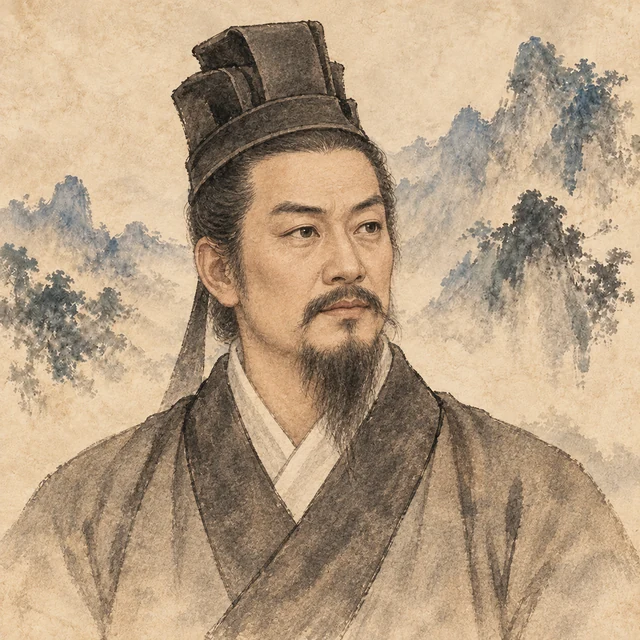
HISTORICAL PERSON
Du Kui
杜夔
A Henan musician who served Han and then Cao Cao as libationer in charge of court music, restoring pitch standards and ceremonial music for Wei.
This entry is supported by historical references, but does not yet have a conversation profile.
PRIMARY BIOGRAPHY
Biography
Du Kui, styled Gongliang, was from Henan. For his knowledge of music he was gentleman for the classical music, leaving office for illness in Zhongping 5. The provinces, commanderies, and the minister of works all invited him with ceremony, but with the age in chaos he fled to Jingzhou. The governor Liu Biao had him and Meng Yao compose classical music for the Han sovereign; when it was ready Liu Biao wished to have it performed in his courtyard, but Du Kui remonstrated, “Your generalship’s commission is not to compose for the Son of Heaven — to perform it in your own courtyard would surely be improper,” and Liu Biao accepted the advice and stopped. When Liu Biao’s son Liu Cong later surrendered to the Grand Ancestor, the Grand Ancestor made Du Kui libationer of the army’s councils, sharing in the affairs of the grand music office, and so charged him with recreating the classical music.
Du Kui was a master of bells and pitch-pipes, his keen intelligence surpassing others; of the eight tones of silk and bamboo there was none he could not command — only song and dance were not his strength. At that time the gentlemen Deng Jing and Yin Qi were skilled at chanting the classical music, the song master Yin Hu could sing the airs of the ancestral temple and the suburban sacrifices, and the dance masters Feng Su and Fu Yang knew the dances of former dynasties; Du Kui presided over them all with refined study, examining the classics afar and collecting old precedents near at hand, teaching and drilling, making ready the instruments — the restoration of the ancient music of former dynasties began with Du Kui. In Huangchu he was prefect of the grand music and commandant harmonizing the pipes.
The Han bell-caster Chai Yu was a craftsman of clever invention, much made among the formed vessels and known to the great men of the day. Du Kui had Chai Yu cast bronze bells, but their tones and pitches were often not according to rule, and he repeatedly had them broken and recast; Chai Yu grew thoroughly sick of it, said Du Kui’s judgments of clear and muddy were arbitrary, and defied him, and the two accused each other before the Grand Ancestor. The Grand Ancestor took the cast bells and had them tested in mixed order, and only then knew Du Kui’s ear was exact and Chai Yu’s work false — and punished Chai Yu and his sons, making them all grooms. Emperor Wen loved and favored Chai Yu, and once had Du Kui play the reed-organ and zither with Zuo Yuan and others among the guests; Du Kui’s face showed his reluctance, and the emperor’s goodwill cooled. Later, on another matter, Du Kui was arrested and Zuo Yuan and the rest were sent to study under him; Du Kui held that what he practiced was classical and that his service had its proper foundation, and his heart remained unresigned — and so he was dismissed and died.
Life and role
- Primary role
- Court musician of Cao Wei
- Active period
- Documented coverage: late Han through Cao Wei
- Primary group
- Cao-Wei
Affiliations across a lifetime
- Jian’an era
Libationer of the army’s councils — recreating the classical music
Presided over the singers and dancers, searched the classics and old precedents, and restored the ancient music of former dynasties from its ruins
- Huangchu era
Prefect of the grand music
Proved his ear against the bell-caster Chai Yu in a blind trial of bells; scorning to perform for guests, he was dismissed and died
HISTORICAL RECORD
Historical sources
- Records of the Three Kingdoms · Wei, Book 29 · 方技传 ↗
Chen Shou’s base text contains the biographies of Hua Tuo, Du Kui, Zhu Jianping, Zhou Xuan, and Guan Lu. Ma Jun appears in a Pei Songzhi annotation under Du Kui, which quotes a preface by Fu Xuan; he is not a separate biography in Chen Shou’s base text. The concluding evaluation is separate from the biographies.