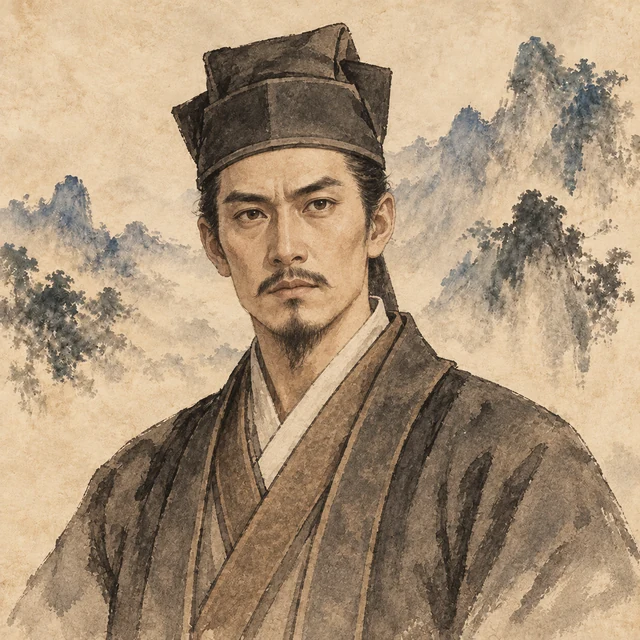
HISTORICAL PERSON
Du Shu
杜恕
Du Shu held several offices and wrote extensive memorials arguing for stronger civil administration, careful personnel selection, and limits on governors’ military roles; he was later impeached and exiled.
This entry is supported by historical references, but does not yet have a conversation profile.
PRIMARY BIOGRAPHY
Biography
Du Shu, styled Wubo, was from Duling in Jingzhao, son of the secretariat supervisor Du Ji. In the Taihe era he served as cavalier attendant and gentleman of the Yellow Gates. He dealt with men in plain sincerity, cultivated no ornament, made no factional friends, and gave himself wholly to public business; whenever policy erred he cited the guiding principles in blunt words, so that senior men like the palace attendant Xin Pi held him in esteem. In his eight years at court his discourse was always of this kind. When the court debated the system of performance examinations for officials, Du Shu memorialized at length against it, arguing that if men are not employed according to their gifts, no examination will help, and that the urgent business was to test men through the four categories and then promote them by proven service.
He went out as administrator of Hongnong, transferred after some years to be chancellor of Zhao, and left ill; called back as administrator of Hedong, he moved within a year to be protector of the army in Huaibei, and again left ill. Wherever he served he attended to the larger pattern, and though his bounty won the people’s hearts, he never equaled his father in it. Presently he was made chief censor; but because he could not harmonize with the powers of the day, he kept being sent out, and went again as inspector of You province with the titles of general who establishes might, bearer of credentials, and colonel protector of the Wuhuan.
The general who campaigns in the north Cheng Xi was then camped at Ji, and the secretariat officer Yuan Kan warned Du Shu to cultivate him; but within a year of taking office, when a Xianbei chieftain came straight to the provincial seat with a few dozen riders without passing the frontier posts, the province beheaded one attendant of his escort and Du Shu sent no memorial about it. Cheng Xi impeached him, and the commandant of justice found the death penalty; because his father Du Ji had drowned in dutiful service, he was instead stripped to commoner rank and exiled to Zhangwu — that was Jiaping 1. Unconstrained in manner and careless of guarding against harm, he came to this ruin. In Zhangwu he wrote the Tilun in eight essays and the Xingxinglun in one. He died in exile in Jiaping 4; in Ganlu 2 the ninety-year-old Yue Xiang of Hedong memorialized on Du Ji’s legacy, and the moved court enfeoffed Du Shu’s son Du Yu as marquis of Fengle precinct with a hundred households.
Life and role
- Primary role
- Court or regional official
- Active period
- Documented coverage: late Han through Cao Wei
- Primary group
- Cao-Wei
Affiliations across a lifetime
- Taihe era
Cavalier attendant, gentleman of the Yellow Gates
Eight years of blunt court discourse, including his great memorial against the examination system
- Jiaping 1 (249)
Inspector of You province, exiled to Zhangwu
Impeached by Cheng Xi over the Xianbei visit, spared death for his father’s merit, and wrote the Tilun in exile
HISTORICAL RECORD
Historical sources
- Records of the Three Kingdoms · Wei, Book 16 · 任苏杜郑仓传 ↗
Chen Shou’s base text: biographies of Ren Jun, Su Ze, Du Ji (including Du Shu and notices about Le Xiang), Zheng Hun, and Cang Ci. Pei Songzhi’s annotations are registered separately.