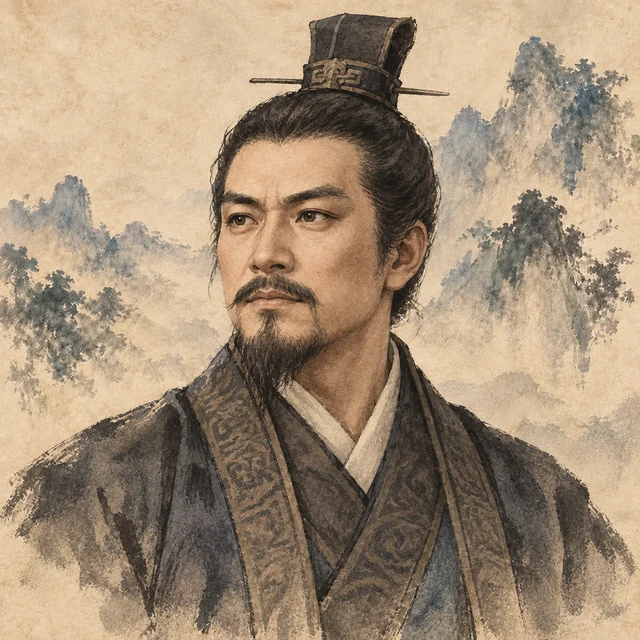
HISTORICAL PERSON
Du Xi
杜袭
A Dingling man from Yingchuan; he served Wei as chief strategist to the General-in-Chief, commanding forces in Guanzhong and holding Hanzhong.
This entry is supported by historical references, but does not yet have a conversation profile.
PRIMARY BIOGRAPHY
Biography
Du Xi, styled Zixu, came from Dingling in Yingchuan; his great-grandfather Du An and grandfather Du Gen were famous in their day. Fleeing the turmoil to Jing province, he was treated by Liu Biao with a guest’s honours. When his fellow townsman Fan Qin was repeatedly found remarkable by Liu Biao, Du Xi told him: “The reason I came with you was simply to coil like a dragon in a hidden pool and await the hour to soar as a phoenix — did you think Governor Liu a lord who could set the age right, that you plan to give him your service? If you go on showing off your talents, you are no companion of mine.” Fan Qin answered with feeling, “I accept your instruction with respect”, and Du Xi went on south to Changsha. At the beginning of Jian’an, when the Grand Progenitor brought the Son of Heaven to dwell at Xu, Du Xi fled back to his home county and was made prefect of Xi’e. The county lay on the southern marches, thick with bandits; the local officers had all penned the people inside the walls, so no farming was done, the fields went wild, the folk were in straits and the granaries empty. Du Xi, knowing the people were bound to him by kindness, sent the old and weak out to scattered farm work and kept the able-bodied for defence, to the joy of officers and people alike. When Jing province sent ten thousand foot and horse against the city, Du Xi gathered all the officers and people fit to hold it — some fifty men — and bound them by oath; those whose kin were outside and who wished to go protect them were freely let go — all knocked their heads and swore to die. He took stone and arrow in his own person and led the desperate fight. Grateful for his kindness, the officers and people gave their lives: several hundred of the enemy fell, but of Du Xi’s men over thirty died and all eighteen of the rest were wounded, and the bandits got into the city. Leading his wounded officers and people he broke out through the ring; of the dead there were almost none left — yet not one had turned coat. He gathered the scattered people and moved to the camp at Mobei, and officers and people followed him as if going home.
The director of retainers Zhong Yao memorialised him as court gentleman and army consultant, and Xun Yu recommended him too; the Grand Progenitor made him libationer of the chancellery’s army. When the state of Wei was founded he became palace attendant, serving alongside Wang Can and He Qia. Wang Can’s powerful memory and broad learning meant he often rode beside the Grand Progenitor on his outings — but in the respect shown him he was not the equal of He Qia and Du Xi. Du Xi once had a private audience that lasted to midnight; Wang Can, of a jealous and striving temper, rose and said, “I wonder what the Duke finds to say to Du Xi?”, and He Qia laughed back: “Can the realm’s business ever be finished? Your day-watch suffices — must you fret to have his night-watch too?” Later Du Xi held the office of senior clerk of the chancellery and followed the Grand Progenitor to Hanzhong against Zhang Lu. When the Grand Progenitor returned, Du Xi was made Commandant-escort and left to direct the military affairs of Hanzhong, where he soothed and guided the people until over eighty thousand households of their own will came out and moved to Luo and Ye.
When Xiahou Yuan was destroyed by Liu Bei and the army had lost its marshal, the officers’ colour failed; Du Xi, with Zhang He and Guo Huai, gathered and directed the several commands, and by expedient made Zhang He commander, uniting all hearts — and the three armies steadied. When the Grand Progenitor returned east he made Du Xi senior clerk of the office left behind, posted in Guanzhong. When Emperor Wen became king Du Xi was enfeoffed Marquis within the Passes, and at the imperial accession he was made censor supervising army provisions, enfeoffed Marquis of Wuping precinct, then enforcement officer of the same, and entered as a Master of Writing. Under Emperor Ming he was advanced to Marquis of Pingyang district. When Zhuge Liang came out by Qinchuan and the General-in-chief Cao Zhen commanded the armies against him, Du Xi was moved to army’s counselor of the General-in-chief; when Cao Zhen died and King Xuan of Sima succeeded him, Du Xi was again counselor. Recalled for illness and made Grandee of the Palace, he died and was posthumously made Privy Treasurer, with the title Marquis Ding.
Life and role
- Primary role
- Cao Wei official
- Active period
- Documented coverage: late Han through Cao Wei
- Primary group
- Cao-Wei
Affiliations across a lifetime
- 196–200s
The death-grip on Xi’e
Fifty sworn men against ten thousand — nearly all died, none deserted, and the people followed him to Mobei as if going home
- 215–219
Held Hanzhong; eighty thousand households moved
Left to direct Hanzhong’s affairs after Zhang Lu’s fall, he guided eighty thousand households to voluntary migration
- 219
Steadied the army, raised Zhang He
With Xiahou Yuan dead and the army shaken, he and Guo Huai made Zhang He commander by expedient — and the three armies steadied
HISTORICAL RECORD
Historical sources
- Records of the Three Kingdoms · Wei, Book 23 · 和常杨杜赵裴传 ↗
Chen Shou’s base text contains the biographies of He Qia, Chang Lin, Yang Jun, Du Xi, Zhao Yan, and Pei Qian. The page also carries Pei Songzhi’s annotations, which should be identified separately.