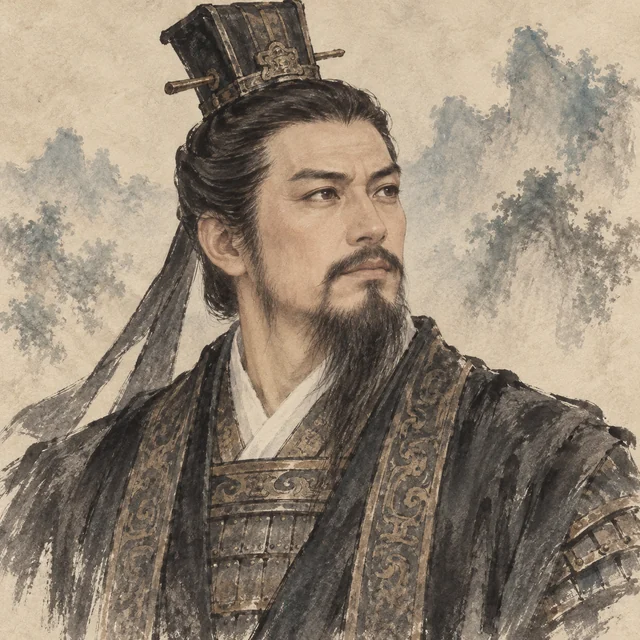
HISTORICAL PERSON
Du Yu
杜预
A Duling man from Jingzhao and Sima Zhao’s brother-in-law; master of the Zuo Tradition and chief advocate of conquering Wu. As General who Guards the South he took Jiangling in 280 and was enfeoffed Marquis of Dangyang; his Zuo commentary endures.
This entry is supported by historical references, but does not yet have a conversation profile.
PRIMARY BIOGRAPHY
Biography
Du Yu (222–285), courtesy name Yuankai, came from Duling in Jingzhao. His grandfather Du Ji had been a Wei imperial secretariat director; his father Du Shu, governor of You province, fell out with Sima Yi and died in confinement, which stunted Du Yu’s early career. When Sima Zhao took power he gave Du Yu his sister, Princess Gaolu, in marriage, and Du Yu entered office through the secretariat and the chancellor’s staff.
Broadly learned and a shrewd judge of policy, Du Yu had a hand in most of the court’s regulations and campaigns; contemporaries nicknamed him "the Du Arsenal," for there was nothing he did not hold in store. In 263 he accompanied Zhong Hui’s conquest of Shu as senior staff; when Zhong Hui’s rebellion collapsed and his staff was slaughtered, Du Yu alone escaped by his wits, and was rewarded with added fief households.
When Yang Hu died in 278 he recommended Du Yu from his deathbed; the emperor made Du Yu General who Guards the South and area commander of Jingzhou at Xiangyang. Du Yu drilled his army, then struck first: he smashed the Wu commander of Xiling, Zhang Zheng, and ostentatiously sent the captured banners and prisoners back to Jianye. Sun Hao took the bait and recalled Zhang Zheng on the eve of war, replacing him with Liu Xian — Wu’s western front changed generals on the threshold of invasion.
In the winter of 279 Du Yu sent up memorial after memorial urging immediate attack: Sun Hao, he argued, would never abandon his capital, and the downstream momentum was irresistible. When the last memorial arrived the emperor was playing go with Zhang Hua; Zhang Hua pushed over the board and pressed for the decision. In the first month of 280 six Jin armies moved at once, Du Yu’s Jingzhou corps making straight for Jiangling.
Du Yu first sent eight hundred picked men under Zhou Zhi and Wu Chao across the river by night against Lexiang, lighting fires on Mount Ba and flying banners everywhere to terrorize the Wu commander Sun Xin; when Sun Xin marched out against Wang Jun and was beaten, Zhou Zhi’s ambushers slipped into the city on the heels of the fleeing Wu troops and seized Sun Xin in his own headquarters. The army coined a saying: "by stratagem instead of battle, one man is worth ten thousand." Du Yu then closed on Jiangling, whose commander Wu Yan feigned surrender while manning the walls; Du Yu stormed the city. With the upper river gone, every Wu prefecture from the Yuan and Xiang south to Jiao and Guang surrendered at word of his coming.
Before Jianye, some generals counseled waiting: a century-old enemy, spring floods rising — better to return in winter. Du Yu answered that with the army’s momentum at its height, the campaign was like splitting bamboo: "once the first joints give, the rest splits to the blade." He directed the columns straight at Jianye, and Wu collapsed. He was enfeoffed as Marquis of Dangyang county with his fief raised to ninety-six hundred households.
Back at Xiangyang, Du Yu cut canals to drain the Yangzi’s flood-threat and open grain transport south to Lingling and Guiyang, and rebuilt schools; the people of the Han river country blessed his name. He could barely ride a horse or pierce a target, yet he held great commands to the end of his life. He never stopped studying: in camp he always had a book in hand, and his Collected Explanations of the Zuo Tradition became the standard commentary for all later readers. Of his contemporaries he said Wang Ji had a horse-bug and He Qiao a money-bug; asked by the emperor what his own bug was, he answered: "Your servant has the Zuo Tradition bug." Summoned as Metropolitan Commandant in 285, he died on the road at Deng county, aged sixty-three.
Life and role
- Primary role
- Western Jin general and classicist
- Active period
- Documented coverage: late Wei through Western Jin
- Primary group
- Western Jin
Affiliations across a lifetime
- Before 263
Late Wei · secretariat and chancellor’s staff
Son-in-law of Sima Zhao through Princess Gaolu; rose through the secretariat.
- 263–278
Conquest of Shu staff · Jin court planner
Served on Zhong Hui’s staff in 263 and escaped the purge; then shaped early Jin institutions.
- 278–280
Jin · commander of Jingzhou, conqueror of Wu
Succeeded Yang Hu at Xiangyang; took Lexiang by stratagem, stormed Jiangling, and ordered the final drive on Jianye — "like splitting bamboo."
- 280–285
Marquis of Dangyang · Zuo Tradition scholar
Built canals and schools in Jingzhou and wrote the standard commentary on the Zuo Tradition, owning to a "Zuo Tradition bug."
HISTORICAL RECORD
Historical sources
- Book of Jin · Annals 3 · Emperor Wu ↗
Use the named biography or chronicle entry in this volume; compare it with the Three Kingdoms record where sources differ.
- Book of Jin · Book 34 · Biographies of Yang Hu and Du Yu ↗
Du Yu’s biography: planning the conquest of Wu and the Jingzhou command.