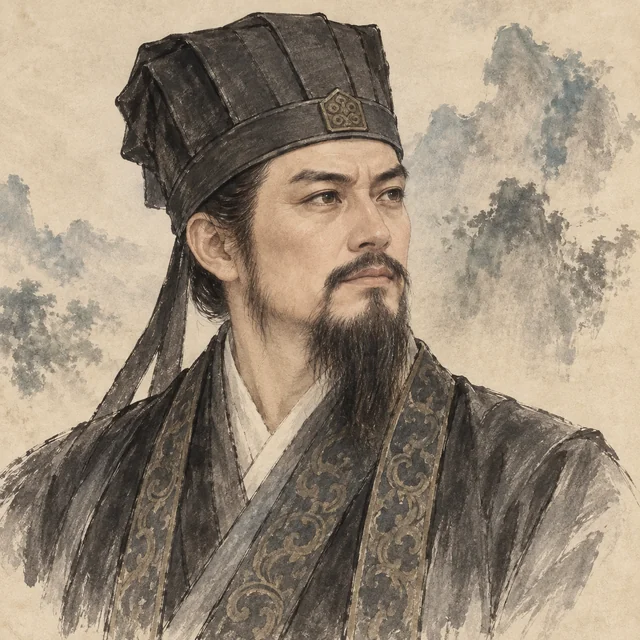
HISTORICAL PERSON
Fei Shi
费诗
A Nan’an man from Jianwei who surrendered Mianzhu to Liu Bei; he reconciled Guan Yu to sharing rank with Huang Zhong, then was demoted for opposing Liu Bei’s accession and ended as Grandee Remonstrant.
This entry is supported by historical references, but does not yet have a conversation profile.
PRIMARY BIOGRAPHY
Biography
Fei Shi, styled Gongju, came from Nan’an in Jianwei. Under Liu Zhang he was prefect of Mianzhu; when the First Sovereign attacked Mianzhu, Fei Shi was the first to bring his city over. Once Chengdu was settled and the First Sovereign held the governorship of Yi province, Fei Shi was made an aide supervising the army, then sent out as administrator of Zangke, and recalled as major of the vanguard of the province.
When the First Sovereign became King of Hanzhong, Fei Shi was sent to invest Guan Yu as General of the Van. Hearing that Huang Zhong was made General of the Rear, Guan Yu said in anger: “A true man will not stand in the same rank as an old soldier!”, and refused the investiture. Fei Shi said to him: “One who founds a king’s work cannot rely on a single sort of man. Of old Xiao He and Cao Can were the High Ancestor’s friends from boyhood, while Chen Ping and Han Xin came as fugitives after — yet in the ordering of ranks Han Xin stood highest, and one never heard that Xiao and Cao resented it. Today the King, for a signal service of the moment, has given high honour to Huang Hansheng — but in the scales of his regard, can that weigh equal with you? Moreover, the King and you are as one body, sharing fortune and misfortune alike. In my humble view you should not be counting the height of titles or the measure of stipends. I am a lone envoy bearing a charge — if you refuse the investiture and I simply return thus, I only fear you may one day regret this gesture.” Guan Yu was moved to instant understanding and at once accepted.
Later, when the assembled ministers proposed that the King of Hanzhong take the imperial title, Fei Shi sent up a memorial: “Because Cao Cao and his son pressed upon the sovereign and usurped his place, Your Highness wandered ten thousand li to gather soldiers to punish the traitor. Now, with the great enemy unconquered, to set yourself up first — I fear men’s hearts will waver in doubt. Of old the High Ancestor covenanted with Chu that whoever broke Qin first should be king; yet even after Xianyang fell and Ziying was taken, he still held back in deference. How much less, when Your Highness has not yet stepped beyond your own gates, should you set yourself up now! Your foolish servant can truly not approve.” For this offence against the royal will he was demoted to aide of Yongchang division. In 225 he accompanied Zhuge Liang on the southern march; when the defector Li Hong brought word from Meng Da and Zhuge Liang remarked that on returning to the capital he should write to Zidu, Fei Shi came forward and said: “That fellow Meng Da was disloyal in the service of the General who Inspires Awe, and afterwards betrayed the late Sovereign — a turncoat through and through, not worth a letter!” Zhuge Liang was silent and did not answer. When Jiang Wan held the government, Fei Shi was made Grandee Remonstrant, and died at home.
Life and role
- Primary role
- Shu Han official
- Active period
- Documented coverage: late Han through Shu Han
- Primary group
- Shu-Han
Affiliations across a lifetime
- 214
First to bring his city over
As Liu Zhang’s prefect of Mianzhu he surrendered his city first, entering the First Sovereign’s service
- 219
Persuading Guan Yu to accept investiture
With the parable of Xiao He and Han Xin he dissolved Guan Yu’s rage at ranking with “an old soldier”
- after 221
Demoted for opposing the accession
His memorial against a premature accession cost him his post; ended his days as Grandee Remonstrant
HISTORICAL RECORD
Historical sources
- Records of the Three Kingdoms · Shu, Book 11 · 霍王向张杨费传 ↗
Chen Shou’s base text contains the biographies of Huo Jun (with his son Huo Yi), Wang Lian, Xiang Lang (with his nephew Xiang Chong), Zhang Yi (張裔), Yang Hong (with He Zhi), and Fei Shi. Luo Xian’s account appears only in Pei Songzhi’s annotation citing the Xiangyang Ji, not in Chen Shou’s base biography text.