HISTORICAL PERSON
Gan Ning
甘宁
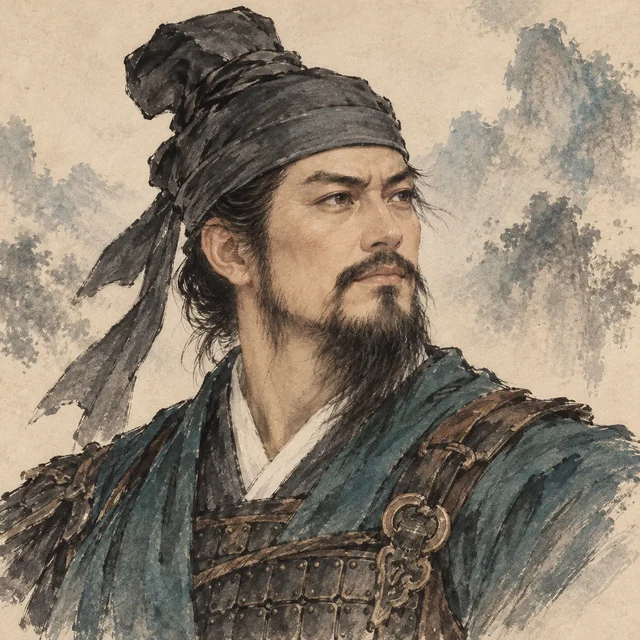
Gan Ning joined Sun Quan after earlier service in the region. At Ruxu he led a night raid on Cao Cao’s camp with a small picked force.
This entry is supported by historical references, but does not yet have a conversation profile.
PRIMARY BIOGRAPHY
Biography
Gan Ning (d. c. 220), courtesy name Xingba, was a Linjiang man who led a river band in youth — boats hung with bells announced his coming, earning the nickname “the bell pirate.” Passed over by Liu Biao and Huang Zu (killing the Wu general Ling Cao in Huang’s service), he crossed to Sun Quan on Zhou Yu’s and Lü Meng’s recommendation and was treated as a veteran.
He proposed striking Huang Zu first, then advancing up the Yangzi toward Ba and Shu — the plan Sun Quan executed in 208. After Chibi he held Yiyang with Lu Su against Guan Yu: with only three hundred men he boasted, “give me five hundred more and Guan Yu won’t dare cross the water while he can hear me cough” — and Guan Yu indeed camped rather than cross, the spot thereafter called “Guan Yu’s Rapids.”
In 215 at Hefei he helped fight Sun Quan out of Zhang Liao’s encirclement. His most famous feat: leading a hundred picked men in a night raid into Cao Cao’s great camp, killing scores and returning unharmed while the northern army lit torches in panic. Sun Quan exulted: “Cao Cao has his Zhang Liao — I have my Xingba, more than a match for him.” He died soon after, mourned by Sun Quan.
Life and role
- Primary role
- General Who Breaks the Enemy
- Active period
- Late Eastern Han to Eastern Wu
- Primary group
- Jiangdong–Sun Wu
Affiliations across a lifetime
- ?–208
Liu Biao, then Huang Zu
Unvalued by Liu Biao and Huang Zu; killed Wu general Ling Cao; escaped east with Su Fei’s help
- 208–c. 220
Under Sun Quan
Administrator of Xiling; faced Guan Yu, raided Cao Cao’s camp with a hundred riders, saved Sun Quan at Hefei
HISTORICAL RECORD
Historical sources
- Records of the Three Kingdoms · Wu, Book 10 · 程黄韩蒋周陈董甘凌徐潘丁传 ↗
Chen Shou’s base text contains the biographies of Cheng Pu, Huang Gai, Han Dang, Jiang Qin, Zhou Tai, Chen Wu (with Chen Biao), Dong Xi, Gan Ning, Ling Tong, Xu Sheng, Pan Zhang, and Ding Feng. The concluding evaluation is separate from the biographies.