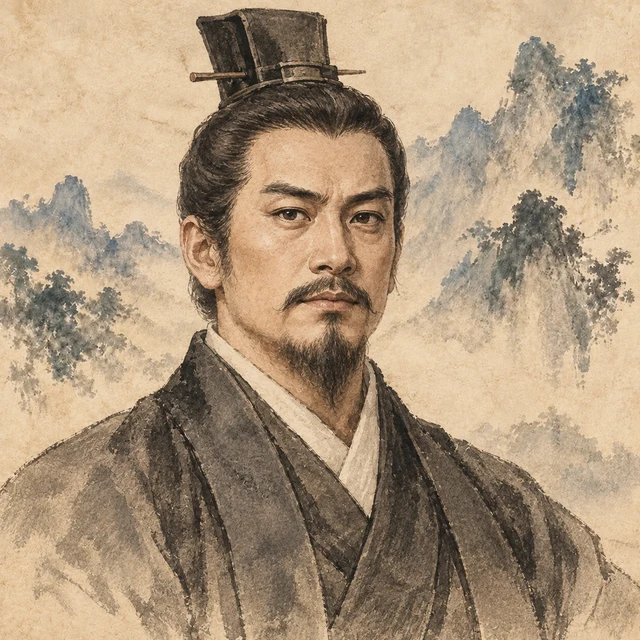
HISTORICAL PERSON
Gao Rou
高柔
A Yu man from Chenliu and cousin of Gao Gan; he headed the Court of Justice for over twenty years, occupied Cao Shuang’s camp for Sima Yi in the Gaoping Tombs coup, and rose to Grand Commandant.
This entry is supported by historical references, but does not yet have a conversation profile.
PRIMARY BIOGRAPHY
Biography
Gao Rou, styled Wenhui, was from Yu in Chenliu. When the Grand Ancestor had pacified the Yuan house he made Gao Rou chief of Guan, where his name was already so well known that several corrupt clerks resigned of themselves. Promoted to clerk of the bureau for investigating crime, he applied the law so justly that no case lingered in his courts, and he was brought into the chancellery as a granaries-bureau clerk. When the musicians Song Jin and others deserted at Hefei, the old law called for the wives and children of deserters to be tried to the death, and the Grand Ancestor, grieved that desertions continued, meant to make the penalty heavier still; Gao Rou remonstrated, “A soldier deserting the army is truly hateful, yet I have heard there are often those among them who repent. In my judgment their families should be spared — this plants distrust of them among the enemy, and gives the deserters a reason to return.” The Grand Ancestor approved, stopped the executions, and many lives were saved.
At the founding of the Wei kingdom he was a secretariat gentleman, then transferred to be law clerk of the chancellery, with an instruction: “In the transformation of settled government, ritual comes first; in the administration of a disordered age, punishment comes first. This clerk is clear of discernment, balanced and just, versed in the statutes — apply yourself to mercy.” At Emperor Wen’s accession he became clerk attending to the law with the rank of marquis within the passes, and in Huangchu 4 rose to commandant of justice. Under Emperor Ming he was enfeoffed marquis of Yanshou precinct. The hunting laws were then severe: Liu Gui, director of agriculture at Yiyang, had poached a rabbit within the park, and his merit clerk Zhang Jing denounced him to the inspectors; the emperor concealed the informer’s name and jailed Liu Gui, and when Gao Rou memorialized for the accuser’s name, the emperor raged, “Liu Gui deserves death for hunting in my preserve — I sent him to the commandant of justice to be examined, why must he ask the informer’s name? Do I arrest men on whim?” Gao Rou answered, “The commandant of justice is the balance of the realm — how can the law be broken to a sovereign’s pleasure or anger?” He memorialized again, with words deep and cutting, until the emperor relented, gave up Zhang Jing’s name, and returned the case to trial, each party receiving his due.
He served as commandant of justice for twenty-three years, then became grand master of ceremonies, rose within ten days to minister of works, and later moved to minister over the masses. When the grand tutor Sima Yi memorialized the dismissal of Cao Shuang, the empress dowager’s edict called on Gao Rou to bear the credentials and act as general-in-chief, seizing Cao Shuang’s camp, and Sima Yi said to him, “You are our Zhou Bo.” After Cao Shuang’s destruction Gao Rou was advanced to marquis of Wansui district; at the Duke of Gaogui District’s accession he was advanced to marquis of Anguo and transferred to grand commandant; at the Duke of Changdao District’s accession his fief rose to four thousand households in all, and two of his sons were enfeoffed marquises of precincts. He died in Jingyuan 4 at the age of ninety, with the posthumous name Yuan.
Life and role
- Primary role
- Cao Wei official
- Active period
- Documented coverage: late Han through Cao Wei
- Primary group
- Cao-Wei
Affiliations across a lifetime
- Huangchu–Zhengshi eras
Twenty-three years as commandant of justice
Spared the deserters’ families, and against the emperor’s anger demanded the informer’s name in Liu Gui’s case — “the commandant of justice is the balance of the realm”
- Jiaping 1 (249)
Seized Cao Shuang’s camp
Acted as general-in-chief in the coup at the Gaoping tombs — Sima Yi called him “our Zhou Bo”; served four reigns and died at ninety
HISTORICAL RECORD
Historical sources
- Records of the Three Kingdoms · Wei, Book 24 · 韩崔高孙王传 ↗
Chen Shou’s base text contains the biographies of Han Ji, Cui Lin, Gao Rou, Sun Li, and Wang Guan. The concluding evaluation is separate from the biographies.