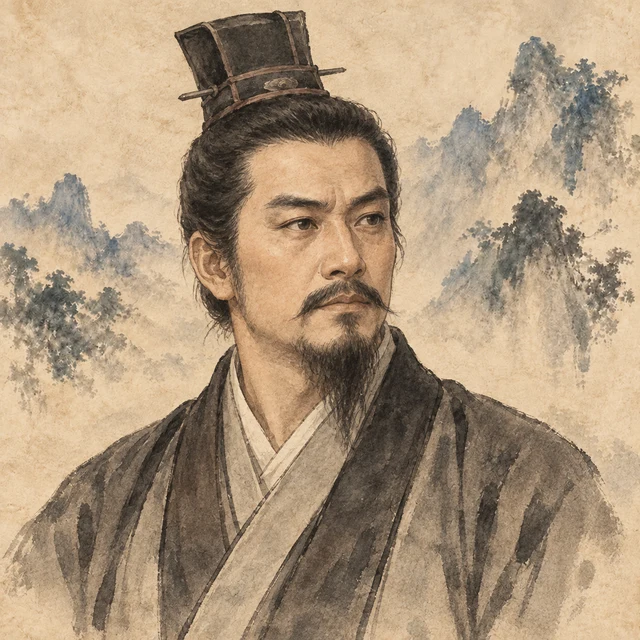
HISTORICAL PERSON
Gaotang Long
高堂隆
A Pingyang man from Taishan descended from Gaotang Sheng; as Superintendent of the Imperial Household he repeatedly protested Emperor Ming’s lavish palace works.
This entry is supported by historical references, but does not yet have a conversation profile.
PRIMARY BIOGRAPHY
Biography
Gaotang Long, styled Shengping, came from Pingyang in Taishan, a descendant of Master Gaotang of Lu. In youth a student, he was made investigating clerk by the Taishan administrator Xue Ti. When the commandery’s army supervisor quarrelled with Xue Ti and addressed him by his personal name with abuse, Gaotang Long put hand to sword and rebuked the man: “When Duke Ding of Lu was insulted, Confucius mounted the steps; when the King of Zhao was made to play the se, Lin Xiangru pressed the fou on the King of Qin. For a servant to speak his lord’s personal name is what right condemns.” The supervisor lost colour and Xue Ti rose in alarm to stop him. Gaotang Long later left office and took refuge in Jinan.
In 213 the Grand Progenitor summoned him as a consulting clerk of the chancellery; he later became letters tutor to the Marquis of Licheng, Cao Hui, and then his chancellor. When Cao Hui, on the Grand Progenitor’s death, did not mourn but rode out hunting and galloping, Gaotang Long remonstrated uprightly by right — he had the true quality of a guide and mentor. In the Huangchu era he was chief of Tangyang, then chosen tutor to the Prince of Pingyuan. When the prince took the throne — Emperor Ming — Gaotang Long was made steward, erudite, and commandant-escort. At the fresh accession some ministers proposed a celebratory feast; Gaotang Long said, “Yao and Shun had the mourning of stilled music, the High Ancestor of Yin the thought that does not speak — thus their utmost virtue shone to the four seas”, and held a feast improper; the emperor respectfully accepted it. Transferred as administrator of Chenliu, he recommended as accounting clerk a commoner of seventy-odd named You Mu, a man of utmost conduct; the emperor praised this and specially made him a gentleman to mark it. Gaotang Long was called in as attendant cavalier and enfeoffed Marquis within the Passes.
In the Qinglong era, when great works were raised on the palaces and the great bells of Chang’an were fetched west, Gaotang Long sent up memorial after memorial of sharp remonstrance — against the palaces’ waste and the warnings written in the portents of heaven — his words piercing to the utmost. He rose to palace attendant while still holding the office of Grand Astrologer. When the Chonghua hall burned and the edict asked what fault it showed and whether rites of expiation were due, he answered that portents are sent to make teaching and warning plain, and only following rite and mending virtue can overcome them. When his illness lay heavy on him he dictated a memorial from his bed, urging the emperor to dismiss the perverse and honour the upright, to guard against eaglet ministers within the very walls, and to spare the palace works. The memorial was presented — and he died. His orders were for a plain burial, in the clothes of the season. An erudite by his classics, famous for straight speech in Emperor Ming’s court, his dying memorial was counted by the men of Wei as proof he had read the signs of the times.
Life and role
- Primary role
- Cao Wei official
- Active period
- Documented coverage: late Han through Cao Wei
- Primary group
- Cao-Wei
Affiliations across a lifetime
- in youth
Hand on sword for his lord’s name
Citing Confucius and Lin Xiangru, he faced down the supervisor who had abused his administrator by name
- 213–226
Chancellor to Cao Hui, tutor to the future emperor
Remonstrated with Cao Hui for hunting in mourning; at Ming’s accession his word stopped the celebratory feast
- 233–237
Against the palaces; the dying memorial
Memorial after memorial against the palace works; from his deathbed a dictated warning against “eaglet ministers within the walls” — presented, and he died
HISTORICAL RECORD
Historical sources
- Records of the Three Kingdoms · Wei, Book 25 · 辛毗杨阜高堂隆传 ↗
Chen Shou’s base text contains the biographies of Xin Pi, Yang Fu, and Gaotang Long (with Zhan Qian). The page also carries Pei Songzhi’s annotations, which should be identified separately.