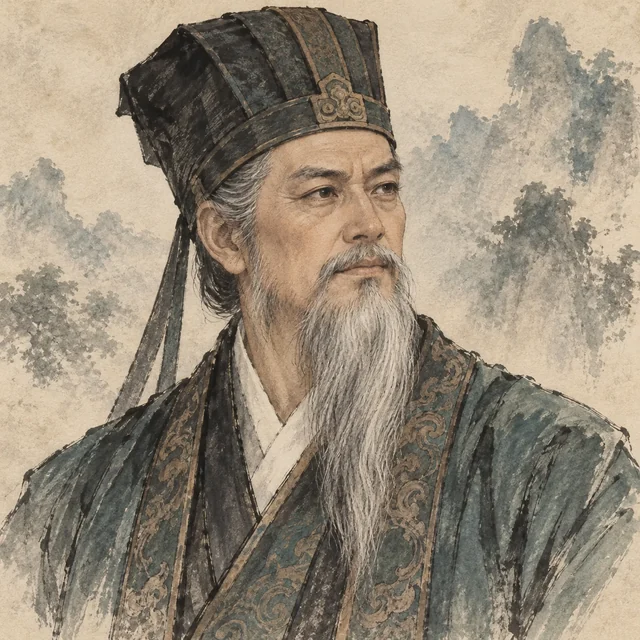
HISTORICAL PERSON
Gu Yong
顾雍
Gu Yong governed commanderies before becoming Sun Quan’s chancellor. He was known for measured speech, careful personnel choices, and private, practical counsel.
This entry is supported by historical references, but does not yet have a conversation profile.
PRIMARY BIOGRAPHY
Biography
Gu Yong, styled Yuantan, came from Wu county in Wu commandery. When Cai Yong had returned from exile and was sheltering from enemies in Wu, Gu Yong studied the zither and letters under him. Devoted, quiet, quick and easy to teach, he was so prized that Cai Yong told him, “You will surely rise high — I give you my own name”; hence Gu Yong bore a name homophonous with his master’s. Barely capped, he served as chief of Hefei, then of Lou, Qu’a and Shangyu, leaving a record of good order in each.
When Sun Quan held the governorship of Kuaiji without residing there, Gu Yong served as his deputy and discharged the governor’s duties: he cleared out bandits, calmed the borders, and clerks and people gave their allegiance. Some years later he entered as major of the left. When Sun Quan became King of Wu, Gu Yong rose through the court of justice and the masters of ritual to direct the Masters of Writing, and was enfeoffed Marquis of Yangsui precinct — a patent his own family only learned of after he came home. In 225 his mother was brought to Wu; Sun Quan attended in person to felicitate her, bowing to her in the courtyard before the assembled ministers, and the crown prince later called to congratulate her. He then succeeded Sun Shao as Chancellor, supervising the Masters of Writing.
Gu Yong did not drink and spoke little, but every move was timely; Sun Quan sighed, “Lord Gu does not speak — but when he speaks, he hits the mark.” At feasts the courtiers feared their drink-follies would meet his eye, and so dared not give themselves licence. He appointed civil and military officers each according to ability, without favour or aversion. He constantly sent out to gather word of the people and the fitness of policies, reporting in secret; if his advice was taken he ascribed the credit to his sovereign, and if not, he never let it leak. He died in 243 at seventy-six, posthumously the Grave Marquis, after nineteen years as chancellor — and the people of Wu praised him.
Life and role
- Primary role
- Chancellor
- Active period
- Late Han and Eastern Wu (190s–250s)
- Primary group
- Jiangdong–Sun Wu
Affiliations across a lifetime
- early years
Pupil of Cai Yong
Studied under Cai Yong, who gave him his own name; governed four counties with distinction
- 221–225
Prefect of the Masters of Writing
Directed the secretariat and was enfeoffed without even his family knowing
- 225–243
Chancellor
“When he speaks, he hits the mark”; gave his sovereign the credit, chancellor nineteen years
HISTORICAL RECORD
Historical sources
- Records of the Three Kingdoms · Wu, Book 7 · 张顾诸葛步传 ↗
Chen Shou’s base text: Zhang Zhao’s nephew Fen, who designed a siege engine at age twenty, later served as a Wu general, and was appointed commander of Pingzhou; other biographies and annotations are outside this locator.