HISTORICAL PERSON
Guan Lu
管辂
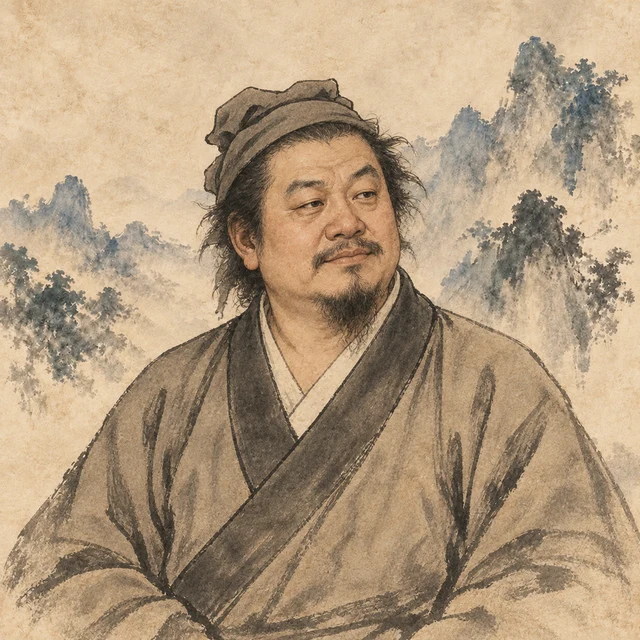
Known for expertise in the Book of Changes, astronomy, and divination, Guan Lu served Wei; Chen Shou included his learning and sayings in the biographies of technical arts.
This entry is supported by historical references, but does not yet have a conversation profile.
PRIMARY BIOGRAPHY
Biography
Guan Lu, styled Gongming, was a man of Pingyuan. Coarse of feature and without any dignified bearing, fond of wine, eating and joking with anyone at all, high or low — so that most men liked him but none stood in awe of him. His father was the transport officer at Licao, where three brothers of the Guo family all suffered crippled legs; they had Guan Lu divine the cause. He said: “In the hexagram there is your own ancestral tomb, and in the tomb a female ghost — not your father’s elder brother’s wife but his younger brother’s. In the famine years there was one who coveted her few pints of rice, pushed her into the well — a clucking sound — and rolled a great stone down that broke her head. The lonely soul in its wrong and pain has complained to Heaven.” Whereupon Guo En wept and confessed his guilt.
In Guangping the wife of Liu Fenglin lay sick to death and her coffin had already been bought — it was the first month — when Guan Lu was had to divine. He said: “Her fate ends on the day Xinmao of the eighth month, at noon.” Liu thought it surely wrong; the woman slowly mended, and when autumn came the sickness stirred — exactly as Guan Lu had said. Visiting the Anping administrator Wang Ji, he was asked to cast a hexagram and said: “A lowly woman shall bear a boy-child who, the moment he touches ground, runs into the stove and dies; upon the bed a great serpent shall appear with a brush in its mouth, seen by great and small, and in a moment be gone; and a crow shall enter the room and fight with a swallow until the swallow dies and the crow departs — three portents.” Wang Ji, greatly alarmed, asked the fortune of it. Guan Lu said: “The office is merely old, and goblins make the show. That the new-born ran — no child can run — is the demon Song Wuji drawing him to the stove. The serpent with the brush is your old clerk of documents. The crow fighting the swallow is your old bellman. The hexagram shows images but no ill omen — these are not marks of calamity, so there is nothing to fear.” And in the end nothing came of it. When Wang Jing of Qinghe left office and came home, he met Guan Lu and said: “Lately there was a strange thing that much displeased me — pray cast a hexagram on it.” When it was cast, Guan Lu said: “The lines are lucky — it is no monster. By night before your hall door a streaming light like a swallow came into your breast with a humming sound; your inward spirit was unquiet, you loosed your robe and wandered, calling to the women, seeking the last of the light.” Wang Jing laughed aloud: “It is exactly as you say.” Guan Lu said: “Lucky — the sign of a transfer of office; the answer will come at once.” Soon Wang Jing was made administrator of Jiangxia.
Going west with the army, he passed the grave of Guanqiu Jian, leaned on a tree and chanted mournfully, low in spirits. Asked why, he said: “Though the woods are lush, no form can last; though the stele’s praise is fine, no posterity will keep it. The Dark Warrior hides his head, the Green Dragon lacks feet, the White Tiger holds a corpse in its mouth, the Vermilion Bird weeps — the four perils all present. By rule, the clan shall be destroyed. In no more than two years the answer comes.” It came as he said. When his younger brother Guan Chen asked him of his own fate, Guan Lu said of himself: “On my brow there is no bone of life, in my eyes no holding essence, my nose lacks beam and pillar, my feet the root of heaven, my back the three jias, my belly the three rens — all signs that I am not for long life. Moreover my birth-year is in Yin and I was born on a night of a lunar eclipse. Heaven has its constant numbers which cannot be gainsaid — only men do not know them. Of those I have physiognomised as fated to die there have been over a hundred, and I was scarcely ever wrong.” In 255 he was made assistant to the Privy Treasurer, and in the second month of the next year he died, aged forty-eight.
Life and role
- Primary role
- Assistant Director of the Imperial Observatory
- Active period
- Documented coverage: Late Han and Cao Wei (c. 210–256)
- Primary group
- Cao-Wei
Affiliations across a lifetime
- early years
The hexagrams never missed
The ghost in Guo En’s well, the day and hour of Liu’s wife’s death, the reading of Wang Ji’s three portents — every cast answered
- about 255
The chant at Guanqiu Jian’s grave
Reading the grave’s four perils he foretold the clan’s destruction within two years — and it came as he said
HISTORICAL RECORD
Historical sources
- Records of the Three Kingdoms · Wei, Book 29 · 方技传 ↗
Chen Shou’s base text contains the biographies of Hua Tuo, Du Kui, Zhu Jianping, Zhou Xuan, and Guan Lu. Ma Jun appears in a Pei Songzhi annotation under Du Kui, which quotes a preface by Fu Xuan; he is not a separate biography in Chen Shou’s base text. The concluding evaluation is separate from the biographies.