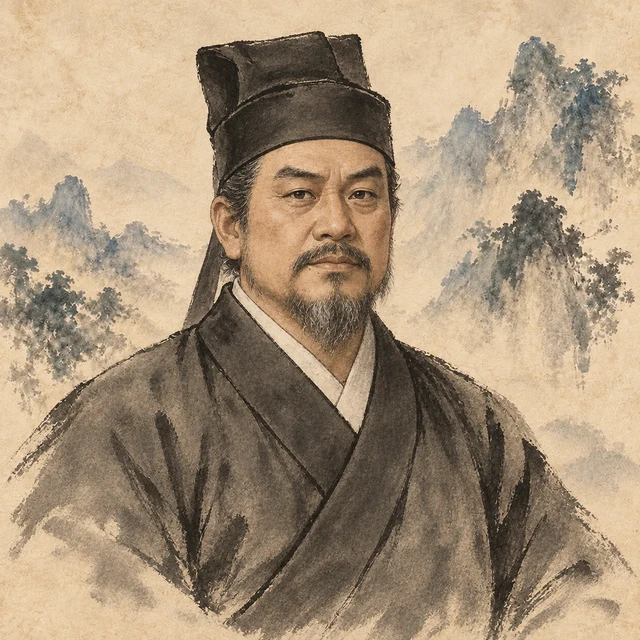
HISTORICAL PERSON
Guo Yuan
国渊
A former student of Zheng Xuan who managed agricultural settlements; after a rebellion, he argued against executing those who were not its leaders.
This entry is supported by historical references, but does not yet have a conversation profile.
PRIMARY BIOGRAPHY
Biography
Guo Yuan, styled Zini, was from Gai in Le’an. He studied under Zheng Xuan, and later fled the disorders to Liaodong with Bing Yuan, Guan Ning, and others. When he returned to his native soil, the Grand Ancestor enlisted him as a clerk of the ministry of works; in debate at court he always spoke plainly with a grave countenance, and kept no private dealings outside it.
The Grand Ancestor wished to plant garrison farms on a broad scale and put Guo Yuan in charge of the work. Guo Yuan repeatedly set out what helped and what harmed: he matched the land to the people, fixed the officers by the count of the people, and made plain the method of assessing merit, so that within five years the granaries were full and the people vied in encouraging one another to their work. When the Grand Ancestor campaigned in Guanzhong, Guo Yuan was made senior clerk of the office left behind, directing its affairs. When Tian Yin and Su Bo rebelled in Hejian and were broken, their remaining partisans were all liable to execution; Guo Yuan held that they were not the ringleaders and begged that the penalty not be carried out, and the Grand Ancestor agreed — more than a thousand owed their lives to Guo Yuan. It was the old practice in reports of victories over bandits to set down one as ten, but when Guo Yuan reported his heads taken, he gave the true number. The Grand Ancestor asked why, and Guo Yuan said, “In chastising an external foe, to multiply the count of the slain is to magnify the martial work and show it to the people’s ears. But Hejian lies within the borders of the realm, and though there is merit in crushing Tian Yin’s rebellion, your servant is privately ashamed of it.” The Grand Ancestor was greatly pleased and promoted him to administrator of Wei commandery.
There was then a man who threw in a letter of slander, and the Grand Ancestor, hating it, was determined to know its author. Guo Yuan asked to keep the original letter and not make it public. The letter quoted much from the Rhapsodies on the Two Capitals, so Guo Yuan instructed his merit clerk: “This commandery is large, and here we stand in the capital district, yet men of learning are few. Choose some quick-witted young men to send to a teacher.” Three were chosen, and at their dismissal audience he instructed them: “What you have studied does not yet reach the Rhapsodies on the Two Capitals — a book wide in its knowledge of things that the age has neglected and few can teach. You should find one who can read it and learn from him” — and privately he made his meaning known. Within ten days a man who could read it was found; the young men went to study under him, and the clerk then asked the teacher to write a note for them. Comparing its hand with the letter, they were by the same hand; the man was arrested and examined, and the whole truth was obtained. He was promoted to grand coachman. At the rank of the nine ministers he wore plain cloth and ate simple fare, scattering his salary and gifts among his old acquaintance and his clan, keeping himself in reverent frugality, and died in office.
Life and role
- Primary role
- Tuntian administrator
- Active period
- Documented coverage: late Han through Cao Wei
- Primary group
- Cao-Wei
Affiliations across a lifetime
- Jian’an era
Director of the garrison farms
Matched land to people and officers to population, and in five years the granaries were full
- as administrator of Wei
The Two Capitals rhapsodies unmask a slanderer
Sent young men to study under the only man who could read the rhapsodies, then matched his handwriting to the slanderous letter
HISTORICAL RECORD
Historical sources
- Records of the Three Kingdoms · Wei, Book 11 · 袁张凉国田王邴管传 ↗
Chen Shou’s base text contains the biographies of Yuan Huan, Zhang Fan (including the account of his brother Zhang Cheng), Liang Mao, Guo Yuan, Tian Chou, Wang Xiu (with Wang Pou), Bing Yuan, and Guan Ning (with the attached accounts of Wang Lie, Zhang Jian, and Hu Zhao). The concluding evaluation is separate from the biographies.