HISTORICAL PERSON
Han Dang
韩当
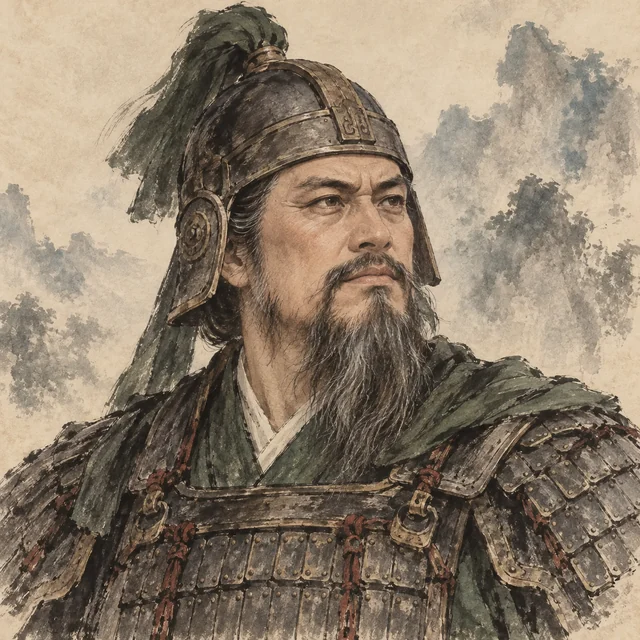
Han Dang followed Sun Jian in campaigns, later served Sun Ce and Sun Quan, and fought in the campaigns against Jiangxia and at Red Cliffs.
This entry is supported by historical references, but does not yet have a conversation profile.
PRIMARY BIOGRAPHY
Biography
Han Dang (d. c. 226), courtesy name Yigong, of Liaoxi, was a horseman and archer of prodigious strength who served Sun Jian through every danger as a separate-command major, then crossed the Yangzi with Sun Ce as a first-over-the-wall colonel with two thousand men.
He fought at Chibi under Zhou Yu, took Nan commandery with Lü Meng, and at the battle of the Zhuoxiang in 222 broke the Shu army with Lu Xun and Zhu Ran. When Cao Zhen besieged Jiangling the next year, Han Dang held the southeastern sector. Marquis of Shicheng and General of Shining Martiality, he crushed the Danyang bandits with ten thousand “dare-to-die” troops and died in office.
His son Han Zong inherited his troops, then — debauched and fearing punishment — carried his father’s coffin and his whole household, several thousand people, over to Wei, to Wu’s lasting shame.
Life and role
- Primary role
- General Who Displays Martial Valour
- Active period
- Late Eastern Han to Eastern Wu
- Primary group
- Jiangdong–Sun Wu
Affiliations across a lifetime
- 184–200
Sun Jian and Sun Ce
Three-generation veteran; first-over-the-wall colonel in the crossing of the Yangzi
- 208–226
Chibi to Yiling
Fought at Chibi, Yiling, and against Cao Zhen; his son later defected to Wei
HISTORICAL RECORD
Historical sources
- Records of the Three Kingdoms · Wei, Book 18 · Biographies of the Two Lis, Zang, Wen, Lü, Xu, Dian, Two Pangs, and Yan ↗
Chen Shou’s base text: biographies of Li Dian, Li Tong, Zang Ba (including Sun Guan), Wen Pin, Lü Qian (including Wang Xiang), Xu Chu, Dian Wei, Pang De, Pang Yu (including his mother Zhao E), and Yan Wen (including Zhang Gong). Pei Songzhi’s annotations are separately registered.
- Records of the Three Kingdoms · Wu, Book 10 · 程黄韩蒋周陈董甘凌徐潘丁传 ↗
Chen Shou’s base text contains the biographies of Cheng Pu, Huang Gai, Han Dang, Jiang Qin, Zhou Tai, Chen Wu (with Chen Biao), Dong Xi, Gan Ning, Ling Tong, Xu Sheng, Pan Zhang, and Ding Feng. The concluding evaluation is separate from the biographies.