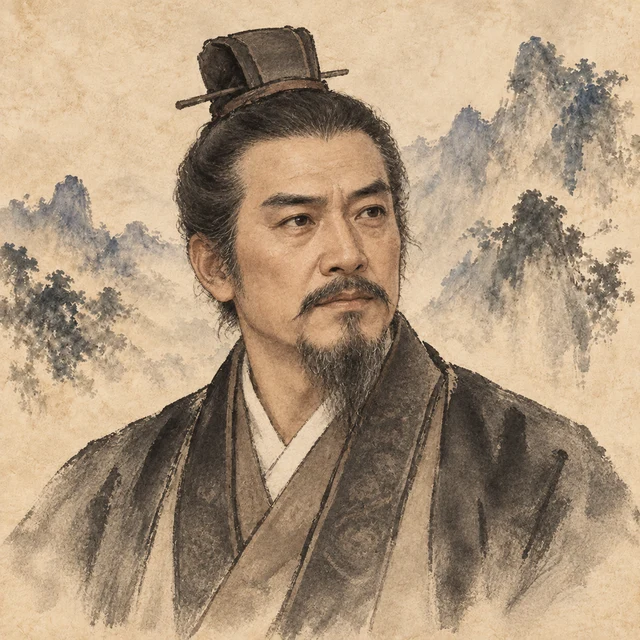
HISTORICAL PERSON
Han Ji
韩暨
A Duyang man from Nanyang who hid from Liu Biao in the mountains; in Wei he served as Director of Metallurgy, replacing horse-powered bellows with water-powered ones, and rose to Minister over the Masses.
This entry is supported by historical references, but does not yet have a conversation profile.
PRIMARY BIOGRAPHY
Biography
Han Ji, styled Gongzhi, was from Duyang in Nanyang. The powerful county man Chen Mao had slandered Han Ji’s father and brother nearly to capital punishment. Han Ji showed no resentment outwardly, but hired himself out to amass funds and secretly bound desperate men to him, then hunted Chen Mao down and took his head to offer at his father’s grave — and so his name was made. Recommended as filially pious and incorrupt and summoned by the minister of works, he declined all, changed his name, and lived hidden in the Luyang hills. When the hill folk banded together as bandits meaning to plunder, he scattered his family wealth on oxen and wine, invited their leaders, and laid out the safety and peril of it, and the hill folk were transformed and never did harm. Fleeing Yuan Shu’s summons he moved to the hills of Shandu; when the governor of Jingzhou Liu Biao invited him with ceremony he fled again and dwelt south in the borders of Chanling, beloved and honored wherever he went — but Liu Biao hated him deeply, and fearing this, Han Ji accepted the summons and was made prefect of Yicheng.
When the Grand Ancestor pacified Jingzhou he enlisted Han Ji as a clerk of the soldiers bureau, then chose him as administrator of Leling, and transferred him to be interlocutor overseeing the foundries. The old practice smelted with horse-powered bellows, a hundred horses to each charge of ore, and man-powered bellows wasted labor in turn; Han Ji used the long-flowing streams to drive water bellows, reckoned three times the former gain. Seven years in office left the arsenals full, an edict praised him, and he was made commandant of the metal-working office, ranked just below the nine ministers. At Emperor Wen’s accession he was enfeoffed marquis of Yicheng precinct, and in Huangchu 7 rose to grand master of ceremonies, advanced to marquis of Nanxiang precinct with two hundred households.
The new capital Luoyang was then not yet fully ordered, and the spirit tablets of the ancestral temple were all still at Ye; Han Ji memorialized to bring the tablets of the four temples from Ye and establish the Luoyang temple, and at the seasonal sacrifices he personally offered the grain — exalting the correct rites, abolishing licentious cults, and setting much to rights. After eight years in office he retired for illness. In the spring of Jingchu 2 an edict said, “The grand counsellor of the palace Han Ji has bathed himself in virtue, his will and integrity are high and pure, he is past eighty and holds the Way ever more firmly — truly pure and sincere, the more venerable with age. Let Han Ji be minister over the masses.” He died in the summer of that year, leaving instructions that he be encoffined in the dress of the season and buried in an earthen grave. His posthumous name was Gong.
Life and role
- Primary role
- Cao Wei official
- Active period
- Documented coverage: late Han through Cao Wei
- Primary group
- Cao-Wei
Affiliations across a lifetime
- Jian’an era
Interlocutor of the foundries — the water bellows
Drove the smelting bellows by water power, tripling the yield, and filled the arsenals in seven years
- Jingchu 2 (238)
Minister over the masses
Made minister over the masses past eighty, praised by edict for holding ever firmer to the Way; left orders for a plain burial
HISTORICAL RECORD
Historical sources
- Records of the Three Kingdoms · Wei, Book 24 · 韩崔高孙王传 ↗
Chen Shou’s base text contains the biographies of Han Ji, Cui Lin, Gao Rou, Sun Li, and Wang Guan. The concluding evaluation is separate from the biographies.