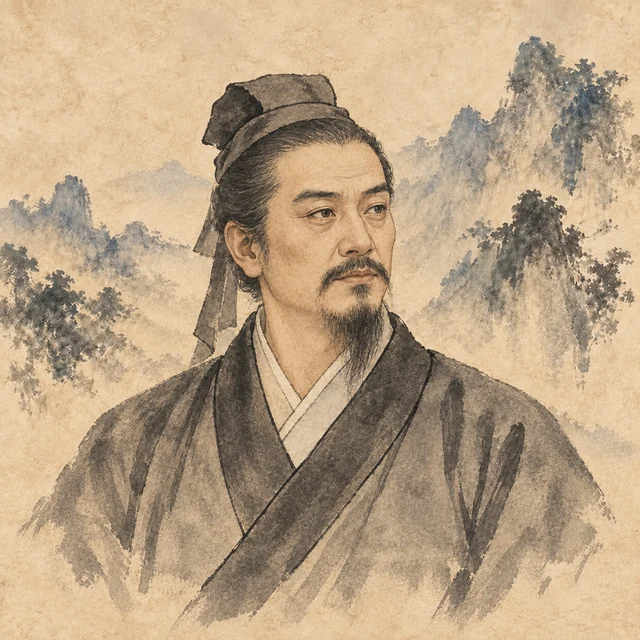
HISTORICAL PERSON
Handan Chun
邯郸淳
The text names Handan Chun among the literary figures attached to Wang Can’s account.; Wei Lue identifies Handan Chun as also called Zhu, courtesy name Zishu, and records his move to Jingzhou, summons by Cao Cao, and appointment as a court academic.
This entry is supported by historical references, but does not yet have a conversation profile.
PRIMARY BIOGRAPHY
Biography
Handan Chun, also named Zhu, styled Zishu, was from Yingchuan. Broadly learned and richly talented, he was also a master of the Cangjie and Erya glossaries and of seal and insect scripts and Xu Shen’s analysis of characters. In the Chuping years he went from the three adjuncts as a sojourner in Jingzhou; when Jingzhou submitted to the dynasty, the Grand Ancestor, who had long heard his name, summoned him to audience and held him in deep honor.
At that time the general of the gentlemen of the household was gathering brilliant scholars about him and, having long heard Handan Chun’s name, petitioned to have him among his literary officers; but it happened that the Marquis of Linzi Cao Zhi also asked for him, and the Grand Ancestor sent Handan Chun to Cao Zhi. Cao Zhi, delighted to have him, discoursed with him on the origins of primal chaos and creation, on the principles that distinguish the myriad things, on the relative merits of sages, worthies, famous ministers, and ardent martyrs since Fuxi, recited the fu and dirges of ancient and modern letters and the order of priorities in official governance, and disputed the dispositions of war and the uses of ambush. When Handan Chun returned home he sighed to his intimates over Cao Zhi’s genius and called him a man of heaven.
At Emperor Wen’s accession Handan Chun was made erudit gentleman within the palace. He composed a Fu on Pitch-pot in more than a thousand words and presented it; the emperor judged it masterly and bestowed a thousand bolts of silk.
Life and role
- Primary role
- Scholar and writer
- Active period
- Documented coverage: late Han through Cao Wei
- Primary group
- Cao-Wei
Affiliations across a lifetime
- Jian’an era
Guest of the Marquis of Linzi
Disputed creation, letters, and the art of war with Cao Zhi, and went home calling him a man of heaven
- Huangchu era
Erudit gentleman within the palace
Master of the ancient scripts and glossaries; his thousand-word Fu on Pitch-pot earned a thousand bolts of silk
HISTORICAL RECORD
Historical sources
- Records of the Three Kingdoms · Wei, Book 21 · 王卫二刘傅传 ↗
Chen Shou’s base text contains the biographies of Wang Can (with attached biographies of Xu Gan, Chen Lin, Ruan Yu, Ying Yang, Liu Zhen, Handan Chun, Fan Qin, Lu Cui, Ding Yi (丁仪), Ding Yi (丁廙), Yang Xiu, Xun Wei, Ying Qu, Ruan Ji, Ji Kang, and Wu Zhi), Wei Ji, Liu Yi, Liu Shao (with attached biographies of Miao Xi, Zhong Changtong, Su Lin, Xiahou Hui, Sun Gai, and Du Zhi), and Fu Gu. The Wei Dan material is in a Pei Songzhi annotation on Liu Shao’s biography, citing the Wenzhang Xulu; identify it as an annotation, not Chen Shou’s base text.
- Records of the Three Kingdoms, with Pei Songzhi annotations · Pei Songzhi annotations to Wei, Book 21 · Wang, Wei, Liu, and Fu biographies ↗
Embedded citations to Wei Lue, Wei Shu, Biographies of the Literary Men, and other works; attributed accounts are kept separate from Chen Shou’s base text.