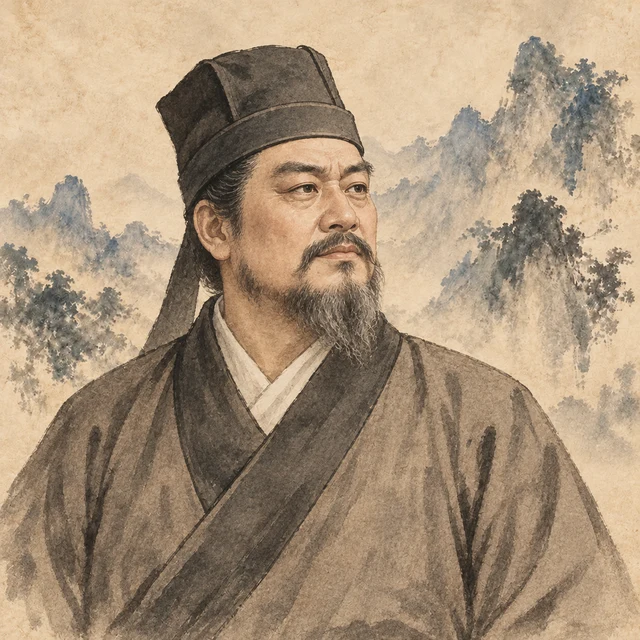
HISTORICAL PERSON
He Kui
何夔
An administrator who resisted Yuan Shu’s pressure and later governed commanderies; his local administration helped pacify unrest.
This entry is supported by historical references, but does not yet have a conversation profile.
PRIMARY BIOGRAPHY
Biography
He Kui, styled Shulong, was from Yangxia in Chen commandery. His great-grandfather He Xi had risen to general of chariots and cavalry under Emperor An of Han. Orphaned of his father young, he dwelt with his mother and elder brother and was known for filial piety and brotherly love. Fleeing the disorders to Huainan, he was summoned by Yuan Shu when Yuan Shu came to Shouchun; He Kui would not answer, but was detained nonetheless. Later, when Yuan Shu with Qiao Rui besieged Qiyang, which held firm for the Grand Ancestor, Yuan Shu, since He Kui was of that commandery, meant to coerce him into persuading the city. He Kui said to Yuan Shu’s counselor Li Ye, “Of old Liuxia Hui’s face clouded when he heard a plan to attack a state, saying, ‘I have heard one does not consult a humane man about attacking a state’ — why should such words come to me?” Whereupon he fled and hid in the Qian hills. Yuan Shu, knowing he would never serve him, let him be.
The Grand Ancestor enlisted him as a clerk of the ministry of works, then sent him out as prefect of Chengfu and promoted him to administrator of Changguang. The commandery bordered the hills and the sea, the Yellow Turbans were not yet pacified, and the local strong men were full of revolt. The bandit Cong Qian of Muping had several thousand men; He Kui led the commandery troops together with Zhang Liao and chastised them into submission. Wang Ying of Dongmou, with more than three thousand households, coerced Changyang county into disorder; He Kui sent his clerk Wang Qin and others with stratagems to scatter his followers, and within the space of a month all was settled. At that time the Grand Ancestor had first issued the new ordinances to the provinces and commanderies, with taxes in silk and floss; He Kui, judging that the commandery was newly established and fresh from the passage of armies and could not at once be held to the letter of the law, memorialized accordingly, and the Grand Ancestor followed his advice.
When Emperor Wen was heir apparent, Liang Mao was made his grand tutor and He Kui his junior tutor, and the two tutors were specially charged, together with the secretariat’s eastern bureau, with choosing the officers of the heir and the princes. When Liang Mao died, He Kui succeeded him as grand tutor. At Emperor Wen’s accession he was enfeoffed marquis of Chengyang precinct. Later he fell ill and repeatedly begged to retire; he died with the posthumous name Jing.
Life and role
- Primary role
- Cao Wei administrator
- Active period
- Documented coverage: late Han through Cao Wei
- Primary group
- Cao-Wei
Affiliations across a lifetime
- Jian’an era
Administrator of Changguang
Joined Zhang Liao against Cong Qian, scattered Wang Ying’s host by stratagem, and won relief from the new ordinances for a war-worn commandery
- Wei kingdom era
Grand tutor to the heir apparent
Co-tutor to the future Emperor Wen, charged with choosing the princes’ officers; posthumously named Jing
HISTORICAL RECORD
Historical sources
- Records of the Three Kingdoms · Wei, Book 12 · 崔毛徐何邢鲍司马传 ↗
Chen Shou’s base text contains the biographies of Cui Yan, Mao Jie, Xu Yi, He Kui (with his son He Zeng), Xing Yong, Bao Xun, and Sima Zhi (with his son Sima Qi). The accounts mention Yang Xun under Cui Yan; Guan Cheng, Wang Ying, and Guo Zu under He Kui; Liu Yao under Bao Xun; and Liu Jie under Sima Zhi. Bao Xin’s extended account is in a Pei Songzhi annotation citing Wei Shu.