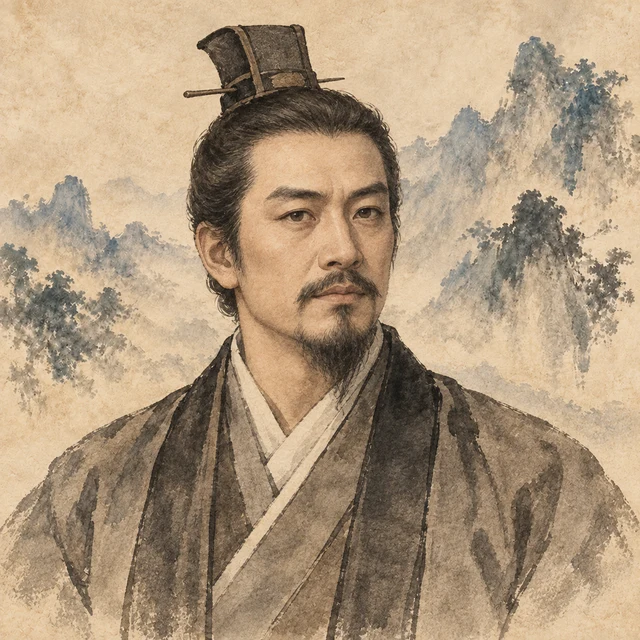
HISTORICAL PERSON
He Qia
和洽
A Xiping man from Runan who rose to Grand Master of Ceremonies in Wei; known for frugality and fairness in official selection.
This entry is supported by historical references, but does not yet have a conversation profile.
PRIMARY BIOGRAPHY
Biography
He Qia, styled Yangshi, came from Xiping in Runan. Recommended filial-and-incorrupt and summoned by the General-in-chief, he declined both. When Yuan Shao, in Ji province, sent envoys to invite the gentlemen of Runan, He Qia alone held that Ji province, a level land of strong folk, was a battleground of all comers — Yuan Benchu might grow mighty on his resources, but with heroes rising everywhere nothing was certain — while Liu Biao’s Jing province, ringed by hard country, was a place one could lean on; so he went south with his kin and old friends to Liu Biao, who treated him as an honoured guest. He Qia said: “My reason for refusing Benchu was to shun a contested land. But a benighted ruler cannot be pressed too near — long closeness grows perilous, for slander and malice are sure to slip between” — and he crossed on south to Wuling.
When the Grand Progenitor settled Jing province he engaged He Qia as a chancellery clerk. In those days Mao Jie and Cui Yan, serving with loyal purity, put frugality first in their selections. He Qia said: “The great vessel of the realm is office given to men — it cannot be ruled by the single measure of thrift. Frugality past the mean will do for ordering oneself; taken as the gauge of all things, much will be lost. Now the court’s talk calls an officer who wears new clothes or drives a good carriage impure, and one whose face goes unadorned and whose furs are tattered pure — until gentlemen deliberately foul their robes, hide their carriages and dress, and great officers of the court carry their own pot and bowl into the office. In establishing teaching and observing custom, the golden mean is prized because it can be kept up. Exalt one hard-to-bear line of conduct as the test of every road, and men will strain to it and end exhausted. The great teaching of antiquity lay simply in suiting human feeling; all strained and eccentric conduct leaves room for hidden falsehood.” When the state of Wei was founded he became palace attendant. Later, when someone accused Mao Jie of slandering the Grand Progenitor, who was greatly enraged, He Qia set out that Mao Jie’s conduct had always been grounded, and asked that the matter be examined for substance. The Grand Progenitor said: “My reason for not examining it is to preserve both Mao Jie and the informer.” He Qia answered: “If Mao Jie truly slandered his sovereign, he should be exposed in the market-place; if not, the informer has falsely accused a great minister and misled his sovereign’s hearing. To leave both unexamined — your servant cannot rest easy.” The Grand Progenitor said: “With the army in the field, how can I examine a matter on the strength of men’s words?”
When the Grand Progenitor conquered Zhang Lu, He Qia set out the advantage of withdrawing the army and moving the people in due season, saving the cost of a garrison. The Grand Progenitor did not take it up — and afterwards indeed moved the people and abandoned Hanzhong. At Emperor Wen’s accession He Qia was made Superintendent of the Imperial Household and enfeoffed Marquis of Ancheng precinct; under Emperor Ming he was advanced to Marquis of Xiling district. In the Taihe era, when Gaotang Long memorialised that the season’s winds failing meant some office had offended heaven’s constancy, and the edict took the blame and broadly consulted opinion, He Qia held that the people were worn out by labour service and husbandry had lapsed, that the art of dispelling portents lay above all in frugality, and that the present need was to cease wearying corvées and store up for war — for if plans are not settled in advance and a weak enemy is lightly held, armies march again and again to no use: what the ancients warned of as “delighting in arms without awe”. Transferred to Grand Master of Ceremonies, he was so poor, keeping to his frugality, that he sold fields and house to supply himself; Emperor Ming, hearing of it, granted him grain and silk. He died with the posthumous title Marquis Jian.
Life and role
- Primary role
- Cao Wei official
- Active period
- Documented coverage: late Han through Cao Wei
- Primary group
- Cao-Wei
Affiliations across a lifetime
- 190s
Choosing where to take refuge
Judged Yuan Shao’s ground contested and Liu Biao too dangerous to approach — moving from Runan to Jing to Wuling
- 208–217
Against the cult of frugality; for Mao Jie
Opposed making exaggerated thrift the test of office, and demanded the slander against Mao Jie be examined to its substance
- after 226
A Grand Master of Ceremonies in poverty
Argued frugality was the one cure and rest from corvée the realm’s need; so poor he sold his fields — the emperor sent grain and silk
HISTORICAL RECORD
Historical sources
- Records of the Three Kingdoms · Wei, Book 23 · 和常杨杜赵裴传 ↗
Chen Shou’s base text contains the biographies of He Qia, Chang Lin, Yang Jun, Du Xi, Zhao Yan, and Pei Qian. The page also carries Pei Songzhi’s annotations, which should be identified separately.