HISTORICAL PERSON
He Yan
何晏
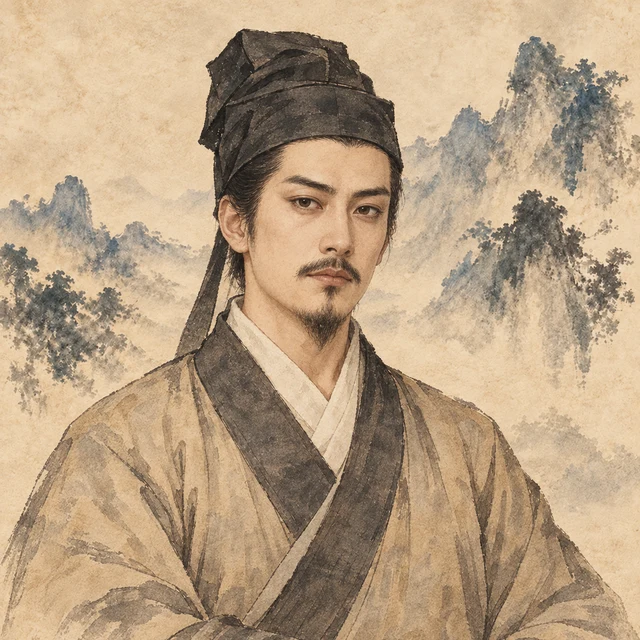
He Yan was known for writing on Daoist thought and held office under Cao Shuang before being executed after the 249 coup.
This entry is supported by historical references, but does not yet have a conversation profile.
PRIMARY BIOGRAPHY
Biography
He Yan, styled Pingshu, was a man of Nanyang and a grandson of the Han general-in-chief He Jin. His mother Lady Yin became a consort of the Grand Progenitor (Cao Cao); He Yan grew up in the palace, married a princess, and was famed from youth for brilliant talent. Loving the words of Laozi and Zhuangzi, he wrote the Discourse on the Way and its Power and dozens of essays and rhapsodies, opening with Wang Bi the xuanxue “dark learning” fashion of the Zhengshi era.
Early in the Zhengshi era, with Cao Shuang as regent, He Yan was made a Master of Writing in charge of appointments, and most of his old friends were promoted. Ruling with his faction, he divided up several hundred qing of the agricultural colonies’ mulberry fields at Luoyang and Yewang and seized bathing-estate lands as his own property, stole government stores by influence, and made demands as he pleased — provincial and commandery officers read the wind and none dared cross him. With the commandant of justice Lu Yu he had an old grudge: over a petty fault of Lu Yu’s clerk, He Yan strained the law to convict him, having the officer first seize Lu Yu’s seal and ribbons and only then reporting it — such was his usurped authority.
In 249 the grand tutor Sima Yi rose and destroyed Cao Shuang; He Yan and the rest were executed, their clans exterminated to the third degree. He Yan had married a princess of rare wisdom who told her mother, the dowager of Pei, “He Yan’s wickedness grows daily — how will he keep himself alive?” After his death his son of five or six was to be seized; his wife hid the boy in the princely palace and slapped her own cheeks before the envoys, begging that the child be allowed to live. The grand tutor, who had heard of her foresight and admired it, and for the Prince of Pei’s sake, specially pardoned the boy.
Life and role
- Primary role
- Court official and Daoist thinker
- Active period
- Late Han and Cao Wei (190s–240s)
- Primary group
- Cao-Wei
Affiliations across a lifetime
- Zhengshi era
Master of Writing over appointments
Cao Shuang’s partisan; seized colony lands and bent the law against rivals
- scholarship
The Zhengshi xuanxue
His Discourse on the Way and Power, with Wang Bi, founded Wei-Jin dark learning
- 249
The Gaoping purge
Executed with his clan when Sima Yi struck; his son spared through the princess’s foresight
HISTORICAL RECORD
Historical sources
- Records of the Three Kingdoms · Wei, Book 9 · Biographies of the Xiahou and Cao families ↗
Chen Shou’s base text: Xiahou Dun (with Han Hao and Shi Huan), Xiahou Yuan, Cao Ren (with Cao Chun), Cao Hong, Cao Xiu, Cao Zhen (with Cao Shuang, Deng Yang, and He Yan), and Xiahou Shang (with Xiahou Xuan, Xu Yun, and Wang Jing). The page also carries Pei Songzhi’s annotations, which should be identified separately.
- Records of the Three Kingdoms, with Pei Songzhi annotations · Pei Songzhi annotations to Wei, Book 9 · Xiahou and Cao biographies ↗
Annotations to the biographies of the Xiahou and Cao families, including Wei Lue and Shi Yu; attributed accounts remain distinct from Chen Shou’s base text.