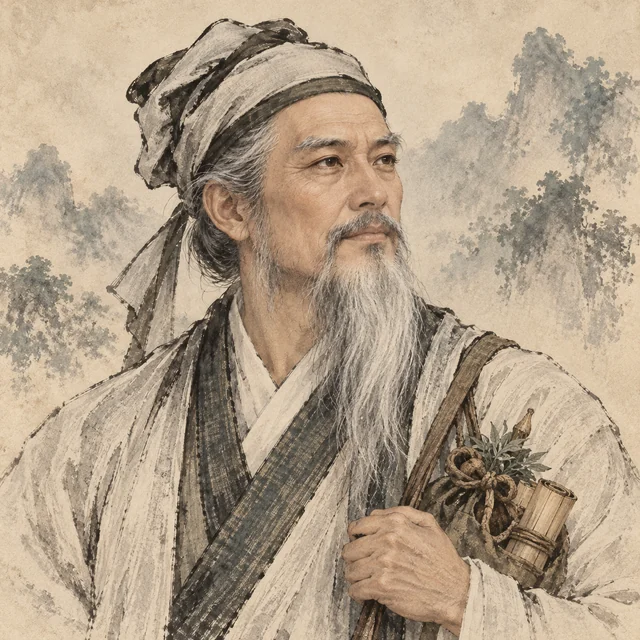
HISTORICAL PERSON
Hua Tuo
华佗
A physician skilled in acupuncture, medicine, and surgery, Hua Tuo is recorded using an anesthetic called mafeisan; he later died in prison after a dispute with Cao Cao over treatment.
This entry is supported by historical references, but does not yet have a conversation profile.
PRIMARY BIOGRAPHY
Biography
Hua Tuo (d. before 208), courtesy name Yuanhua, of Qiao in Pei, studied the classics in Xu yet refused nomination to office — Filially Incorrupt from the chancellor of Pei, summons from the Grand Commandant alike. He knew the arts of nurturing life, so that near a hundred he kept a vigorous look. His prescriptions held only a few ingredients, measured by eye, never weighed; his moxa touched a spot or two, his needles one or two. When disease lay beyond reach of needle and drug, he gave his numbing powder: the patient sank as if drunken dead, and he cut and removed what ailed them, or opened the bowel to wash it, sewed the belly, and salved it — painless, and whole within a month.
The clerks Ni Xun and Li Yan suffered the same headache and fever. “Ni Xun must be purged; Li Yan must sweat,” Hua Tuo said — “one’s fullness is outside, the other’s inside, so the treatment must differ.” Both rose next morning. Administrator Chen Deng lay flushed and faint; Hua Tuo felt his pulse: “Several pints of worms in your lordship’s stomach, from eating raw fish.” Two pints of decoction brought up three pints of red-headed worms, half-formed from fish paste. “This will recur in three years,” he warned; it did, and with Hua Tuo away, Chen Deng died just as foretold.
Cao Cao kept him at hand for his head-wind; one needle and the pain vanished. But Hua Tuo, a gentleman by training, regretted being classed a physician. Homesick, he claimed his wife was ill and would not return despite summons after summons. Cao Cao jailed him at Xu. Xun Yu pleaded: “His art is real; men’s lives hang on it — spare him.” Cao Cao answered, “Fear not — will the realm lack such vermin?” and had him executed. Dying, Hua Tuo offered the jailer a book: “This could save lives.” The jailer dared not take it; Hua Tuo burned it. When Cao Cao’s beloved son Cao Chong later lay dying, Cao Cao sighed: “I repent killing Hua Tuo — this boy dies for it.” To his disciple Wu Pu he taught the Five-Animal Frolic — tiger, deer, bear, ape, bird: “The body must be worked, just never to exhaustion; move, and grain-energy disperses, blood flows, sickness cannot lodge — a door hinge never rots.” Wu Pu practiced it and at ninety still saw sharply, heard clearly, and kept every tooth.
Life and role
- Primary role
- Physician
- Active period
- Documented coverage: Late Eastern Han (c. 145–208)
- Primary group
- Han court & warlords
Affiliations across a lifetime
- ?–Jian’an era
Wandering physician
Anesthetic surgery; foretold Chen Deng’s death to the year
- ?–before 208
Cao Cao’s physician
Cured Cao Cao’s head-wind with one needle; jailed and executed, his book burned
HISTORICAL RECORD
Historical sources
- Records of the Three Kingdoms · Wei, Book 29 · 方技传 ↗
Chen Shou’s base text contains the biographies of Hua Tuo, Du Kui, Zhu Jianping, Zhou Xuan, and Guan Lu. Ma Jun appears in a Pei Songzhi annotation under Du Kui, which quotes a preface by Fu Xuan; he is not a separate biography in Chen Shou’s base text. The concluding evaluation is separate from the biographies.