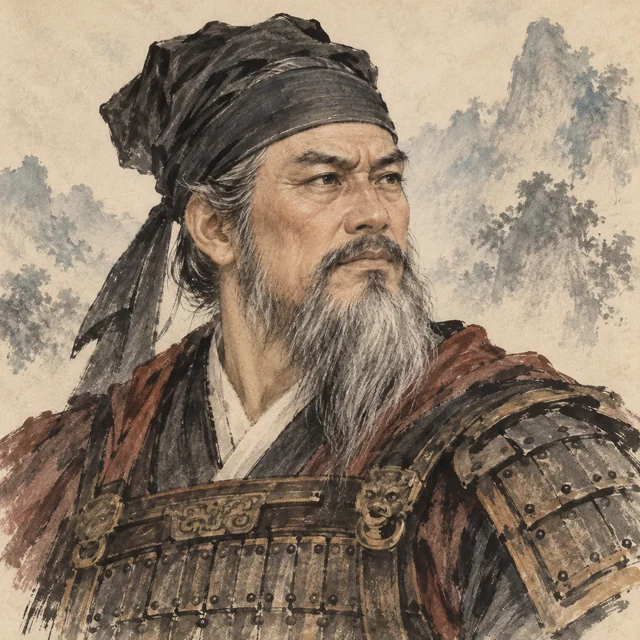
HISTORICAL PERSON
Huang Gai
黄盖
Huang Gai served three generations of the Sun family. At Red Cliffs, he proposed the fire attack and led the ships that set Cao Cao’s fleet alight.
This entry is supported by historical references, but does not yet have a conversation profile.
PRIMARY BIOGRAPHY
Biography
Huang Gai (d. after 210), courtesy name Gongfu, of Quanling in Lingling, followed Sun Jian from the first muster and served all three Sun rulers. Whenever a county rose in revolt, Huang Gai was sent in as prefect — nine counties in all, each pacified.
At Chibi in 208 it was Huang Gai who proposed the fire attack — “the enemy outnumbers us, but their ships are chained bow to stern: burn them and they flee” — and who led the false surrender: dozens of war-junks loaded with reeds and oil bore down on Cao Cao’s fleet under flags of surrender, then torched within two li of the northern line. Fire raced downwind into the shore camps; Cao Cao’s host burned and drowned. The victory at Chibi began with Huang Gai.
Struck by an arrow and dumped unidentified into the freezing river, he saved himself by shouting Han Dang’s name until recognized. As Administrator of Wuling he ended a tribal revolt within a season. He died in office, and the people of Wu painted his portrait and sacrificed to it. Chen Shou counted him among “the tiger ministers of Jiangdong.”
Life and role
- Primary role
- General of the Household
- Active period
- Late Eastern Han to Eastern Wu
- Primary group
- Jiangdong–Sun Wu
Affiliations across a lifetime
- 190–208
Three generations of the Sun
Veteran of Sun Jian, Ce, and Quan; pacified nine rebellious counties
- 208–c. 210
Chibi and Wuling
Author of the Chibi fire attack and its feigned surrender; later pacified Wuling
HISTORICAL RECORD
Historical sources
- Records of the Three Kingdoms · Wu, Book 10 · 程黄韩蒋周陈董甘凌徐潘丁传 ↗
Chen Shou’s base text contains the biographies of Cheng Pu, Huang Gai, Han Dang, Jiang Qin, Zhou Tai, Chen Wu (with Chen Biao), Dong Xi, Gan Ning, Ling Tong, Xu Sheng, Pan Zhang, and Ding Feng. The concluding evaluation is separate from the biographies.