HISTORICAL PERSON
Ji Kang
嵇康
The text describes Ji Kang’s writings, interests in Laozi and Zhuangzi, and execution during the Jingyuan era.; A Pei annotation citing the Ji family genealogy says Ji Kang’s wife was a daughter of Cao Lin (林).
This entry is supported by historical references, but does not yet have a conversation profile.
PRIMARY BIOGRAPHY
Biography
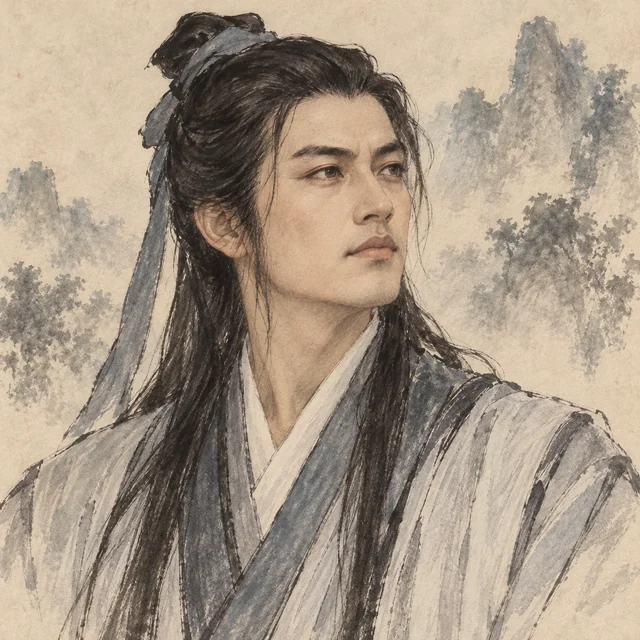
Ji Kang (223–262), styled Shuye, was a native of Zhi in Qiao commandery. His ancestors, surnamed Xi, had fled Shangyu in Kuaiji over a feud and taken their new surname from Mount Ji. Raised in a Confucian family, he stood seven chi eight cun tall, careless of adornment yet so commanding in bearing that contemporaries called him dragon-patterned and phoenix-mannered. Widely read and devoted in maturity to Laozi and Zhuangzi, he married the Princess Changleting, a great-granddaughter of Cao Cao, and served as Grand Master of Palace Leisure — hence the name Ji Zhongsan.
With Ruan Ji, Shan Tao, Xiang Xiu, Liu Ling, Wang Rong, and Ruan Xian he wandered the bamboo groves, and the age dubbed them the Seven Worthies of the Bamboo Grove. A gifted smith, he dammed a stream around a great willow by his house and forged iron beneath it in the summer months, Xiang Xiu working the bellows beside him. Zhong Hui, then in favor with Sima Zhao, came to call; Ji Kang kept forging and paid him no courtesy. As Zhong Hui left, Ji Kang asked: "What did you hear that made you come? What have you seen that makes you leave?" — "I heard what I heard and came; I see what I see and leave," Zhong Hui answered, and nursed the slight. When Shan Tao recommended Ji Kang as his own successor in office, Ji Kang wrote his famous letter breaking off the friendship, listing seven things he could not endure and two he could never accept, scorning Kings Tang and Wu and slighting the Duke of Zhou and Confucius — words that enraged Sima Zhao.
In 262 his friend Lü An was jailed on his own brother’s false accusation; Ji Kang testified to his innocence and was himself thrown to the court of justice. Zhong Hui argued that Ji Kang "neither served the Son of Heaven above nor deferred to kings and lords below, scorned his age and profited it nothing," and urged his execution. Facing death in the Eastern Market, three thousand Imperial University students petitioned for him to be made their teacher, in vain. Ji Kang looked at the sun’s shadow, asked for his qin, and played: "Yuan Xiaoni once begged to learn Guangling San from me, and I always refused. From today Guangling San is lost forever." He was forty. Scholars across the realm mourned him; Sima Zhao soon regretted it. His essays, including On the Absence of Sorrow and Joy in Sounds and On Nourishing Life, survive.
Life and role
- Primary role
- Historical figure in the primary record
- Active period
- Documented coverage: late Wei and Western Jin
- Primary group
- Western Jin
Affiliations across a lifetime
- ?–262
Cao Wei · Grand Master of Palace Leisure
Married Cao Cao’s great-granddaughter; forged iron beneath the willow with Xiang Xiu at the bellows
- Zhengshi–Jingyuan era
Seven Worthies of the Bamboo Grove
Roamed the groves with the six others; his letter breaking with Shan Tao angered Sima Zhao
- 262
Death in the Eastern Market
Jailed over Lü An’s case and slandered by Zhong Hui; played Guangling San at the execution ground
HISTORICAL RECORD
Historical sources
- Records of the Three Kingdoms · Wei, Book 21 · 王卫二刘傅传 ↗
Chen Shou’s base text contains the biographies of Wang Can (with attached biographies of Xu Gan, Chen Lin, Ruan Yu, Ying Yang, Liu Zhen, Handan Chun, Fan Qin, Lu Cui, Ding Yi (丁仪), Ding Yi (丁廙), Yang Xiu, Xun Wei, Ying Qu, Ruan Ji, Ji Kang, and Wu Zhi), Wei Ji, Liu Yi, Liu Shao (with attached biographies of Miao Xi, Zhong Changtong, Su Lin, Xiahou Hui, Sun Gai, and Du Zhi), and Fu Gu. The Wei Dan material is in a Pei Songzhi annotation on Liu Shao’s biography, citing the Wenzhang Xulu; identify it as an annotation, not Chen Shou’s base text.
- Records of the Three Kingdoms, with Pei Songzhi annotations · Pei Songzhi’s annotations to Wei, Book 20 ↗
Annotations to the biographies of Cao Cao’s and Cao Pi’s sons, including cited passages from Wei Lue, Wei Shu, Han-Wei Chunqiu, and Jin Shu; kept distinct from Chen Shou’s base text.
- Records of the Three Kingdoms, with Pei Songzhi annotations · Pei Songzhi annotations to Wei, Book 21 · Wang, Wei, Liu, and Fu biographies ↗
Embedded citations to Wei Lue, Wei Shu, Biographies of the Literary Men, and other works; attributed accounts are kept separate from Chen Shou’s base text.
- Book of Jin · Biographies 49 · Ruan Ji, Ji Kang and others ↗
Biographies of Ruan Ji, Ji Kang, Xiang Xiu, Liu Ling and Ruan Xian, with the main accounts of the Bamboo Grove circle.