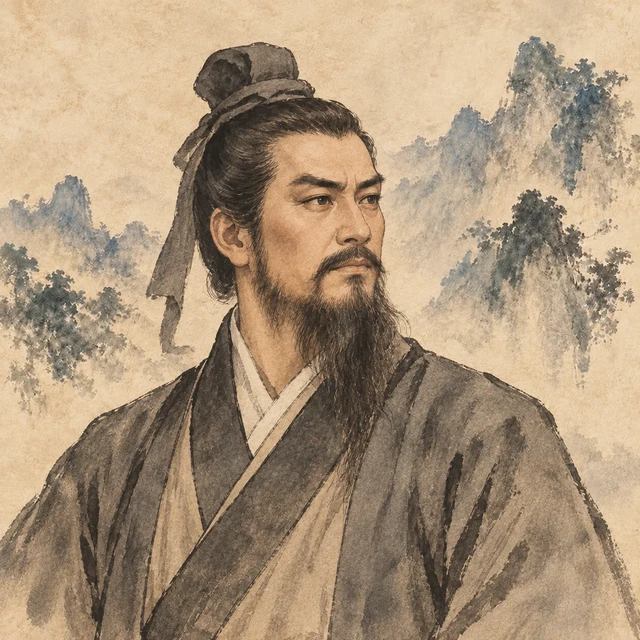
HISTORICAL PERSON
Jia Kui
贾逵
A Wei general and provincial governor who defended Jiangyi, helped suppress rebellions, and moved quickly to rescue Cao Xiu at the Battle of Jiashi.
This entry is supported by historical references, but does not yet have a conversation profile.
PRIMARY BIOGRAPHY
Biography
Jia Kui, styled Liangdao, came from Xiangling in Hedong. Starting as a commandery clerk, he acted as chief of Jiangyi. When Guo Yuan invaded Hedong and every city on his road fell, Jia Kui held fast until Guo Yuan called up the Chanyu’s hordes for a joint assault. With the walls about to break, the elders of Jiang made Guo Yuan swear not to harm Jia Kui. After the fall, Guo Yuan, hearing of his name, tried to force him into service at spearpoint; Jia Kui would not move, and when the guards pulled at him to kowtow he shouted, “Since when does a state officer kowtow to a rebel?” Guo Yuan in fury would have beheaded him, but the clerks and people of Jiang mounted the walls crying, “Break your oath and kill our worthy lord, and we will all die together!” — and the captors, moved by his righteousness, interceded until he was spared. Earlier, knowing the city must fall, Jia Kui had sent a runner by by-roads to return his seal to the commandery with word to hold Pishi at once; and fearing Guo Yuan would get there first, he fed Guo Yuan’s adviser Zhu Ao false counsel, so that the enemy delayed seven days — and the commandery, following his word, escaped defeat.
Later recommended as flourishing talent and made magistrate of Mianchi, he was caught when Gao Gan rebelled and Zhang Yan of his county rose to answer: ignorant of the plot, Jia Kui had called on Zhang Yan, and finding the rising begun and return cut off, he counselled Zhang Yan as if he were a fellow plotter, won his trust, begged troops to repair the walls, learned from the plotters every name — and put them all to death, then manned the walls against Zhang Yan. When the Grand Progenitor campaigned against Ma Chao and reached Hongnong, saying “this is the key to the western road”, he made Jia Kui its administrator; receiving him in council he was so pleased that he told his attendants, “If every two-thousand-bushel officer in the realm were a Jia Kui, what would I have to worry about?” When the Grand Progenitor died at Luoyang, Jia Kui directed the mourning. The Marquis of Yanling, Cao Zhang, acting as colonel of the Yueqi, hurried from Chang’an and asked where the late king’s seal and ribbons were. Jia Kui answered with a stern face: “The heir is at Ye; the state has its designated successor. The late king’s seal and ribbons are not for Your Lordship to ask about.” Then he escorted the coffin back to Ye.
When Emperor Wen took the throne, Jia Kui went out as inspector of Yu province. The realm had just been reunited and many provinces were slack; Jia Kui made the assessments strict and memorialised the dismissal of every officer below the two-thousand-bushel rank who bent the law. The emperor said, “Jia Kui is a true inspector”, and published it through the realm, holding Yu province up as the model, and enfeoffed him Marquis within the Passes. Where the province bordered Wu to the south he kept sharp scouts, repaired arms and armour, and made ready for defence so the enemy dared not trespass; at home he dammed the Yan and Ru to make the Xin reservoir, cut the mountain streams to make the Lesser Yiyang reservoir, and opened over two hundred li of transport canal — the Jia Lord Canal of later fame. In the Huangchu era he joined the campaign against Wu and defeated Lü Fan at Dongpu, advanced to Marquis of Yangli precinct and General who Establishes Might. In 228, when Cao Xiu was defeated by Wu at Shiting, Jia Kui force-marched his command forward, setting out drums and banners everywhere as decoys; the enemy saw his army and withdrew, and Jia Kui, holding Jiashi, fed Cao Xiu’s army with his own grain so that it stood again — though the two had long been on bad terms, but for Jia Kui, Cao Xiu’s army would hardly have been saved. In 230, mortally ill, he told his attendants: “I have received the state’s heavy grace; my one regret is not to have beheaded Sun Quan and faced the late emperor below. Not a thing is to be elaborated for my funeral.” He died, posthumously the Grave Marquis; his son Jia Chong succeeded. The clerks and people of Yu province, remembering him, carved stone and raised a shrine; in the Qinglong era the emperor, campaigning east, drove into the shrine and decreed: “Yesterday I passed Xiang and saw Jia Kui’s stele and image, and my heart ached with remembrance.”
Life and role
- Primary role
- Cao Wei general and inspector
- Active period
- Documented coverage: late Han through Cao Wei
- Primary group
- Cao-Wei
Affiliations across a lifetime
- Jian’an era
Chief of Jiangyi
Held Jiang against Guo Yuan, refusing to kowtow to a rebel; smuggled out his seal to save Pishi
- 220–228
Inspector of Yu province
His inspections made the model for all provinces; cut the Jia Lord Canal; beat Lü Fan at Dongpu
- 228–230
The rescue at Jiashi
Saved Cao Xiu’s broken army at Jiashi with decoys and grain; died regretting he had not beheaded Sun Quan
HISTORICAL RECORD
Historical sources
- Records of the Three Kingdoms · Wei, Book 15 · 刘司马梁张温贾传 ↗
Chen Shou’s base text: biographies of Liu Fu, Sima Lang, Liang Xi, Zhang Ji, Wen Hui, and Jia Kui, including attached notices about sons and associated figures. Pei Songzhi’s annotations are registered separately.
- Records of the Three Kingdoms, with Pei Songzhi annotations · Pei Songzhi annotations to Wei, Book 15 ↗
Annotations to Wei Book 15, including Sima Biao’s preface, Wei Lue, Sanfu Juelu Zhu, Jin Yang Qiu, and Jin Zhu Gong Zan. Biographical details from these notes are kept distinct from Chen Shou’s base text.
- Records of the Three Kingdoms, with Pei Songzhi annotations · Pei Songzhi’s annotations to Wei, Book 19 ↗
Annotations to the biographies of Cao Zhang, Cao Zhi, and Cao Xiong, including passages from Wei Lue, Wei Shi Chunqiu, Shiyu, Ding Yi zhuan, and other cited works; all are kept distinct from Chen Shou’s base text.