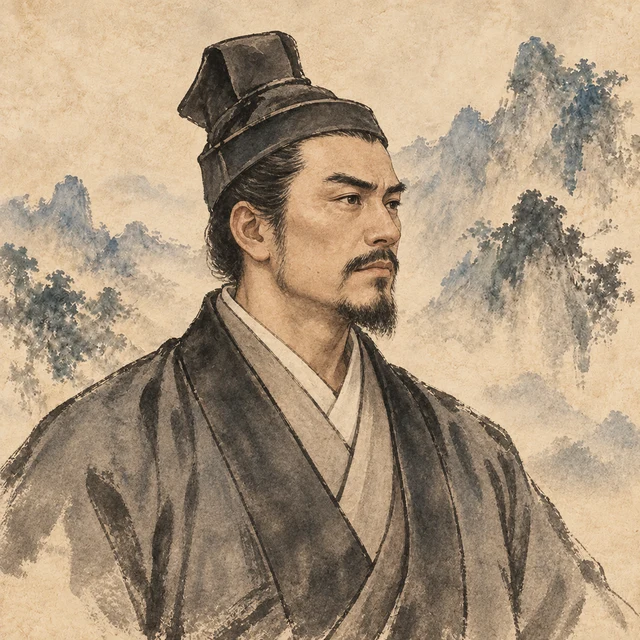
HISTORICAL PERSON
Jiang Ji
蒋济
Jiang Ji helped defend Hefei from Sun Quan with a deception about reinforcements, advised Cao Cao on the movements of Huainan’s population and Guan Yu’s siege of Fancheng, and later served as a senior Wei official.
This entry is supported by historical references, but does not yet have a conversation profile.
PRIMARY BIOGRAPHY
Biography
Jiang Ji (d. 249), courtesy name Zitong, saved Hefei in 208 by forgery: with relief armies stalled by plague and Sun Quan at the walls, he fabricated a letter announcing forty thousand reinforcements at Yulou and let two of three couriers be captured. Sun Quan believed it, burned his siege lines, and withdrew.
Under Emperor Wen he presented the Wanji Lun on statecraft and served as palace attendant; under Emperor Ming he commanded the palace guard and remonstrated frankly on appointments and palace-building.
In 249 he stood with Sima Yi at the Luo bridge during the Gaoping Tombs coup and wrote to Cao Shuang urging surrender. When Cao Shuang was nonetheless exterminated with his clan, Jiang Ji — whose letter had implied clemency — died within months, ashamed, it was said, of his broken word. Posthumously the Clear-sighted Marquis (Jing).
Life and role
- Primary role
- Grand Commandant
- Active period
- Late Han and Cao Wei (190s–240s)
- Primary group
- Cao-Wei
Affiliations across a lifetime
- 208–226
Under Cao Cao and Cao Pi
Forged the relief letter that lifted the siege of Hefei; authored the Wanji Lun
- 226–249
Wei — commander of the guard
Led the palace guard; aided the Gaoping Tombs coup and died soon after
HISTORICAL RECORD
Historical sources
- Records of the Three Kingdoms · Wei, Book 14 · 程郭董刘蒋刘传 ↗
Chen Shou’s base text: biographies of Cheng Yu (including his grandson Cheng Xiao), Guo Jia, Dong Zhao, Liu Ye (including his son Liu Tao), Jiang Ji, and Liu Fang. Pei Songzhi’s annotations are registered separately.