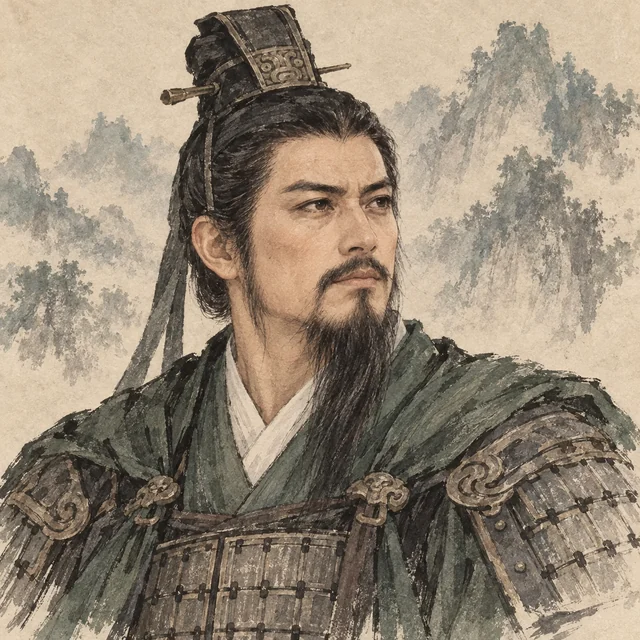
HISTORICAL PERSON
Jiang Wei
姜维
Jiang Wei first served Wei in Tianshui and joined Zhuge Liang after the 227 campaign reached the area. He later commanded Shu Han forces in repeated campaigns against Wei.
This entry is supported by historical references, but does not yet have a conversation profile.
PRIMARY BIOGRAPHY
Biography
Jiang Wei (202–264), courtesy name Boyue, came from Ji county in Tianshui. Orphaned young, he grew up with his mother and studied the Zheng-school classics. He served Wei as a commandery officer in his native Tianshui, rising no higher than adjutant. In 228, when Zhuge Liang marched on Qishan, the Tianshui administrator Ma Zun suspected his own officers of disloyalty and fled overnight to Shanggui; shut out of both cities, Jiang Wei and his colleagues Liang Xu, Yin Shang and Liang Qian went over to Shu Han.
Zhuge Liang prized him at once: he made Jiang Wei a granary clerk on his staff, granted him the title General who Upholds Righteousness, and enfeoffed him as Marquis of Dangyang precinct at age twenty-seven. Writing to the regency office, Zhuge Liang called him "diligent and exacting in the affairs of the time, precise and thorough in thought," a man who "kept the Han house in his heart and was doubly talented among men." Jiang Wei campaigned under Zhuge Liang until the latter’s death at Wuzhangyuan in 234, then rose through Right Supervisor of the Army and General who Assists Han to General who Guards the West, holding the acting governorship of Liang province. While Jiang Wan and Fei Yi governed, he led detached columns west into Longyou and fought Wei generals Guo Huai and Xiahou Ba.
After Fei Yi’s assassination in 253, Jiang Wei held effective command of Shu’s armies and campaigned north almost every year. In 254 the Wei garrison chief of Didao, Li Jian, surrendered his city; Jiang Wei pressed on to besiege Xiangwu, killed the Wei general Xu Zhi in battle, and removed the populations of three border counties into Shu. In 255 he crushed Wei inspector Wang Jing west of the Tao River — the Wei army lost several ten-thousands dead, the greatest victory of Jiang Wei’s campaigns. Promoted General-in-Chief in 256, he was then badly beaten by Deng Ai at Duangu when the rendezvous with Hu Ji failed, and demoted himself to General of the Rear. In 257 he struck through the Luo valley while Zhuge Dan’s rebellion distracted Wei, but Sima Wang and Deng Ai refused battle at Mangshui. In 262 Deng Ai defeated him again at Houhe, and he withdrew to Tazhong.
The campaigns coincided with the eunuch Huang Hao’s domination of the Chengdu court. Huang Hao schemed with General of the Right Yan Yu to replace Jiang Wei; fearing for his life, Jiang Wei stopped returning to the capital and asked leave to garrison-farm at Tazhong instead.
In 263 Wei launched its conquest of Shu. Jiang Wei had warned the throne that Zhong Hui was drilling armies in Guanzhong and asked that Zhang Yi and Liao Hua secure the Yang’an pass and the Yinping bridgehead in advance; Huang Hao, trusting diviners, suppressed the memorial. When the invasion came, Jiang Wei broke away from Deng Ai and Zhuge Xu’s encirclement in the northwest, joined Liao Hua, Zhang Yi and Dong Jue, and held the sword-gate fortress of Jiange against Zhong Hui’s hundred-thousand-strong main force. Zhong Hui, checked and short of grain, was already discussing retreat — when Deng Ai crossed seven hundred li of trackless mountains from Yinping, crushed Zhuge Zhan at Mianzhu, and forced the abdication of Liu Shan, who ordered Jiang Wei to surrender to Zhong Hui. The soldiers received the order in fury, hacking stones with their swords.
Zhong Hui treated the surrendered Jiang Wei as an intimate — "sharing a carriage when out, a mat when seated." Jiang Wei saw that Zhong Hui meant to rebel and planned to use him to restore Shu: he urged Zhong Hui to first massacre the northern generals, and wrote secretly to the deposed emperor: "May Your Majesty endure a few days of humiliation; your servant intends to make the state safe again out of peril, to make the sun and moon shine once more out of darkness" (recorded by the Huayang Guozhi). In the first month of 264 the plot leaked, the Wei soldiers rioted and killed Zhong Hui; Jiang Wei died with him at sixty-three, and his wife and children were executed.
Life and role
- Primary role
- General-in-Chief
- Active period
- Late Eastern Han to Shu Han
- Primary group
- Shu-Han
Affiliations across a lifetime
- Before 228
Wei · Tianshui commandery adjutant
A local officer of his home commandery under Wei, with no path to higher office.
- 228–234
Shu Han · staff of Zhuge Liang
Defected during the first Qishan campaign; Zhuge Liang made him a staff officer with a marquisate at twenty-seven and trained him for command.
- 234–253
Shu Han · western corps under Jiang Wan and Fei Yi
Led detached columns into Longyou against Guo Huai and Xiahou Ba, rising to General who Guards the West.
- 253–263
Shu Han · General-in-Chief, northern expeditions
Commanded the annual offensives: the great Taoxi victory over Wang Jing, the defeat at Duangu, and the final check at Houhe.
- 263–264
Surrendered to Zhong Hui · secret plot to restore Shu
Ordered by Liu Shan to surrender, he feigned intimacy with Zhong Hui and plotted to use the mutiny to restore the state; the plot failed and he was killed with his family.
HISTORICAL RECORD
Historical sources
- Records of the Three Kingdoms · Wei, Book 28 · 王毌丘诸葛邓锺传 ↗
Chen Shou’s base text contains the biographies of Wang Ling, Guanqiu Jian (with Wen Qin), Zhuge Dan (with Tang Zi), Deng Ai (with Zhou Tai), and Zhong Hui (with Wang Bi). Zhong Hui’s biography also records Jiang Wei’s final actions after Shu fell. Pei Songzhi’s annotations on the page should be identified separately.
- Records of the Three Kingdoms · Shu, Book 14 · 蒋琬费祎姜维传 ↗
The grouped biographies of Jiang Wan, Fei Yi, and Jiang Wei (Shu, Book 14) record Jiang Wan’s regency and administration, Fei Yi’s service as a senior official and regent, and Jiang Wei’s career and northern campaigns through the fall of Shu.