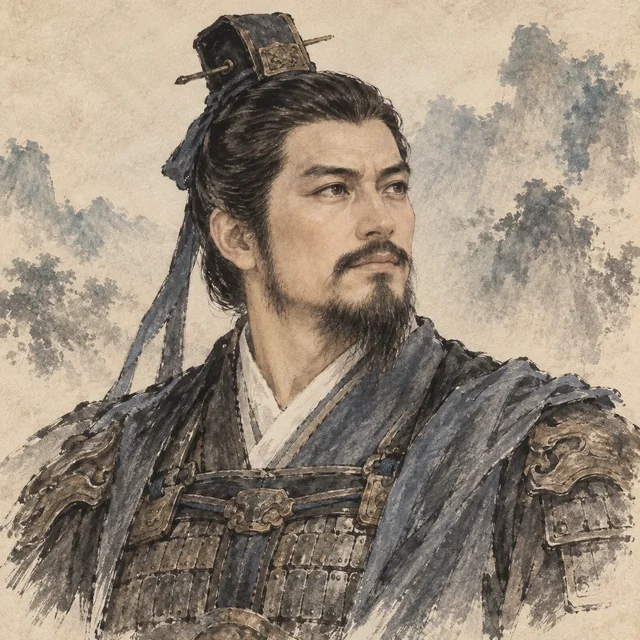
HISTORICAL PERSON
Li Dian
李典
Li Dian served in Cao Cao’s campaigns, warned Xiahou Dun against pursuing Liu Bei into a suspected ambush, and joined Zhang Liao’s strike at Hefei despite prior friction.
This entry is supported by historical references, but does not yet have a conversation profile.
PRIMARY BIOGRAPHY
Biography
Li Dian (d. after 215), courtesy name Mancheng, inherited the private army of his clan — several thousand guest-retainers raised by his uncle Li Qian — and supplied Cao Cao’s Guandu campaign with clan grain and silk.
At Bowang he warned Xiahou Dun not to pursue Liu Bei’s retreat: “A retreat without cause means an ambush — the southern road is narrow and the brush thick.” Ignored, Dun marched into the trap; Li Dian’s rescue force saved him.
At Hefei in 215, when Sun Quan’s hundred thousand came and Cao Cao’s sealed order bade Zhang Liao and Li Dian sally while Yue Jin held the walls, the three officers — long at odds — faced mutiny by hesitation. Li Dian declared: “This is the state’s affair — how could I let a private grudge betray public duty?” and charged beside Zhang Liao to rout Sun Quan. A bookish, self-effacing man who never contested credit, he died at thirty-six; Emperor Wen honored him with the posthumous title Min for the Hefei victory.
Life and role
- Primary role
- Wei commander
- Active period
- Late Han and Cao Wei (190s–240s)
- Primary group
- Cao-Wei
Affiliations across a lifetime
- c. 190–215
Cao Cao’s army
Clan army of thousands; warned against the Bowang ambush and rescued Xiahou Dun from it
- 215
Battle of Hefei
Set aside his feud with Zhang Liao to rout Sun Quan; posthumously honored
HISTORICAL RECORD
Historical sources
- Records of the Three Kingdoms · Wei, Book 18 · Biographies of the Two Lis, Zang, Wen, Lü, Xu, Dian, Two Pangs, and Yan ↗
Chen Shou’s base text: biographies of Li Dian, Li Tong, Zang Ba (including Sun Guan), Wen Pin, Lü Qian (including Wang Xiang), Xu Chu, Dian Wei, Pang De, Pang Yu (including his mother Zhao E), and Yan Wen (including Zhang Gong). Pei Songzhi’s annotations are separately registered.