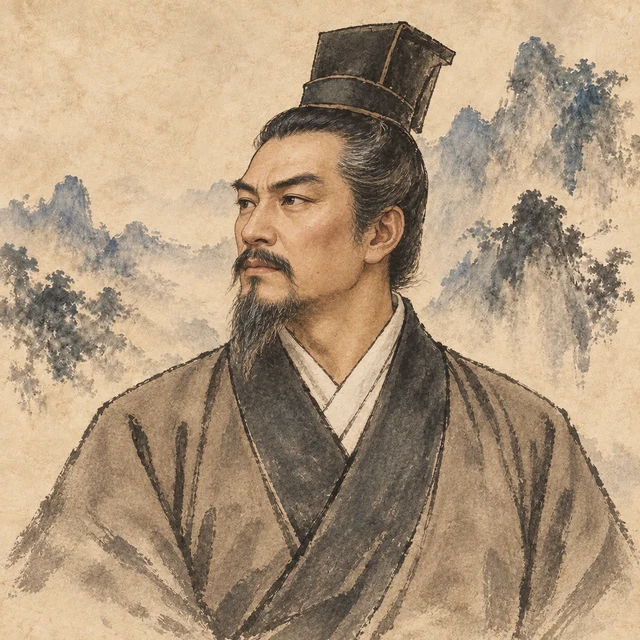
HISTORICAL PERSON
Liang Mao
凉茂
A Han and Wei official who governed several commanderies and dissuaded Gongsun Du from attacking Ye during Cao Cao’s northern campaign.
This entry is supported by historical references, but does not yet have a conversation profile.
PRIMARY BIOGRAPHY
Biography
Liang Mao, styled Bofang, was from Changyi in Shanyang. In youth he loved learning, and in discourse always held to the classics to decide right and wrong. The Grand Ancestor enlisted him as a clerk of the ministry of works, recommended him in the highest grade, and he was appointed palace-attending clerk.
When Taishan was overrun by bandits, Liang Mao was made its administrator, and within the space of a month a thousand households came back bearing their children on their backs. He transferred to be administrator of Lelang, but Gongsun Du in Liaodong detained him by force and would not let him take up his post — and to the end Liang Mao would not bend. Whenever Gongsun Du questioned him, Liang Mao answered with a stern countenance, and Gongsun Du could not break him.
At the founding of the Wei kingdom he rose to supervisor of the secretariat, then served as commandant of the capital and grand master of ceremonies. When Emperor Wen was in the heir’s palace, Liang Mao was again made grand tutor to the heir apparent and was treated with deep honor. He died in office.
Life and role
- Primary role
- Cao Wei official
- Active period
- Documented coverage: late Han through Cao Wei
- Primary group
- Cao-Wei
Affiliations across a lifetime
- Jian’an era
Administrator of Taishan
A thousand households came back to Taishan in a month; detained by Gongsun Du in Liaodong, he never bent
- founding of Wei
Grand tutor to the heir apparent
Rose through the secretariat and the capital command to become tutor to the future Emperor Wen, dying in office
HISTORICAL RECORD
Historical sources
- Records of the Three Kingdoms · Wei, Book 11 · 袁张凉国田王邴管传 ↗
Chen Shou’s base text contains the biographies of Yuan Huan, Zhang Fan (including the account of his brother Zhang Cheng), Liang Mao, Guo Yuan, Tian Chou, Wang Xiu (with Wang Pou), Bing Yuan, and Guan Ning (with the attached accounts of Wang Lie, Zhang Jian, and Hu Zhao). The concluding evaluation is separate from the biographies.