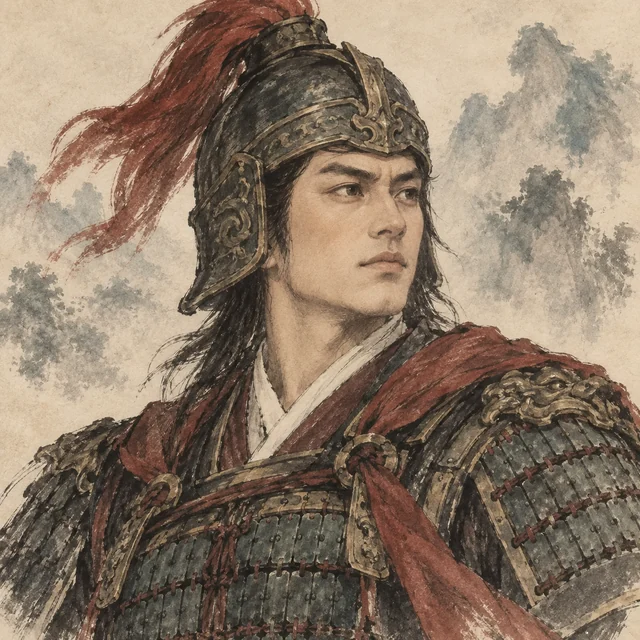
HISTORICAL PERSON
Ling Tong
凌统
Ling Tong served Sun Quan from a young age. During the Hefei campaign, he fought through the encirclement to protect Sun Quan’s retreat.
This entry is supported by historical references, but does not yet have a conversation profile.
PRIMARY BIOGRAPHY
Biography
Ling Tong (189–217), courtesy name Gongji, was the son of Ling Cao, the daring vanguard officer killed by Gan Ning’s arrow at Xiakou — a feud Sun Quan managed by keeping the two apart. At fifteen Ling Tong inherited his father’s troops as a major, and led from the front in the Shanyue wars, his sector of the assault always the first to break through.
Off the battlefield he was reckoned a man of state: generous with his wealth, courteous to scholars, beloved by soldiers who were glad to die for him.
In 215 at Xiaoyao Ford, Zhang Liao’s charge cut Sun Quan off; Ling Tong led three hundred personal guards into the encirclement to fight him out, then turned back to cover the retreat — his guard died to the last man, his armor shredded by wounds, and he swam the river in full mail. Grieving for his dead companions, he wept; Sun Quan wiped Ling Tong’s tears with his own sleeve: “Gongji, the dead are gone — while I have you, what do I lack?” He died at twenty-nine; Sun Quan beat his couch and wept for days, and raised Ling Tong’s two small sons in his own palace.
Life and role
- Primary role
- General of the Household
- Active period
- Late Eastern Han to Eastern Wu
- Primary group
- Jiangdong–Sun Wu
Affiliations across a lifetime
- 203–215
Wu — separate command
Inherited his father’s troops at fifteen; veteran of the Shanyue, Huang Zu, and Cao Ren campaigns
- 215–217
The rescue at Hefei
Fought Sun Quan out of Zhang Liao’s trap with 300 guards, all slain; made Lieutenant-General
HISTORICAL RECORD
Historical sources
- Records of the Three Kingdoms · Wu, Book 10 · 程黄韩蒋周陈董甘凌徐潘丁传 ↗
Chen Shou’s base text contains the biographies of Cheng Pu, Huang Gai, Han Dang, Jiang Qin, Zhou Tai, Chen Wu (with Chen Biao), Dong Xi, Gan Ning, Ling Tong, Xu Sheng, Pan Zhang, and Ding Feng. The concluding evaluation is separate from the biographies.