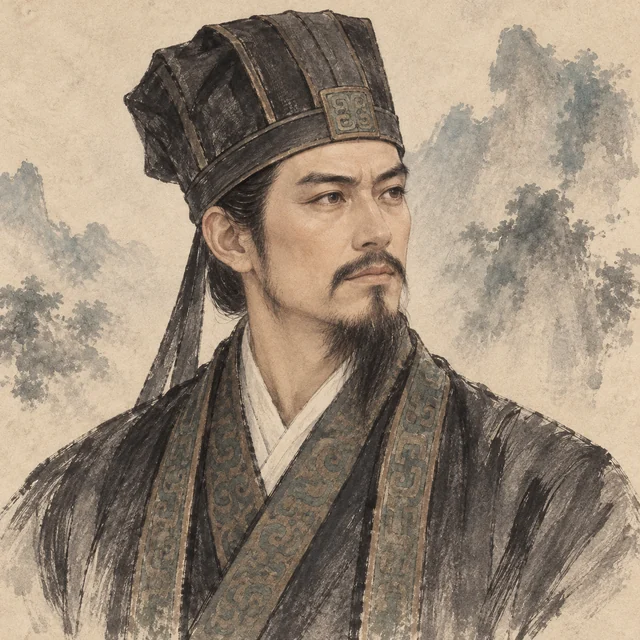
HISTORICAL PERSON
Liu Ba
刘巴
Liu Ba declined repeated appointments from Liu Biao, briefly served Cao Cao, later joined Liu Bei, helped stabilize public finances in Chengdu, and drafted state documents.
This entry is supported by historical references, but does not yet have a conversation profile.
PRIMARY BIOGRAPHY
Biography
Liu Ba, styled Zichu, came from Zhengyang in Lingling. Famed from youth, he refused every summons from the Jing province governor Liu Biao, even nomination as Flourishing Talent. When Liu Biao died and Duke Cao marched on Jing province, the scholars of Jing and Chu flocked to the fleeing First Sovereign like clouds — but Liu Ba went north to Duke Cao, who engaged him as an officer and sent him to win over Changsha, Lingling and Guiyang. The First Sovereign meanwhile took those three commanderies; unable to return and report, Liu Ba went far away to Jiaozhi, and the First Sovereign bore the grudge deeply.
From Jiaozhi, Liu Ba made his way to Shu. Soon the First Sovereign settled Yi province; Liu Ba came to confess his faults, and the First Sovereign did not blame him. Zhuge Liang recommended him again and again, and he was engaged as west bureau clerk of the General of the Left. In 219 he became a Master of Writing, and later succeeded Fa Zheng as Prefect of the Masters of Writing. Personally pure and frugal, he built up no property; and knowing he had not been an early follower, he feared suspicion, kept humble and silent, held no private friendships, and spoke only on public business. When the First Sovereign took the imperial title, the proclamation to August Heaven and the gods of earth — indeed every edict, mandate and patent of those days — was of Liu Ba’s composing.
When the attack on Liu Zhang began, the First Sovereign had covenanted with his men: “If the work is done, I claim nothing of the hundred treasures in the treasuries.” When Chengdu fell the soldiers cast down their arms and rushed the storehouses, scrambling for treasure, until the army’s own funds ran short and the Sovereign was deeply troubled. Liu Ba said: “Easy enough — simply cast hundred-value cash, stabilise the price of goods, and have the officers run an official market.” It was done, and within a few months the treasuries were full. Zhang Fei once went to lodge with Liu Ba; Liu Ba would not speak with him, and Zhang Fei was furious. Zhuge Liang said to Liu Ba: “Zhang Fei may be a fighting man, but he honours you. Our lord is gathering men of war and letters to settle great affairs — high-minded as you are, you might bend a little.” Liu Ba said: “A man in this world should keep company with the heroes of the four seas — how can I converse with a soldier?” He died in 222. Afterwards Chen Qun, Wei’s deputy Prefect of the Masters of Writing, wrote to Chancellor Zhuge Liang asking after Liu Ba, speaking of “Master Liu Zichu” with the greatest respect.
Life and role
- Primary role
- Director of the Secretariat
- Active period
- Late Han and Shu Han (200s–240s)
- Primary group
- Shu-Han
Affiliations across a lifetime
- 208–214
North to Cao Cao, then far to Jiaozhi
While all Jing province flocked to Liu Bei he alone went to Cao Cao; cut off from returning, he came to Shu by way of Jiaozhi
- 214–219
The hundred-value cash that filled the treasuries
When the plundered treasuries ran dry he proposed the hundred-value coinage and official markets; within months the coffers were full
- 219–222
Prefect of the Masters of Writing
Succeeded Fa Zheng; every edict and patent of the accession was his drafting — yet he refused to speak with Zhang Fei
HISTORICAL RECORD
Historical sources
- Records of the Three Kingdoms · Shu, Book 9 · 董刘马陈董吕传 ↗
Chen Shou’s base text contains the biographies of Dong He, Liu Ba, Ma Liang, Chen Zhen, Dong Yun (with Chen Zhi), and Lü Yi. Ma Su’s account is included in the narrative under Ma Liang, and Dong Yun’s account records his opposition to Huang Hao. The concluding evaluation is separate; Pei Songzhi’s annotations should be identified separately.