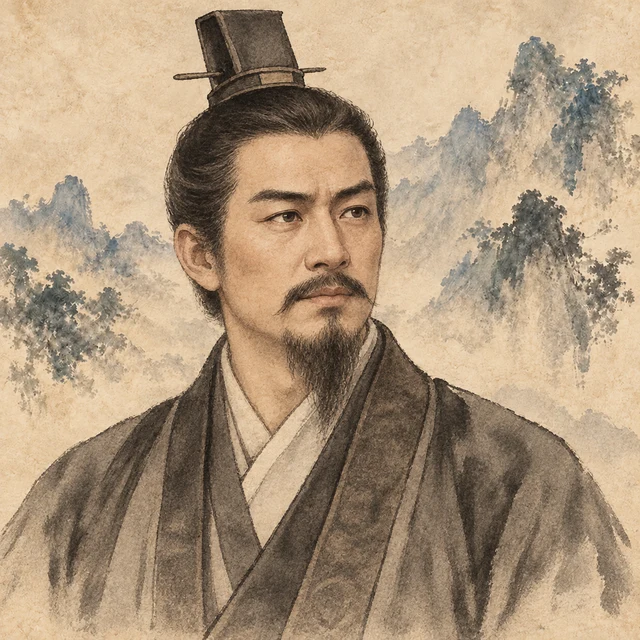
HISTORICAL PERSON
Lu Yu
卢毓
Son of Lu Zhi of Zhuo commandery; he served Wei up to Minister of Works and long supervised official selection, judging men by both reputation and substance.
This entry is supported by historical references, but does not yet have a conversation profile.
PRIMARY BIOGRAPHY
Biography
Lu Yu, styled Zijia, came from Zhuo in Zhuo commandery, a son of Lu Zhi. Orphaned at ten in his province’s troubles, with both elder brothers dead in the fighting, he kept his widowed sister-in-law and his brother’s orphan through the famine of the Yuan Shao–Gongsun Zan wars, and was known for learning and conduct. When the future Emperor Wen was General of the Five Offices he summoned Lu Yu to the gate bureau, and Cui Yan recommended him as registrar of Ji province. In those raw years desertion was common and the law against runaway soldiers fell on their wives and children. When the wife of one deserter, a woman Bai who had been but a few days in her husband’s house and had never met him, was sentenced by the chief justice to die in the market, Lu Yu wrote in rebuttal: “A woman’s affection springs from meeting her husband, her duty from becoming his wife. Now Bai in life knew the sorrow of never seeing him, and in death would suffer as one never a wife — yet the officers would subject her to the utmost penalty; then what penalty would remain for one who had shared the cup and the couch? Moreover the Records say ‘in attaching, follow the lighter’, and the Book says ‘rather than slay the innocent, risk the irregular’ — I fear this is too heavy.” The Grand Progenitor said: “Lu Yu’s holding is right, and his citation of the classics has substance — it makes me sigh with admiration.” He was made law clerk of the chancellery, then of the west bureau.
When the state of Wei was founded he became a gentleman of the ministry of personnel; at Emperor Wen’s accession he was moved to Gentleman of the Yellow Gate, then sent out as chancellor of Jiyin and administrator of Liang and Qiao. The emperor, Qiao being his homeland, moved multitudes to people it as garrison-farms; but Qiao’s soil was stony and poor and the people in straits. Lu Yu pitied them and memorialised that the settlers should be moved to the fertile spreads of Liang. This crossed the emperor’s wish — he allowed the transfer yet bore the grudge, and demoted Lu Yu to commandant of agriculture at Suiyang. Lu Yu’s heart was set on the people’s benefit; he watched over them in person and chose fine fields for their dwellings, and the people relied on him. Transferred to Anping and Guangping as administrator, he left beneficent government in both. In 234 he entered as palace attendant. When the palace attendant Gaotang Long repeatedly remonstrated sharply over the palace works and the emperor grew displeased, Lu Yu came forward: “Your servant has heard that when the ruler is enlightened his servants are straight. The sage kings of old, fearing they might not hear their faults, set up the drum for daring remonstrance. That your near servants fail Gaotang Long in plain speech is our shortcoming; he bears the name of the mad and the blunt — Your Majesty should bear with him.” In three years of office he disputed and contested much. The edict made him Master of Writing of personnel and bade him choose his own replacement — “it must be one like yourself.” Lu Yu proposed the attendant Zheng Chong; the emperor said, “Wenhe I already know — name one I have not heard of” — and he named Ruan Wu and Sun Yong, of whom the emperor used Sun Yong.
Earlier, Zhuge Dan, Deng Yang and their set had raced after fame, mocked as “the four keen-eared and eight penetrating”, and the emperor detested them. When a gentleman of the secretariat was to be chosen, the edict said: “Whether we get the right man rests with Master Lu. In selection take none for his fame: fame is a cake drawn on the ground — it cannot be eaten.” Lu Yu answered: “Fame cannot summon the extraordinary man, but it can win the ordinary good officer. The ordinary officer reveres instruction and aspires to goodness, and so wins a name — that is not to be despised. Your foolish servant can neither recognise the extraordinary nor do otherwise than follow names and examine the constant record — but there must be a way of testing what comes after. Thus the ancients had them present their words and tested them by their works. Today the law of assessing merit is abolished and men rise and fall by praise and blame, so that true and false are jumbled and substance and show deceive each other.” The emperor accepted his words and at once ordered a law of assessment drawn up. When the ministry over the masses fell vacant, Lu Yu proposed the recluse Guan Ning; the emperor could not use him, and asked for the next. Lu Yu answered: “For devotion and utmost conduct, the Grandee Han Ji; for upright clarity, the colonel-director Cui Lin; for firm purity, the Grand Master of Ceremonies Chang Lin.” The emperor used Han Ji. In judging men and in selection, Lu Yu put nature and conduct first and spoke of talent after. Once he said: “Talent is that by which good is done — great talent accomplishes great good, small talent small good. To call a man talented who cannot do good is talent that misses its vessel.” When the Duke of Gaogui district took the throne, Lu Yu was advanced to Marquis of Rongcheng with two thousand three hundred households, and made Excellency of Works. He died in 257 with the posthumous title Marquis Cheng.
Life and role
- Primary role
- Cao Wei official
- Active period
- Documented coverage: late Han through Cao Wei
- Primary group
- Cao-Wei
Affiliations across a lifetime
- 200s
The case of the deserter’s wife
Won the rebuttal that a wife who never met her husband should not die for his desertion — “it makes me sigh with admiration”, said Cao Cao
- 220s
Demoted for the settlers’ sake
Demoted for memorialising that Qiao’s poor-soil settlers be moved to fertile Liang; he chose their fields in person
- 234–254
Master of personnel; the assessment law
Answered the “cake drawn on the ground” edict that fame wins the ordinary good officer but must be tested by works — hence the assessment law; he put character before talent
HISTORICAL RECORD
Historical sources
- Records of the Three Kingdoms · Wei, Book 22 · 桓二陈徐卫卢传 ↗
Chen Shou’s base text contains the biographies of Huan Jie, Chen Qun (with his son Chen Tai), Chen Jiao, Xu Xuan, Wei Zhen, and Lu Yu. The concluding evaluation is separate from the biographies.