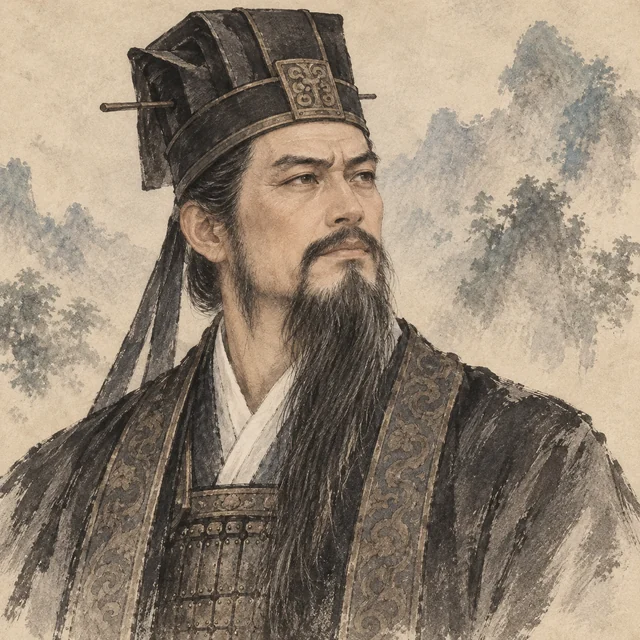
HISTORICAL PERSON
Lu Zhi
卢植
Lu Zhi served as a Han general in the campaign against Zhang Jiao before the command was transferred to Huangfu Song.
This entry is supported by historical references, but does not yet have a conversation profile.
PRIMARY BIOGRAPHY
Biography
Lu Zhi, styled Zigan, came from Zhuo county in Zhuo commandery. He stood eight chi two cun tall with a voice like a bell. In youth he and Zheng Xuan studied together under Ma Rong; he mastered both ancient and modern learning, prizing deep research over chapter-and-verse pedantry. Ma Rong, a kinsman of the imperial house, kept singing girls dancing before his lectures, yet Lu Zhi attended for years without once turning his eyes, and Ma Rong honoured him for it. When his studies ended he went home and taught behind closed doors. Firm of temper and great of principle, he cherished a will to save the age, cared nothing for verse, and could drink a dan of wine. When the empress’s father Dou Wu, as General-in-Chief, set Emperor Ling on the throne and the court moved to shower him with titles, Lu Zhi — a commoner — sent in a letter urging him to decline the great rewards and keep his name whole; Dou Wu could not heed it.
Lu Zhi was summoned as an erudit, served as administrator of Jiujiang and Lujiang, and as gentleman-consultant collated the Five Classics and their commentaries in the Eastern Lodge with Cai Yong and Yang Biao; he was made attendant within the palace and then a Master of Writing. In 184, when the Yellow Turbans rose, the four offices recommended him; he was made General of the Gentlemen of the North with the credentials, led the five regiments of the Northern Army and levies from every commandery, fought successive actions, and besieged Zhang Jue at Guangzong. The emperor sent the junior eunuch Zuo Feng to inspect the army; someone urged Lu Zhi to send him a bribe, and he refused. Zuo Feng reported back: “The Guangzong rebels could be crushed easily, but General Lu rests on his ramparts and waits for Heaven’s execution.” The furious emperor had Lu Zhi brought back in a cage cart, his death commuted by one degree. When Huangfu Song later finished the Turbans, he praised Lu Zhi’s original campaign plan, and Lu Zhi was restored as Master of Writing.
When Dong Zhuo assembled the hundred officials and proposed deposing the emperor, none dared speak — Lu Zhi alone voiced a dissenting protest. Dong Zhuo broke up the assembly in rage and would have killed him, but Cai Yong, an old friend, pleaded for him, and the gentleman-consultant Peng Bo remonstrated: “Master Lu of the secretariat is the realm’s great scholar, the hope of all men; harm him first and the empire will tremble.” Dong Zhuo stopped at dismissing him. Feigning age and illness, Lu Zhi begged to go home, then slipped away by a by-road through the Huanyuan pass; Dong Zhuo did send riders after him, but they reached Huai too late. He lived in seclusion in Shanggu, seeing no one, until the Ji province governor Yuan Shao invited him to be his army’s counsellor. He died in 192. On his deathbed he ordered his son to bury him in a plain earthen grave without coffin or vault, wrapped only in a single layer of cloth; he left six pieces of steles, dirges, memorials and records. Years later, campaigning north against Liucheng, Cao Cao passed through Zhuo commandery and proclaimed to its officers: “The late General Lu Zhi — his name is writ across the seas; in learning he was the patriarch of the classicists, the very model of a scholar, the ridgepole of the state.” He sent his aides to clear and repair the grave and treated Lu Zhi’s descendants generously.
Life and role
- Primary role
- Han official and general
- Active period
- Late Eastern Han (170s–220)
- Primary group
- Han court & warlords
Affiliations across a lifetime
- early years
Ma Rong’s pupil · Eastern Lodge collator
Never turned his eyes at Ma Rong’s lectures; governed Jiujiang and Lujiang, collated the Five Classics with Cai Yong
- 184
General of the Gentlemen of the North
Besieged Zhang Jue at Guangzong; refused to bribe the eunuch and was carted off — Huangfu Song later vindicated his plan
- 189–192
Lone dissent against Dong Zhuo
Alone protested the deposition and nearly died for it; hid in Shanggu, then counselled Yuan Shao
HISTORICAL RECORD
Historical sources
- Book of the Later Han · Book 71 · Biographies of Huangfu Song and Zhu Jun ↗
Use the named biography or chronicle entry in this volume; compare it with the Three Kingdoms record where sources differ.
- Book of the Later Han · Book 64 · Biographies of Wu, Yan, Shi, Lu and Zhao ↗
Use the named biography or chronicle entry in this volume; compare it with the Three Kingdoms record where sources differ.