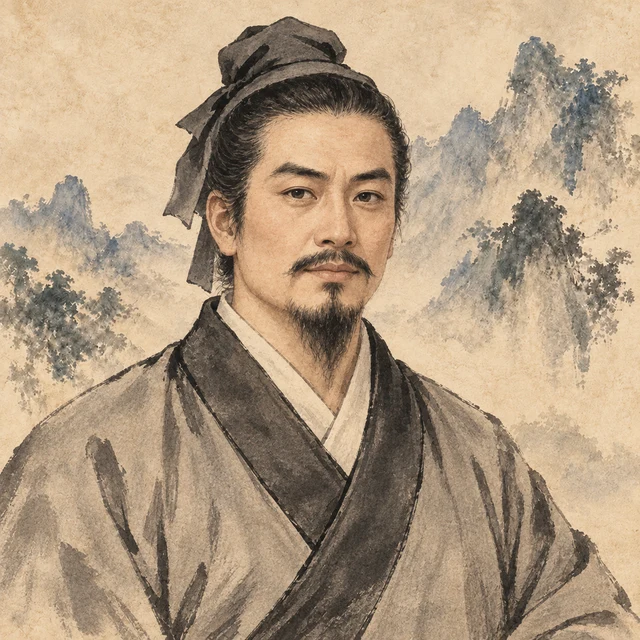
HISTORICAL PERSON
Ma Jun
马钧
Renowned for mechanical ingenuity, Ma Jun improved a silk loom and built devices including a south-pointing chariot; Wei officials repeatedly recommended his work.
This entry is supported by historical references, but does not yet have a conversation profile.
PRIMARY BIOGRAPHY
Biography
Ma Jun, styled Deheng, was from Fufeng, a man whose ingenious thought surpassed his age. As an erudit, living in poverty, he set his mind to transforming the damask loom, and without a word the world learned his skill: the old looms had fifty heddles with fifty treadles, or sixty of each, and he, hating the waste of labor and days, changed them all to twelve treadles — while the marvels of pattern they could weave, answering to the weaver’s fancy, were like forms shaping of themselves, inexhaustible as yin and yang.
As gentleman within the palace he disputed at court with the palace attendant Gaotang Long and the general of agile cavalry Qin Lang. When the south-pointing chariot came up, the two held that no such chariot had existed in antiquity and the records of it were falsehood; Ma Jun said, “The ancients had it — you have simply not thought it through. What is so remote about it?” They laughed at him, and he said, “Wrangling over empty words is worth less than a trial — that is easily tested.” The two reported this to Emperor Ming, an edict ordered Ma Jun to build it, and the south-pointing chariot was completed. Dwelling in the capital, he had ground within the city that could serve as a garden but suffered the want of water to water it; so he made a square-pallet chain pump, set a boy to turning it, and the water poured over of itself, running in and out in turn — its cleverness a hundredfold the common way.
Later a man presented a set of hundred-plays figures that could be arranged but not moved. The emperor asked Ma Jun whether they could be made to move; he said they could — and whether their cleverness could be increased; he said it could. Charged by edict, he carved a great wooden frame shaped like a wheel, set it level on the ground, and drove it secretly by water: he made female musicians dance, and to this day the wooden men strike the drums and blow the pipes; he made mountains rise, set wooden men juggling balls and tossing swords, climbing ropes and standing on their hands, moving in and out at will, with the hundred offices in their rows, pestles and mills and fighting cocks — a hundred transformations of ingenuity. Seeing Zhuge Liang’s repeating crossbow, Ma Jun said, “Ingenious, to be sure — but not yet perfected,” claiming he could make one five times stronger. And troubled that the stone-throwing engines could not wet the hanging screens on enemy towers, he devised a great wheel with dozens of stones hung on it, driven by mechanism in constant motion, cutting loose the hanging stones to fly against the enemy’s walls in unbroken succession like lightning; in trial he hung dozens of tiles on a cartwheel and flew them several hundred paces.
Life and role
- Primary role
- Court official and mechanical inventor
- Active period
- Documented coverage: Cao Wei (c. 220s–260s)
- Primary group
- Cao-Wei
Affiliations across a lifetime
- Emperor Ming’s reign
The south-pointing chariot and the chain pump
Proved at court that the ancients had the south-pointing chariot and built one by edict; his chain pump watered gardens a hundredfold better than the common way
- Emperor Ming’s reign
The water-driven hundred plays
Drove wooden performers secretly by water — drumming, piping, juggling, rope-climbing — and judged he could quintuple Zhuge Liang’s repeating crossbow
HISTORICAL RECORD
Historical sources
- Records of the Three Kingdoms · Wei, Book 29 · 方技传 ↗
Chen Shou’s base text contains the biographies of Hua Tuo, Du Kui, Zhu Jianping, Zhou Xuan, and Guan Lu. Ma Jun appears in a Pei Songzhi annotation under Du Kui, which quotes a preface by Fu Xuan; he is not a separate biography in Chen Shou’s base text. The concluding evaluation is separate from the biographies.