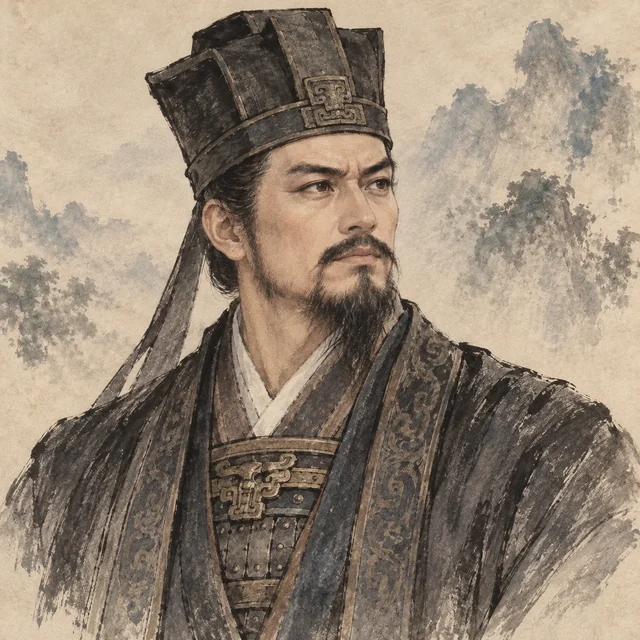
HISTORICAL PERSON
Man Chong
满宠
Known for strict administration and frontier command, Man Chong helped hold Wei’s Huainan defenses and repeatedly opposed Wu advances around Hefei.
This entry is supported by historical references, but does not yet have a conversation profile.
PRIMARY BIOGRAPHY
Biography
Man Chong (d. 242), courtesy name Boning, made his name as a fearsome county officer: as prefect of Xu he executed Cao Hong’s lawbreaking retainers despite the general’s plea — Cao Cao approved: “Isn’t this exactly how one should serve?” When he interrogated the eminent minister Yang Biao by the book and urged Cao Cao to release rather than kill a blameless famous man, even Xun Yu and Kong Rong, who had begged leniency, respected him the more.
In 219, with Guan Yu’s flood at the walls of Fan and Yu Jin’s seven armies drowned, the council proposed abandoning the city. Man Chong argued the flood would recede and that flight would cost everything south of the Yellow River; he drowned a white horse in oath with his men and held until Xu Huang’s relief arrived.
As commander at Yang province he spent the 230s repelling Sun Quan’s repeated drives on Hefei: in 234, facing Sun Quan’s hundred thousand at Hefei’s New City, he sent picked men with pine torches soaked in oil to burn the siege engines downwind and shot dead Sun Quan’s nephew Sun Tai. Recalled as Grand Commandant in 238, he died in 242. Chen Shou: “firm of will, brave, and full of plans.”
Life and role
- Primary role
- General Who Conquers the East
- Active period
- Documented coverage: Late Han and Cao Wei (c. 190–242)
- Primary group
- Cao-Wei
Affiliations across a lifetime
- ?–219
Under Cao Cao
Law-and-order administrator; at the siege of Fan he swore the white-horse oath and held the city
- 220–242
Wei — Yang province command
Repelled Sun Quan’s Hefei campaigns; retired as Grand Commandant
HISTORICAL RECORD
Historical sources
- Records of the Three Kingdoms · Wei, Book 26 · 满田牵郭传 ↗
Chen Shou’s base text contains the biographies of Man Chong, Tian Yu, Qian Zhao, and Guo Huai. The page also carries Pei Songzhi’s annotations, which should be identified separately.