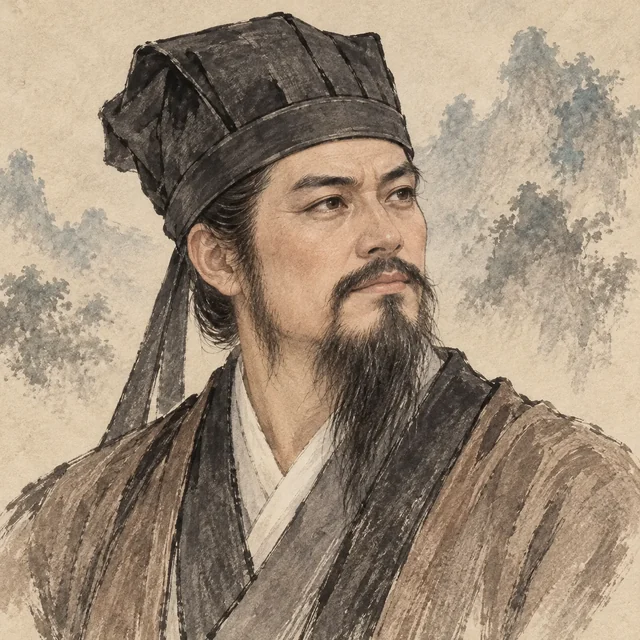
HISTORICAL PERSON
Pang Tong
庞统
Liu Bei appointed Pang Tong to his staff after taking Jingzhou. Pang Tong accompanied the campaign into Yi Province and died after being wounded during the siege of Luo County.
This entry is supported by historical references, but does not yet have a conversation profile.
PRIMARY BIOGRAPHY
Biography
Pang Tong (179–214), courtesy name Shiyuan, came from Xiangyang. In youth he seemed dull and no one thought much of him. Around the age of twenty he visited Sima Hui of Yingchuan, the celebrated judge of men, and found him picking mulberry leaves up a tree; Sima Hui had Pang Tong sit below, and they talked from day into night. Astonished, Sima Hui declared him the crown of the scholars of the south, and from that day Pang Tong’s name was made. He later served as his commandery’s merit officer.
He loved to evaluate and encourage men, and his praise often ran ahead of their real merits. Asked why, he answered: the world is in chaos, the right way decays, good men are few and bad men many. To revive custom and advance the Way, we must speak well of the good so their fame draws others; if I commend ten men and five fall short, five are still gained — enough to honor the teaching and hearten the willing. Is that not worthwhile?
When Zhou Yu died at Baqiu in 210, Pang Tong escorted the funeral to Wu, where the scholars had long heard of him. On his journey home Lu Ji, Gu Shao and Quan Cong saw him off at the Chang gate, and he graded them: Lu Ji, a nag with a racer’s hidden strength; Gu Shao, a plodding ox that carries weight over distance. They accepted his judgments and befriended him.
When Liu Bei became governor of Jingzhou, Pang Tong served as acting magistrate of Leiyang and was dismissed for neglecting the county. Lu Su wrote to Liu Bei: "Pang Shiyuan is no talent for a hundred-li county" — only a seat in the provincial administration would give his ability scope. Zhuge Liang said the same. Liu Bei summoned him for a long conversation, was won over completely, made him palace aide, treated him second only to Zhuge Liang, and soon named him, jointly with Zhuge Liang, Army-Planning General of the Household.
In 211 Liu Zhang sent Fa Zheng to invite Liu Bei into Shu against Zhang Lu. Pang Tong urged acceptance: Jingzhou was ruined and emptied, with Wu to the east and Cao Cao to the north — no tripod could stand on it; Yi province had a million households, rich soil and full storehouses, the foundation for great designs. Liu Bei left Zhuge Liang and Guan Yu in Jingzhou and marched west with Pang Tong. When Liu Zhang returned to Chengdu, leaving Liu Bei at Jiameng, Pang Tong offered three plans: a picked force marching day and night to surprise Chengdu — the best plan; a feigned recall to Jingzhou to lure the pass commanders Yang Huai and Gao Pei out to be seized and their troops absorbed — the middle plan; a withdrawal to Baidi to try again slowly — the worst plan; and, he warned, to linger undecided was to court ruin. Liu Bei took the middle plan, executed Yang Huai and Gao Pei, and marched on Chengdu, taking every position in his path.
In 214 Liu Bei besieged Luo city. Pang Tong led the assault and was struck by a stray arrow; he died below the walls at thirty-six. Liu Bei grieved so deeply that he wept whenever he spoke of him, made Pang Tong’s father a court gentleman and then grandee-remonstrant with Zhuge Liang delivering the appointment in person, and posthumously granted Pang Tong a marquisate within the passes and the title Tranquil Marquis.
Life and role
- Primary role
- Staff General
- Active period
- Late Eastern Han to Shu Han
- Primary group
- Shu-Han
Affiliations across a lifetime
- Before 208
Jingzhou scholar · commandery merit officer
Declared "the crown of southern scholars" by Sima Hui; befriended the leading men of Wu at Zhou Yu’s funeral.
- 209–211
Liu Bei’s staff · co-planner with Zhuge Liang
Recommended by Lu Su and Zhuge Liang after the Leiyang dismissal; treated second only to Zhuge Liang.
- 211–214
Architect of the conquest of Shu
Urged the seizure of Yi province, supplied the three stratagems, and died by a stray arrow below the walls of Luo at thirty-six.
HISTORICAL RECORD
Historical sources
- Records of the Three Kingdoms · Wu, Book 9 · Biographies of Zhou Yu, Lu Su, and Lü Meng ↗
Zhou Yu’s section in the grouped biographies of Zhou Yu, Lu Su, and Lü Meng (Wu, Book 9) records his Red Cliffs and Nanjun campaigns, his death at Baqiu in 210, and Pang Tong escorting his funeral to Wu; it attributes the fire-attack proposal to Huang Gai. Pei Songzhi’s notes are separate.
- Records of the Three Kingdoms · Shu, Book 7 · 庞统法正传 ↗
Chen Shou’s base text contains the biographies of Pang Tong and Fa Zheng. The page also carries Pei Songzhi’s annotations, which should be identified separately.