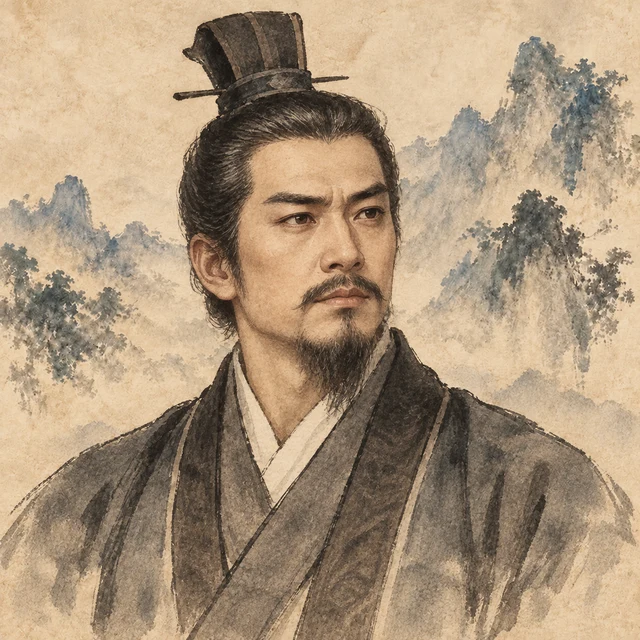
HISTORICAL PERSON
Pei Qian
裴潜
A Wenxi man from Hedong; as Administrator of Dai he pacified the Wuhuan and earned frontier prestige, later rising to Prefect of the Masters of Writing.
This entry is supported by historical references, but does not yet have a conversation profile.
PRIMARY BIOGRAPHY
Biography
Pei Qian, styled Wenxing, was from Wenxi in Hedong. Fleeing the disorders into Jingzhou, he was treated by Liu Biao with a guest’s honors, but privately told his intimates Wang Can and Sima Zhi, “Governor Liu is no hegemon’s timber, yet he would seat himself as another Earl of the West — his fall cannot be long in coming,” and went south to Changsha. When the Grand Ancestor settled Jingzhou he had Pei Qian join the chancellery’s military affairs; after three prefectures he came in as a clerk of the granaries bureau. The Grand Ancestor asked him, “You were with Liu Bei in Jingzhou — how do you rate his talents?” Pei Qian answered, “Set him in the central realm and he can throw men into confusion but could never govern them; let him seize a defensible gap, though, and he is well able to lord one region.”
Dai commandery was then in great disorder, and Pei Qian was made its administrator. The Wuhuan king and two of his chieftains had each proclaimed himself chanyu and ruled the commandery’s affairs at will, which previous administrators had been powerless to correct; the Grand Ancestor wished to give him picked troops to suppress them, but Pei Qian declined: “Dai is populous, with ten thousand bows ready to string. The chanyus know their license has run long and are uneasy within; come with a great army and fear will close the frontier against you, come with a small one and they will not be awed. This is to be taken by stratagem, not pressed by arms.” He went to the commandery in a single carriage. The chanyus were astonished and delighted; he soothed them with calm, and the chanyus and all below them doffed their caps and knocked their brows to the ground, returning every woman, weapon, and chattel they had plundered. Pei Qian then arraigned and executed more than ten senior clerks of the commandery, Hao Wen, Guo Duan, and others, who had been in league with the chanyus — the northern marches trembled and the people gave him their hearts. After three years in Dai he returned as law clerk of the chancellery, and when the Grand Ancestor praised his governance, Pei Qian said, “I was lenient with the people but stern with the Hu. My successor, thinking me too harsh, will treat them with leniency; they have always been proud and unrestrained, and too much leniency will loosen them, and once loosened they must be reined in by law — from this quarrels arise. By the logic of it, Dai must revolt again.” The Grand Ancestor deeply regretted recalling him so soon; a few dozen days later word came that the three chanyus had indeed rebelled, and the Marquis of Yanling Cao Zhang was sent as general of agile cavalry to chastise them.
He then went out as chancellor of Pei and inspector of Yan province, where the Grand Ancestor, halting at Mobei, admired the perfect order of his arrayed troops and gave him special rewards. Under Emperor Wen he came in as cavalier attendant-in-ordinary, went out as gentleman of the household for agriculture in Wei commandery and Yingchuan — memorializing that the agricultural colonies be given the same right of recommendation as commanderies and kingdoms, opening the road of office to the farming officers — and rose to inspector of Jing province as marquis within the passes. Under Emperor Ming he served as secretariat officer, intendant of Henan, military counselor to the grand commandant, and grand minister of agriculture as marquis of Qingyang precinct with two hundred households, then came in as director of the secretariat, where he regularized the division of offices and verified names against substance, settling more than a hundred and fifty standing questions of government. Leaving office for his father’s mourning, he was made grandee glorious and grand, died in Zhengshi 5, and was posthumously made grand master of ceremonies with the posthumous name Zhen.
Life and role
- Primary role
- Cao Wei official
- Active period
- Documented coverage: late Han through Cao Wei
- Primary group
- Cao-Wei
Affiliations across a lifetime
- Jian’an era
Administrator of Dai
Rode alone into Dai, made the three chanyus knock their brows to the ground, and foretold the revolt that followed his recall
- Emperor Ming’s reign
Director of the secretariat
Regularized the offices and settled a hundred and fifty standing questions of government; posthumously named Zhen
HISTORICAL RECORD
Historical sources
- Records of the Three Kingdoms · Wei, Book 23 · 和常杨杜赵裴传 ↗
Chen Shou’s base text contains the biographies of He Qia, Chang Lin, Yang Jun, Du Xi, Zhao Yan, and Pei Qian. The page also carries Pei Songzhi’s annotations, which should be identified separately.